
 Search Articles


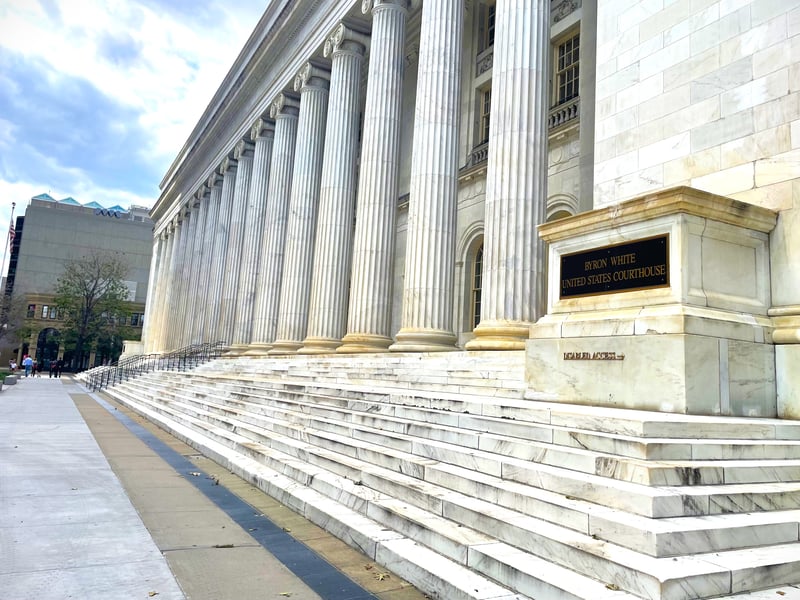
DENVER (CN) — The 10th Circuit on Tuesday tossed GEO Group’s interlocutory appeal seeking sovereign immunity against a trafficking lawsuit filed by underpaid immigration detainees 10 years ago.
“We conclude that a district court’s order denying application of the Yearsley doctrine is not subject to interlocutory appeal,” wrote Chief U.S. Circuit Judge Jerome Holmes in a 28-page opinion.
Alejandro Menocal was detained at the GEO-managed Aurora Immigration Processing Center in June 2014, where he was required to clean common areas from the windows to the toilets and chairs. Punishment for refusing to work ranged from being denied television access to being thrown in solitary confinement.
Detainees were also allowed to join a “voluntary work program,” which paid $1 a day to prepare food, run the library, cut hair and do laundry.
Menocal filed a class action against GEO on Oct. 22, 2014, claiming the company was wrongly making money off detainee labor and that the mandatory sanitation program violated the Trafficking Victims Protection Act.
GEO first appealed the lower court’s scheme for certifying the class, which the 10th Circuit upheld in 2018.
After the lower court denied GEO Group’s derivative sovereign immunity claim in 2022, finding the contractor didn’t meet the Yearsley test, the company filed a second interlocutory appeal seeking to rebuild its shield.
The 1940 case Yearsley v. Ross Construction held that a contractor working on a federal Missouri River project was not liable for causing erosion that damaged Nebraska landowners’ property because the Supreme Court found the “project was validly conferred,” and “what was done was within the constitutional power of Congress.”
The Supreme Court narrowed Yearsley’s scope in 2016’s Campbell-Ewald Co. v Gomez when the powers of operating under the government’s direction clashed with individuals receiving marketing text messages prohibited by the Telephone Consumer Protection Act.
GEO asked the 10th Circuit to reverse and find Yearsley provided outright immunity over the detainees’ claims. The detainees countered that the doctrine was merely a defense. The appellate panel however declined to take up the issue, since whether GEO’s $1 wage was sanctioned by the government contract hinges on the case’s yet-to-be determined facts.
The appellate panel therefore found it could not review GEO’s Yearsley question in isolation without diving into the merits, rendering the issue inappropriate for interlocutory appeal.
“Factual questions concerning what the government did and did not specifically direct would be at the heart of the Yearsley inquiry on the second prong and also at the heart of the merits inquiry into the lawfulness of a contractor’s challenged actions,” Holmes, a George W. Bush appointee, wrote. “We thus cannot say that orders denying the applicability of the Yearsley doctrine would implicate questions ‘significantly different from’ the merits of a plaintiff’s claims.”
Barack Obama-appointed U.S. Circuit Judge Carolyn McHugh signed onto the opinion alongside Donald Trump-appointed U.S. Circuit Judge Joel Carson.
The detainees’ attorney at the nonprofit firm Towards Justice applauded the decision.
“This class period goes back to 2004, so this is a really longstanding issue that affects thousands of people’s rights to get paid for their work and to work without the threat of physical harm compelling them to do so,” attorney Rachel Dempsey told Courthouse News via phone. “We think it was the right decision and we’re looking forward to continuing to, to move the case forward to trial."
Attorney Dominic Draye of Greenberg Traurig in Washington represented GEO on appeal. In an email, a GEO Group spokesperson said Yearsley is still on the table.
“This order only relates to timing for review of important legal issues GEO has raised in this proceeding. The order is not a final appellate determination of GEO’s constitutional defenses in this case,” the spokesperson wrote. “GEO looks forward to the continued opportunity to demonstrate that the Voluntary Work Program at federal ICE facilities is appropriately managed in full compliance with both our contract with ICE and with all applicable state and federal laws.”
 Follow @bright_lamp
Subscribe to our free newsletters
Our weekly newsletter Closing Arguments offers the latest about ongoing trials, major litigation and rulings in courthouses around the U.S. and the world, while the monthly Under the Lights dishes the legal dirt from Hollywood, sports, Big Tech and the arts.