
 Search Articles


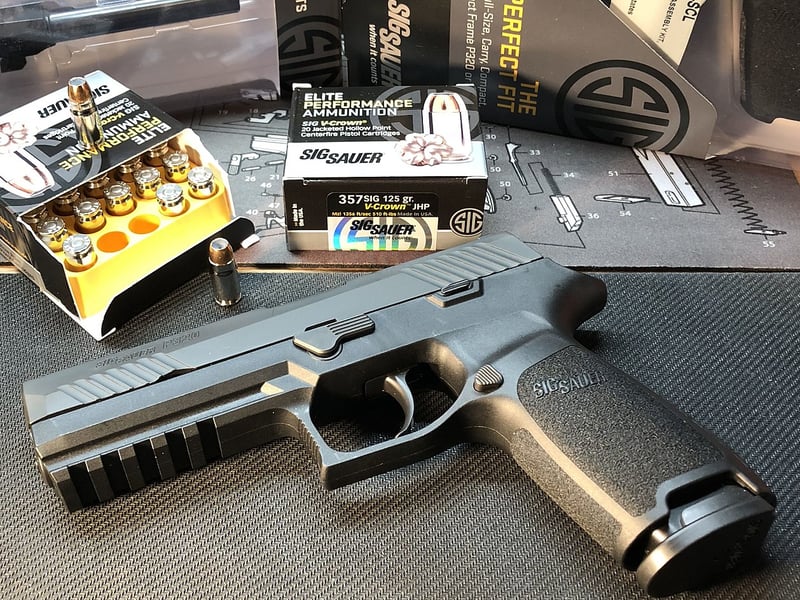
(CN) — A gun manufacturer cannot be held liable for an Oklahoma man’s self-inflicted gunshot wound he blames on a lack of a safety feature, the 10th Circuit ruled Friday.
The appeals court affirmed a lower court decision granting summary judgment to Sig Sauer, creator of the P320 handgun, and precluding testimony from two subject matter experts who say the presence of a safety would have prevented the gun from discharging when John Tyler Herman pulled the gun from his holster in February 2018.
“Mr. Herman has identified no circumstantial evidence that establishes a probability of causation,” U.S. Circuit Judge Jerome Holmoes wrote in a 17-page opinion filed Friday morning. “He has not provided evidence that the thing that made contact with his P320 would likely not have squarely depressed a tabbed trigger, and he has not provided evidence — free from the preclusive effect of our waiver doctrine — that he would likely have engaged a thumb safety.”
To date, the P320 is Sig Sauer’s most popular handgun, selling 2.5 million units. At the same time, dozens of gun owners have reported the gun unintentionally firing, driving six similar lawsuits nationwide, including one in Philadelphia where a jury last month awarded a man $11 million in damages.
Those claims often return to the fact that the weapon comes with no safety, which, on most other handguns, would prevent the accidental discharge of a weapon without direct pressure applied squarely on the trigger.
Herman purchased his P320 in 2018 and accidentally shot himself in the leg while struggling to remove the handgun from a recently purchased holster. He sued in 2021, claiming product liability and negligence, but U.S. District Judge David Russell granted summary judgment to Sig Sauer in September 2023.
“There was no evidence in the record (expert or circumstantial) that the firearm’s discharge was not caused by something squarely contacting the face of the trigger, or that a thumb safety would have been engaged,” the Ronald Reagan appointee wrote.
Herman’s causation argument relied on the validity of his expert witnesses, who say Herman wouldn’t have shot himself if the gun in question had a safety feature. But the 10th Circuit agreed with the lower court that the experts’ opinions relied too heavily on speculation, not knowing how the trigger was pulled in the first place or whether a safety would have prevented the discharge.
“First, a tabbed trigger safety only prevents a firearm from accidentally discharging in circumstances where something does not squarely depress the trigger,” wrote Holmes, a George W. Bush appointee. “However, neither Mr. Tertin nor Dr. Vigilante had a factual basis to opine that nothing squarely depressed the trigger of Mr. Herman’s firearm.”
Holmes further opined that had the weapon had a thumb safety, which must be switched on and off, it’s uncertain whether Herman would have engaged the safety before holstering the handgun.
“If Mr. Herman would not have placed the thumb safety in the ‘Safe’ position, the gun would still have discharged,” he added.
At oral arguments in December, Herman argued that a weapon without a safety feature is “defective” and that “common sense” would find that a safety would prevent an accidental discharge. But the judges said his argument didn’t reach the right threshold; Herman argued only whether the gun is defective rather than arguing whether a specific defect directly caused the injury.
The judges also placed some blame on Herman for knowingly purchasing a weapon without a safety, ignoring his grandfather’s gun safety advice he recalled in a deposition.
Neither party has replied to a request for comment.
 Follow @JournalistJoeAZ
Subscribe to our free newsletters
Our weekly newsletter Closing Arguments offers the latest about ongoing trials, major litigation and rulings in courthouses around the U.S. and the world, while the monthly Under the Lights dishes the legal dirt from Hollywood, sports, Big Tech and the arts.