
 Search Articles


ATLANTA (CN) — A divided panel of the 11th Circuit on Friday tossed out a Georgia federal judge’s decision, which would have let people living outside the Atlanta city limits join an effort to repeal the local ordinance authorizing the land lease for the nation’s largest public safety training center.
In a 2–1 decision, the Atlanta-based appeals court ruled that the plaintiffs — four people living near the proposed $115 million facility and seeking to gather signatures for a referendum — “have no right to the petition process they seek to utilize.”
The plaintiffs sued the city and state to challenge a municipal code barring non-residents from collecting signatures. Activists gathered more than 108,000 signatures in 2023 to repeal the leasing ordinance that allows Atlanta Mayor Andre Dickens to lease 381 acres to the Atlanta Police Foundation for the controversial facility.
The plaintiffs argued the residency requirement violates the First Amendment, shrinks the pool of eligible petition circulators and unfairly blocks them from organizing on an issue that affects them.
A Georgia federal judge in 2023 granted the plaintiffs a preliminary injunction blocking the city from enforcing the residency requirement, finding it imposed “a severe burden on core political speech.”
However, on Friday, a panel of Trump-appointed judges found the plaintiffs cannot show they will suffer “irreparable harm” without the injunction.
The majority relied on the Georgia Supreme Court’s 1998 Kemp v. City of Claxton decision to conclude the petition process applies only to amendments to municipal charters. Because the plaintiffs are not seeking to amend Atlanta’s city charter, the court ruled, they cannot use the referendum process.
“Because Georgia never granted the plaintiffs a referendum or repeal process for city ordinances in the first place, they cannot be irreparably harmed from being denied the ability to participate in an unavailable process,” U.S. Circuit Judge Elizabeth Branch wrote on behalf of the majority. “Thus, they cannot satisfy the irreparable injury requirement for obtaining an injunction.”
Branch was joined in the majority by U.S. Circuit Judge Robert Luck.
Attorneys for the plaintiffs and the city did not immediately respond to requests for comment Friday afternoon. A spokesperson for Atlanta Mayor Andre Dickens also did not respond to an emailed request for comment.
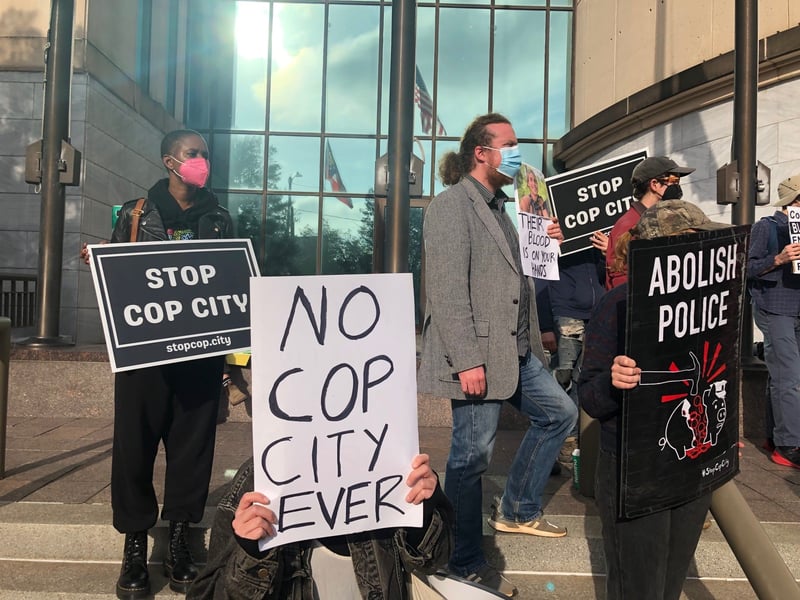
Dubbed “Cop City” by opponents, the 85-acre complex opened in April 2025 after months of protests and hours of public commentary urging council members not to lease the land to the Atlanta Police Foundation.
Debate over the training center drew national attention after state troopers fatally shot a protester near the site in January 2023. Opponents expressed fears that the training center — which includes burn buildings, “mock” villages, VR tools, a driving course, a shooting range and a wellness center — will fuel police militarization and deepen over-policing of poor and majority-Black communities.
Although the majority noted construction is now “substantially complete,” the judges said the case is not moot because the plaintiffs could have gathered enough signatures to put the referendum on the ballot had they prevailed.
In a three-page dissent, U.S. Circuit Judge Kevin Newsom disagreed that the plaintiffs had not demonstrated irreparable injury. The Trump appointee wrote that they should be allowed to collect signatures even if their effort may be “doomed to fail.”
“However remote the possibility that city officials will ultimately approve their petition, it seems to me that the plaintiffs have a separate, stand-alone First Amendment interest in participating in the signature-gathering process itself — in going through the motions, so to speak,” Newsom wrote.
The judge pointed out that even if the plaintiffs’ petition was rejected by the city, they could appeal the denial through the state court system.
“Even if the plaintiffs’ campaign is a fool’s errand, it’s a fool’s errand to which the First Amendment entitles them,” Newsom wrote.
 Follow @KaylaGoggin_CNS
Subscribe to our free newsletters
Our weekly newsletter Closing Arguments offers the latest about ongoing trials, major litigation and rulings in courthouses around the U.S. and the world, while the monthly Under the Lights dishes the legal dirt from Hollywood, sports, Big Tech and the arts.