Search Articles


(CN) — Jets blasting from a black hole can carry the energy of about 10,000 Suns, researchers say, in one of the clearest measurements yet of how black holes shape their surroundings.
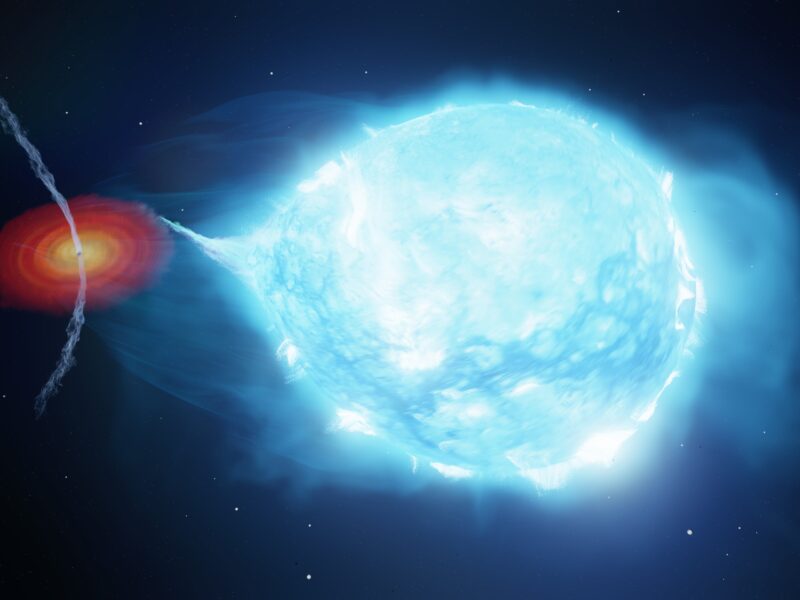
In a study published Thursday in Nature Astronomy, an international team led by Curtin University analyzed the well-known black hole system Cygnus X-1, one of the first ever confirmed. The system includes a black hole paired with a massive star, whose powerful winds push against jets streaming from the black hole.
As the two objects orbit each other, those winds bend and deflect the jets, creating what researchers describe as “dancing jets.”
That movement gave scientists a rare opportunity to measure their power.
Using a network of radio telescopes spanning the Earth, the team tracked how much the jets were pushed by the star’s winds.
By comparing the strength of the wind with the degree of bending, they were able to calculate the jets’ power directly, something that has long been difficult to measure.
Lead author Steve Prabu said the motion helped reveal how energy flows away from black holes.
“A key finding from this research is that about 10% of the energy released as matter falls in toward the black hole is carried away by the jets,” Prabu said in a press release. “This is what scientists usually assume in large-scale simulated models of the Universe, but it has been hard to confirm by observation until now.”
Researchers also measured the jets’ speed at roughly half the speed of light, or about 150,000 kilometers per second, another value that has been challenging to pin down.
Black holes are often described as objects that pull everything inward, but they also send energy outward through these jets. That process can influence how gas moves, how stars form and how galaxies evolve.
Until now, most estimates of jet power relied on long-term averages, sometimes spanning thousands or even millions of years.
That made it difficult to compare with the energy released in real time as matter falls into a black hole.
Co-author and professor James Miller-Jones said the new measurement provides a clearer reference point.
“And because our theories suggest that the physics around black holes is very similar, we can now use this measurement to anchor our understanding of jets, whether they are from black holes 10 or 10 million times the mass of the Sun,” he said in the press release.
The findings could help guide future observations as new telescope projects come online, including the Square Kilometre Array Observatory under construction in Western Australia and South Africa.
Researchers say having a reliable way to measure jet power will be key as scientists begin detecting jets from black holes in millions of distant galaxies.
“Black hole jets provide an important source of feedback to the surrounding environment and are critical to understanding the evolution of galaxies,” Miller-Jones said.
Subscribe to our free newsletters
Our weekly newsletter Closing Arguments offers the latest about ongoing trials, major litigation and rulings in courthouses around the U.S. and the world, while the monthly Under the Lights dishes the legal dirt from Hollywood, sports, Big Tech and the arts.
Additional Reads
 Blood test offers earliest prediction of Alzheimer's disease April 14, 2026
 Record-breaking March heat worsens Arizona drought outlook April 14, 2026