
 Search Articles


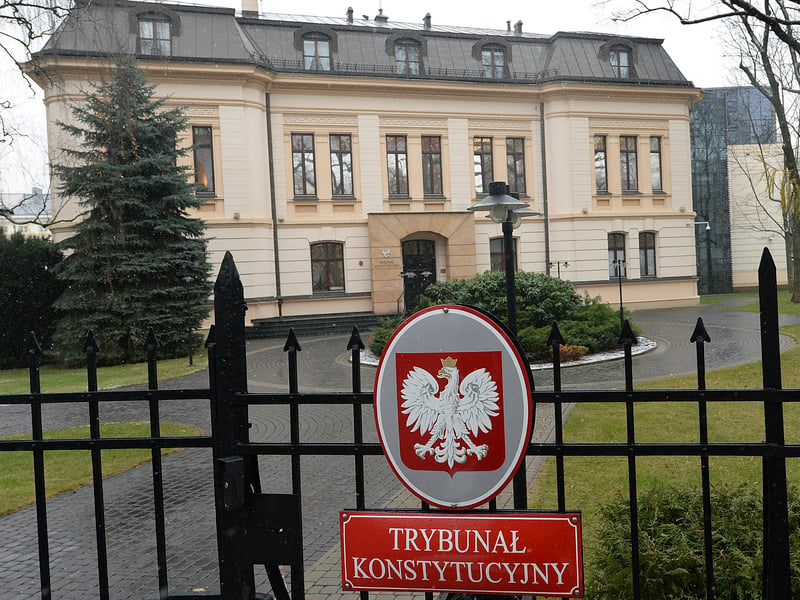
(CN) — Poland faces an unprecedented legal mess where its Constitutional Court and hundreds of rulings it issued over the past nine years may be deemed unlawful — a prospect that became even more probable Tuesday after an advocate general at the European Court of Justice said the nation’s previous right-wing nationalist government illegally stacked the court with judges it favored.
Advocate General Dean Spielmann advised the Court of Justice to declare the Constitutional Court in Warsaw unfit to be called an “independent and impartial tribunal” in violation of EU law.
The Court of Justice, the European Union’s high court, is expected to issue a ruling later this year agreeing with Spielmann. The EU court has repeatedly ruled against judicial reforms enacted by Poland’s former right-wing and anti-EU Law and Justice government. Opinions from advocates general are not binding and serve as legal guidance to the high court.
“It would be the very first time in the history of EU law that a Constitutional Court of an EU member state is going to be held not to be a lawful court within the meaning of EU law,” said Laurent Pech, a law professor at University College Dublin who’s written extensively on this long-running legal fight.
The dispute goes back to 2015 when the Law and Justice party seized power in Warsaw and enacted a series of judicial reforms, including controversial appointments to the Constitutional Court.
The reforms were criticized as an attempt by Law and Justice to concentrate power in its hands by filling the courts with allies and ousting judges it didn’t like.
In its defense, Law and Justice said Poland’s old court system needed to be overhauled because it was corrupt, inefficient and filled with communist-era judges. To achieve its goals, it set up new disciplinary chambers and other mechanisms to oust unfriendly judges and streamline the legal system.
In 2017, the European Commission, the EU’s executive branch, initiated infringement proceedings against Poland and won several cases before the Court of Justice. The dispute reached a climax in October 2021 when the Constitutional Court declared the Court of Justice’s rulings related to the judicial reforms did not have to be obeyed because Poland’s constitution trumped EU law.
In Tuesday’s opinion, Spielmann said the Constitutional Court’s finding that Polish laws have “primacy” over EU laws was wrong.
“Such an approach does not merely constitute some minor friction between the EU legal order and the national legal order: it strikes to the heart of the principle of primacy, going so far as to call into question the hierarchy of norms in the EU legal order,” Spielmann wrote.
Pech said in a telephone interview, “The irony of it is that you have a Constitutional Court refusing to recognize the primacy of EU rule-of-law requirements in the name of the constitution, which is itself, in fact, violated by this fake court established in breach of the constitution.”
The legal dispute took a dramatic turn after the Law and Justice party was booted from power in October 2023 parliamentary elections.
Since then, pro-EU Polish Prime Minister Donald Tusk has sought to reverse the previous government’s reforms, but his efforts have been blocked by Polish President Andrzej Duda, an ally of Law and Justice. This May, Poland will elect a new president; a Tusk ally, Warsaw Mayor Rafał Trzaskowski, is ahead in the polls.
Since Tusk’s win, Pech said the Polish government has ignored the Constitutional Court and its judgments. The uncertainty over the court’s legal standing also prompted many Polish courts to disregard its rulings, he said.
“Polish judges are kind of already ignoring, disregarding the judgments,” he said. “They’ve done so on the basis of their own interpretation of EU law in the absence of a judgment of the EU Court of Justice because they all expected the Court of Justice to confirm the current analysis, which seems to be correct.”
He said that between 2017 and 2022, the Constitutional Court issued 159 judgments and that 85 of those rulings were “delivered with improperly composed panels.” Between 2023 and 2024, the court issued 52 more rulings.
“What are we going to do with all these so-called judgments from the so-called Constitutional Court?” Pech said. “As a matter of EU law, ordinary courts, all Polish courts, must disregard the judgments of the Constitutional Court if issued from an unlawfully composed bench.”
“This is not an easy legal issue because — at least in the context of the EU — we have never really faced such a challenge,” he said.
He added that the dispute hanging over the Constitutional Court left a “gap in judicial protection” because no court was “able to guarantee constitutional review of Polish legislation since 2016.”
Courthouse News reporter Cain Burdeau is based in the European Union.
 Follow @cainburdeau
Subscribe to our free newsletters
Our weekly newsletter Closing Arguments offers the latest about ongoing trials, major litigation and rulings in courthouses around the U.S. and the world, while the monthly Under the Lights dishes the legal dirt from Hollywood, sports, Big Tech and the arts.