
 Search Articles


PHOENIX (CN) — As politicians begin their campaigns for next year’s midterms, voters across the country are increasingly frustrated with both major political parties, feeling like neither represents the interests of everyday Americans.
A new Pew Research survey of 3,445 adults shows that more than half of Americans view both the Democratic and Republican parties as “too extreme.” Only 39% of Americans believe the Republican party governs “ethically and honestly,” and only 42% of Americans say the same about the Democrats.
In a political climate fueled by heightened tensions and hostile rhetoric, University of Arizona professor Samara Klar says the results are anything but surprising.
“Our policy preferences haven’t changed dramatically,” she said. “Republicans and Democrats, if anything, often agree with each other much more on most issues than they would realize.”
The main driver of the divide, the political scientist suggested, is tone.
The most unifying data points from the survey show that most Americans want politicians to tone down rhetoric and denounce calls for violence on both sides. Large majorities say that the opposite party needs to do a better job of compromising with their side.
“Why is it that politicians act like this? Who likes this?” Klar asked about increasingly common rhetoric that has helped fuel an increase in political violence. “Turns out the answer is nobody.”
While many attribute the increased hostility to President Donald Trump, Klar said the phenomena is nothing new. For her book, Independent Politics: How American Disdain for Parties Leads to Political Inaction, co-authored by Yanna Krupnikov, Klar tracked partisan disagreement in every presidential debate from 1996 to 2012.
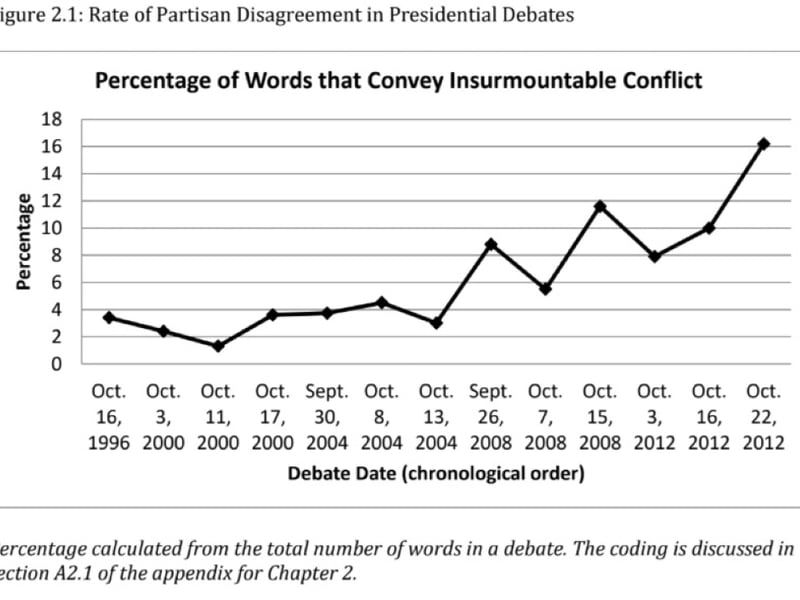
“The incidents of name calling and hostility in presidential debates, the rise has been exponential over time. And that was, again, before Trump,” she said.
Both sides widely view the opposing party as “too extreme,” and the share of voters who hold that opinion has grown over time. One explanation for that could be the rise of the 24-hour news cycle, and, more recently, the rise of social media’s role in politics.
“More bombastic, aggressive behavior is rewarded with more attention, and that helps campaigns,” Klar said.
But because independents are increasingly frustrated with both political parties, that could also lead to political apathy and decreased political participation from the growing cohort that makes up nearly half of all Americans.
While the Pew survey illustrates dissatisfaction with both parties, Democrats seem to be more frustrated with their own party than Republicans are with theirs. And the trend is growing. Nearly 70% of Democrats surveyed say that their party frustrates them, compared to only 50% of Democrats who said the same thing in 2021. Their main complaint is that their party isn’t fighting hard enough against President Donald Trump.
By contrast, only 40% of Republicans say their own party frustrates them, compared to 50% who said so in 2021. Nearly 70% say their party makes them feel hopeful.
While Trump’s approval rating remains at historic lows, his perceived wins on immigration and crime have kept his party’s overall satisfaction afloat, whereas Democrats have lost ground in almost every measurable category, including LGBTQ issues, on which Democrats lost an eight-percentage point lead to Republicans in the last two years.
While Democrats still command greater approval on issues such as race, abortion, health care and climate change, “these aren’t the issues that affect people every day, for the most part,” Klar said.
Republicans garner more approval from survey respondents regarding what Klar calls “materialist” issues like the economy and crime rather than “post-materialist” social issues.
“If you’re not able to buy groceries and you’re not able to pay rent, you are also not spending a lot of time thinking about climate change,” Klar said.
In historically red Arizona, Democrats have found recent success in part by focusing on those materialist issues, while remaining “very committed to the image of being moderate.” Klar said the campaign approaches of Governor Katie Hobbs and Senator Mark Kelly, for example, have focused on border security, crime prevention and economic advancement, for a large part shying away from other social issues.
When compared to Kari Lake, who campaigned on MAGA and pro-Trump stances, Hobbs appeared moderate enough to Arizona voters to win the gubernatorial election in 2022. In a recent reelection campaign video, Hobbs makes no mention of culture war issues, focusing almost entirely on jobs and border security.
While some Democratic voters may see the approach as bending the knee, Klar said this is how Democrats can earn moderate and independent votes. And while Republicans may seem more satisfied than their liberal opponents, Klar warned that a lack of party unity should still make Republican officials nervous for approaching midterms.
 Follow @JournalistJoeAZ
Subscribe to our free newsletters
Our weekly newsletter Closing Arguments offers the latest about ongoing trials, major litigation and rulings in courthouses around the U.S. and the world, while the monthly Under the Lights dishes the legal dirt from Hollywood, sports, Big Tech and the arts.