Search Articles


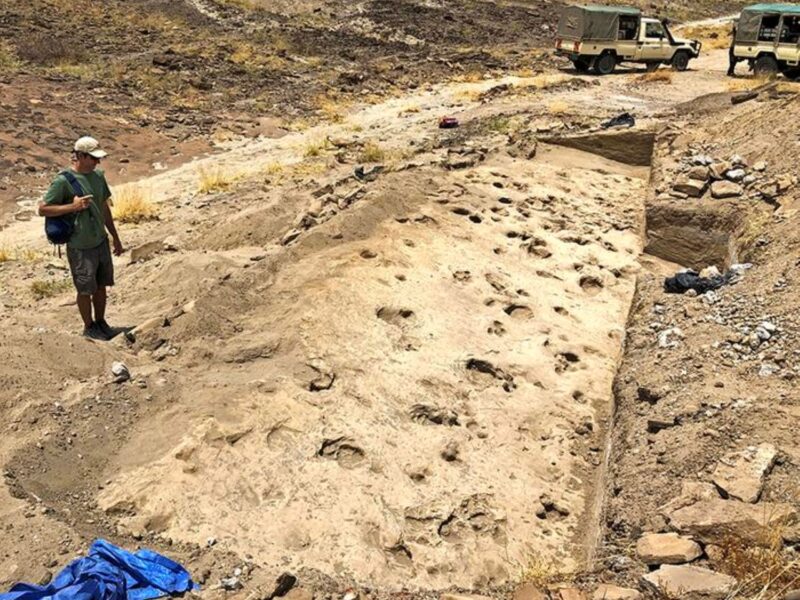
(CN) — Fossil footprints preserved on the ancient shoreline of Kenya’s Lake Turkana suggest an extinct human relative grew much larger than scientists had believed and may have traveled in groups of mostly adult males 1.43 million years ago.
In a study published Monday in the Proceedings of the National Academy of Sciences, researchers examined 21 fossilized footprints left by eight individuals of Paranthropus boisei, an early human relative best known by their powerful jaws and oversized teeth.
Based on the size and shape of the tracks, the team concluded the hominins could have stood as tall as 6 feet and weighed about 165 pounds, dimensions previously associated with the larger Homo erectus.
“The sizes of the footprints indicate human-like body sizes — up to 6 feet tall and around 165 pounds,” lead author Kevin Hatala, an associate professor of biology at Chatham University, said in a press release.
The findings suggest P. boisei was considerably larger than earlier estimates indicated and lived alongside similarly sized Homo erectus populations in eastern Africa during the Early Pleistocene period.
The footprints also provide a rare glimpse into behavior rather than anatomy. Researchers determined the tracks were likely made by a group of mostly adult males moving together across a muddy lakeshore, an arrangement that could point to more sophisticated social organization than previously recognized.
“The fact that eight, mostly adult male, P. boisei individuals seemingly traveled together as a group, without females or children, hints at a complex social structure in this species,” co-author Neil Roach of Harvard University said. “They may have lived in large groups, where males competed for mates, but also tolerated each other at times for safety in a dangerous environment.”
Scientists dated the tracks to roughly 1.43 million years ago using volcanic ash preserved in surrounding rock layers.
At the time, the Lake Turkana shoreline supported crocodiles, elephants, hippopotamuses, antelope and at least two hominin species: P. boisei and Homo erectus, a potential ancestor of modern humans.
The footprints were first discovered in northern Kenya in 1978 by a research team that included Smithsonian paleontologist Kay Behrensmeyer.
After the initial excavation, the site was reburied for protection until researchers returned in 2016 and 2023, uncovering many additional tracks preserved in the same sediment layer.
The site, known as GaJi10, is one of hundreds of fossil footprint locations found along Lake Turkana’s eastern shore. Researchers plan to return to the region later this year to continue investigating why the lakeshore preserved so many footprints and what they can reveal.
“The special thing about footprints scientifically is that they preserve an instant in time,” Behrensmeyer said in a statement. “They also allow people to relate to these fossils much more easily than an isolated piece of bone or jaw.”
Subscribe to our free newsletters
Our weekly newsletter Closing Arguments offers the latest about ongoing trials, major litigation and rulings in courthouses around the U.S. and the world, while the monthly Under the Lights dishes the legal dirt from Hollywood, sports, Big Tech and the arts.