
 Search Articles


(CN) — As shoppers look for holiday deals, Arizona sued Temu in Maricopa County on Tuesday, claiming the online retailer violated the rights of consumers under state law by misleading users and secretly collecting their data.
“We allege that Temu has repeatedly and willfully violated the Arizona Consumer Fraud Act and put the privacy of Arizonans, including minors, at extreme risk,” Arizona Attorney General Kris Mayes said in a statement. “Arizonans should be aware that behind Temu’s low prices and shiny advertising, there is real danger. The Temu app can infect users’ devices with malware to steal their private data while carefully hiding its tracks.”
Owned by the Chinese company PDD Holdings Inc., the Temu app has been available to American consumers since 2022, selling cheap Chinese products and urging consumers to “shop like a billionaire.”
Following Google and Apple app store suspensions of Temu and its predecessor, Pinduoduo, the Arizona attorney general’s office conducted an independent forensic investigation. According to Mayes in the complaint, Temu consumers unwittingly give the company access to their geolocation, phone apps and accounts, photos, videos, cellular data and WiFi network information.
In addition to collecting information from the Temu app, the company also collects user data from other apps, including competitors. In combination, Mayes says the data gives the company a deeply private picture of individual users.
“Over time, location data reveals private living patterns of Temu users, including where they work, where they reside, where they go to school, and when they are at each of these locations,” Mayes says in the lawsuit. “Location data, either standing alone, or combined with other information, exposes deeply private and personal information about Temu users’ health, religion, politics and intimate relationships.”
Not only does Temu fail to disclose the information grab, Arizona asserts, the app itself is designed to evade forensic review, a feat accomplished by a team of 100 engineers who studied Android phone vulnerabilities.
“Defendants’ unlawful intrusion into their users’ privacy is made even more egregious and offensive by the fact that the defendants are targeting and collecting information in a manner that is intended to go undetected,” Mayes says.
Arizona also raised concerns about Temu’s connection to China, and the possibility that it is providing information about Arizona consumers to the Chinese government. In addition, the app’s lack of user age verification and use of friendly cartoons in advertising leave minors vulnerable to exploitation, Mayes says in the lawsuit.
In line with similar concerns, Montana banned use of Temu and other Chinese-owned apps on devices used by state employees. Montana’s attempt to outright ban TikTok use in the state was defeated in federal court last year.
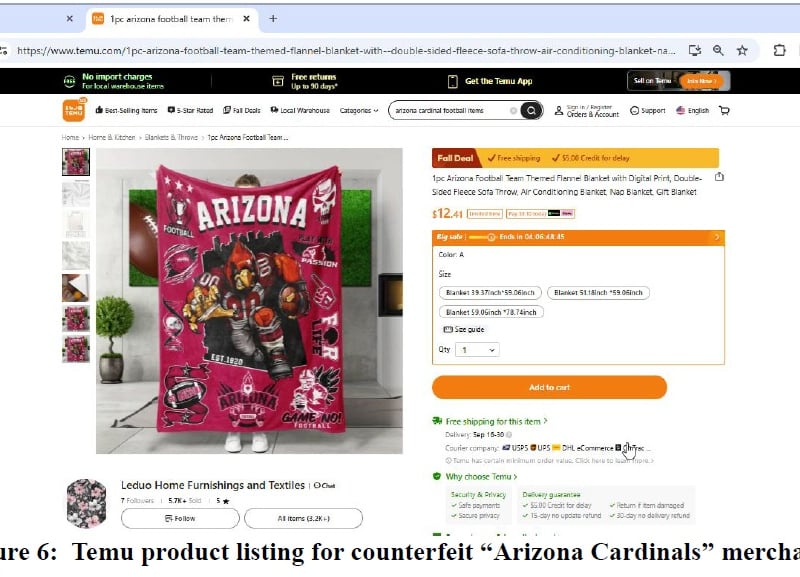
In addition to harvesting user data, Mayes claims Temu is selling unlicensed products illegally printed with logos from local companies including the Arizona Cardinals, Fender Guitars and the University of Arizona. The attorney general reiterates complaints Arizonans filed with the Better Business Bureau and the attorney general’s office against the company ranging from undelivered packages to poor quality of goods.
In filing three claims under the Arizona Consumer Fraud Act, Mayes asks the court to order Temu to refund Arizonans’ money given under deceit and to demand civil penalties of $10,000 per violation of the law.
A spokesperson for Temu denied the claims and emphasized the company’s cost-saving business model.
“We help consumers and families access quality products at affordable prices,” the spokesperson wrote in an email. “We also create growth opportunities for businesses by offering a low-cost alternative to traditional gatekeepers. By providing another route to market, we return power and choice to local players, small and medium-sized businesses, and consumers.”
 Follow @bright_lamp
Subscribe to our free newsletters
Our weekly newsletter Closing Arguments offers the latest about ongoing trials, major litigation and rulings in courthouses around the U.S. and the world, while the monthly Under the Lights dishes the legal dirt from Hollywood, sports, Big Tech and the arts.