
 Search Articles


PHOENIX (CN) — Arizona Attorney General Kris Mayes sued Reynolds Consumer Products on Wednesday, accusing the parent company behind the Hefty brand of violating consumer protections by advertising nonrecyclable garbage bags as “recyclable” and “sustainable.”
Hefty, known best for selling trash bags, has sold transparent “recycling bags” since at least 2019, Mayes says in the complaint. But despite the branding, those products are largely nonrecyclable and instead can become tangled in sorting equipment and even shut down entire Arizona recycling facilities.
“Corporate greed was prioritized over being honest to consumers,” Mayes said in a Wednesday press release. “Reynolds lied on the packaging, misled Arizonans and profited off well-meaning consumers who simply wanted to protect our state by recycling. Companies who ‘greenwash’ will be held accountable by my office.”
Mayes accuses Reynolds of profiting off Arizonans’ desire to do the right thing, advertising its bags as “ideal for collecting recyclable materials” without clarifying that the bags themselves aren’t actually recyclable. When a consumer recycles the bag, the contents most often end up in a landfill instead.
“These greenwashing practices exploit consumers who prioritize sustainability and limiting their environmental impact, and they are completely unacceptable in Arizona,” Mayes said.
Though Reynolds changed the messaging on its packaging beginning in 2019, Mayes says every version so far has violated the Arizona Consumer Fraud Act.
In 2019, “perfect for all your recycling needs” and “transparent for quick sorting and curbside identification” were written across every package. The packaging also included an image of a blue recycling truck with a “chasing arrows” recycling symbol, which is a recognizable marketing symbol indicating that a product is recyclable. Under that symbol read: “developed for use in municipal recycling programs where applicable.”
The state of Connecticut sued Reynolds under the Connecticut Unfair Trade Practices Act in 2022, prompting Reynolds to adopt new packaging. In her complaint, Mayes says that the updated packaging continued to label the bags with “RECYCLING” and still contained images widely associated with recycling, adding only smaller text saying “these bags are not recyclable” and “contact your local municipality or recycling center to confirm.”
Despite the textual clarification, Mayes says the use of the common recycling logo, called the Möbius loop, still implies that the product is entirely recyclable and therefore is deceptive to consumers.
The state of Minnesota sued Reynolds and Walmart in 2023 for the same reasons under its own consumer fraud statute, and in 2024 Reynolds updated its packaging once again.
In the most recent redesign, the “recycling” bags are rebranded as “clear” or “blue” bags. The new packaging again states “these bags are not recyclable” and clarifies that they are “developed for use in participating municipal programs only.” The Möbius loop remains.
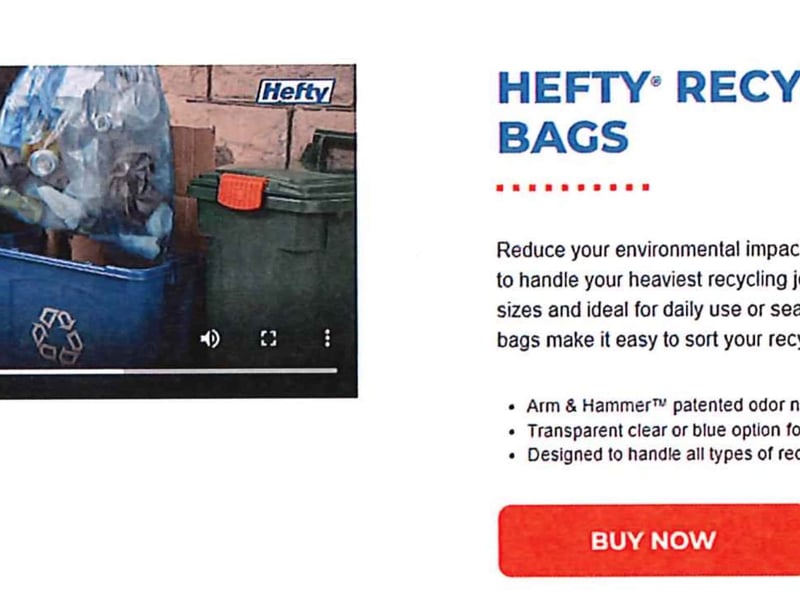
On Reynolds’ website, the bags are listed under the “sustainable solutions” tab, and the images used are identical to the images used in the 2019 packaging, Mayes claims.
“Defendant Reynolds knew or should have known that Arizona consumers would make no new inferences about the bags when the only change from the front design of the package was the removal of the word “RECYCLING,” she says in the complaint. “Defendant Reynolds knew or should have known that Arizona consumers would believe that the bags could be used for recycling pickup when the packaging displays an illustration of the product being used to bag recyclables — the same image used in the two previous packaging versions.”
Mayes adds that all three versions of the product are still available for online purchase.
She seeks a permanent injunction requiring Reynolds to stop packaging nonrecyclable products with recycling language or imagery. She also seeks restitution for consumers as well as civil penalties of up to $10,000 for each willful violation of the Arizona Consumer Fraud Act.
Reynolds hasn’t replied to a request for comment.
 Follow @JournalistJoeAZ
Subscribe to our free newsletters
Our weekly newsletter Closing Arguments offers the latest about ongoing trials, major litigation and rulings in courthouses around the U.S. and the world, while the monthly Under the Lights dishes the legal dirt from Hollywood, sports, Big Tech and the arts.