Search Articles


DENVER (CN) — A Colorado man sentenced to three years in federal prison after violating a probationary sentence forbidding him from threatening public officials prompted an en banc appellate panel on Monday to reconsider the 10th Circuit’s resentencing guidelines down to the meaning of “resentencing” itself.
“Is the judgment only going to reference the revocation of probation?” asked the 10th Circuit’s Chief U.S. Circuit Judge Jerome Holmes. “It’s not going to harken back to the original matter, right?”
Presiding 10th Circuit caselaw currently guides trial courts to follow a two-step process for resentencing, laid out in Moore I: first, consider sentencing guidelines for the original offense, and then calculate another term for the probation violation.
Public defender Jacob Rasch-Chabot is fighting to overturn the two-step process entirely, arguing a federal court need only look to the probation violation in calculating resentencing, since the original sentence was already imposed.
In the case of Rasch-Chabot’s client, Malachi Mathias Moon Seals, however, simply looking to guidelines for his probation violation risked appearing to “erase” the five year probation sentence for which he only served eight days.
Because the guideline for probation offense seemed too easy on the offender, Joe Biden-appointed U.S. District Judge Charlotte Sweeney had looked to different guidelines for Moon Seals’ original offense of threatening public officials, then resentenced him to three years in prison.
Moon Seals appealed, arguing the lower court erred in resentencing him for the original offense rather than simply calculating the probation violation.
A three-judge panel affirmed Moon Seals’ sentence in October, largely because he didn’t show how his preferred sentencing scheme would change the outcome in his case — but the question posed nonetheless piqued the interest of the full court.
“There has to only be one new sentence, as a technical matter, it is the replacement of the original sentence for the underlying offense,” Rasch-Chabot argued.
But the idea of Moon Seals possibly walking away with a lighter sentence than he originally faced didn’t sit well with the court.
“The objection I’m struggling with is no one is getting any kind of punitive action because this wipes out the original sentence,” Holmes said.
U.S. attorney Ethan Sachs asked the court to affirm the sentence and overturn Moore I to give trial judges more deference in choosing the right resentencing scheme for the right case.
“The district court is probably in the best position to consider ‘well, I just gave this defendant a break, and that should be considered in resentencing,’” Sachs argued. “The probation violation here was a really hateful dangerous crime, and Mr. Moon Seals had a lack of regret.
U.S. Circuit Judge Gregory Phillips — who penned the majority opinion that affirmed Moon Seals’ sentence last year — contemplated the wide gulf between sentencing schemes for various criminal offenses and probation violations.
“Say you have two judges, you have one that thinks ‘this is really awful’ and he had to get a security detail, and you get another judge who says ‘everyone knows there are a lot of screwballs out there. If one judge gives him a tiny variance, and the other gives large variance, how do we evaluate those differences?” Phillips asked.
“We have something with the guidelines, we have nothing without them," the Barack Obama appointee added.
Because both the public defender and the U.S. attorney were willing to throw out Moore I’, the court appointed attorney Fredrick Yarger to defend the two-step scheme.
“Moore I just makes sure all the appropriate boxes have been checked,” Yarger, who practices with Wheeler Trigg in Denver, argued. “If the court rejects probation violation guidance under Chapter 7, without Moore I there’s no requirement to look at Chapter 5 and explain where those numbers came from.”
Holmes questioned how clearly the two-step process showed the work.
“What has always puzzled me about that ‘show your work’ is if your range is 3 to 9 and I gave you 100 months, the court could just say ‘I looked at Chapter 5,’ and that’s my decision,” said Holmes, an appointee of George W. Bush.
Yarger didn’t falter.
“That’s the virtue of Moore,” Yarger said.
Holmes circled back to the question of guideline versus requirement.
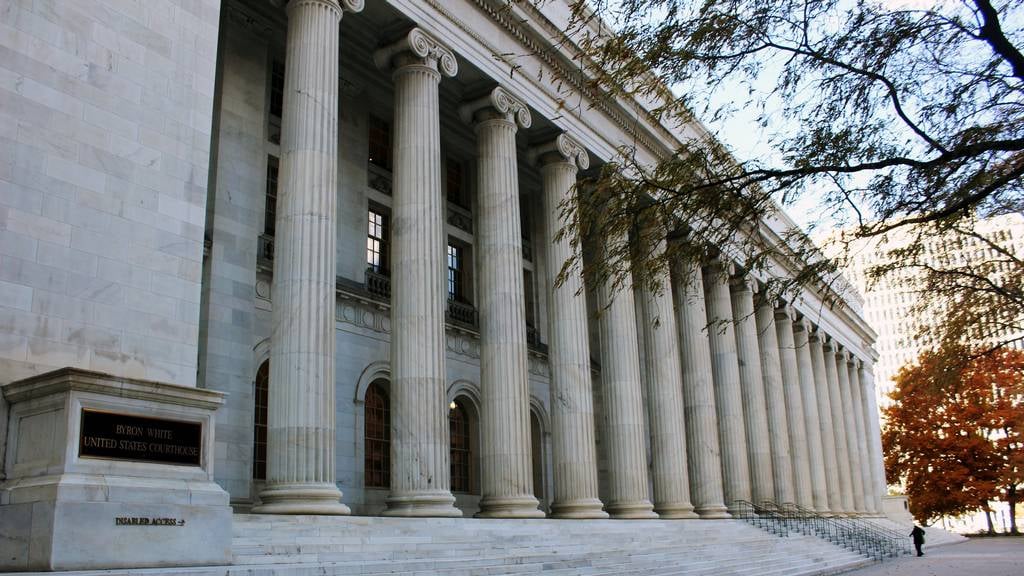
“What’s the difference between a virtue and a requirement?” Holmes quipped, prompting a wave of laughter from the crowd packed into the biggest courtroom in the Byron White U.S. Courthouse in Denver.
Moon Seals’ original offense spanned from November 2021 to January 2022, when he sent vulgar threats to several members of Congress and their families. After a grand jury indicted him on six counts of threatening a federal official and six counts of interstate communication of threats, the 18-year-old pleaded guilty and was sentenced to five years of probation.
Calling them therapeutic, Moon Seals admitted to sending the messages, but said he didn’t intend to carry out any of the threats such as “shov[ing] my rusty machete into their tight little throats and twist[ing] like a fork in some pumkin mush.”
Weeks into serving his sentence, however, Moon Seals sent a new threat to a former CIA official, prompting Sweeney to resentence him to three years in prison with the comment: “You just simply cannot get this many chances to behave.”
Moon Seals’ probation-breaking threat called his target a “pathetic fucking n—er ch–k camel toed sand eating shit monkey.”
The panel also included George W. Bush-appointed U.S. Circuit Judge Harris Hartz and Senior U.S. Circuit Judge Timothy Tymkovich; Barack Obama-appointed U.S. Circuit Judges Scott Matheson, Robert Bacharach, Caroline McHugh and Nancy Moritz; Donald Trump-appointed U.S. Circuit Judges Joel Carson and Allison Eid; and Joe Biden-appointed U.S. Circuit Judges Veronica Rossman and Richard Federico.
Eid and Phillips decided Moon Seals’ first appeal alongside Senior U.S. Circuit Judge Michael Murphy, who was not seated on Monday’s panel.
Holmes thanked the parties for their arguments but did not indicate when or how the court would decide the case.
 Follow @bright_lamp
Subscribe to our free newsletters
Our weekly newsletter Closing Arguments offers the latest about ongoing trials, major litigation and rulings in courthouses around the U.S. and the world, while the monthly Under the Lights dishes the legal dirt from Hollywood, sports, Big Tech and the arts.