Search Articles


WASHINGTON (CN) — In just under two weeks, residents of Washington, D.C., will go to the polls and select a Democratic nominee for mayor.
The capital city is one of the country’s most solidly blue areas, and whoever secures the Democratic nomination in June 16’s primary election will likely occupy the Wilson Building after November. But the D.C. mayoral race — and its two leading contenders — may serve as a referendum not only on the stewardship of a city enduring hardship at the hands of the Trump administration but also the broader direction of Democratic Party politics.
Unlike state governments, Washington, D.C.’s leadership faces unique challenges in its interactions with Congress and the federal government, which exert outsize control over the capital’s municipal policy and budget. And under President Donald Trump, that influence has become more apparent than ever.
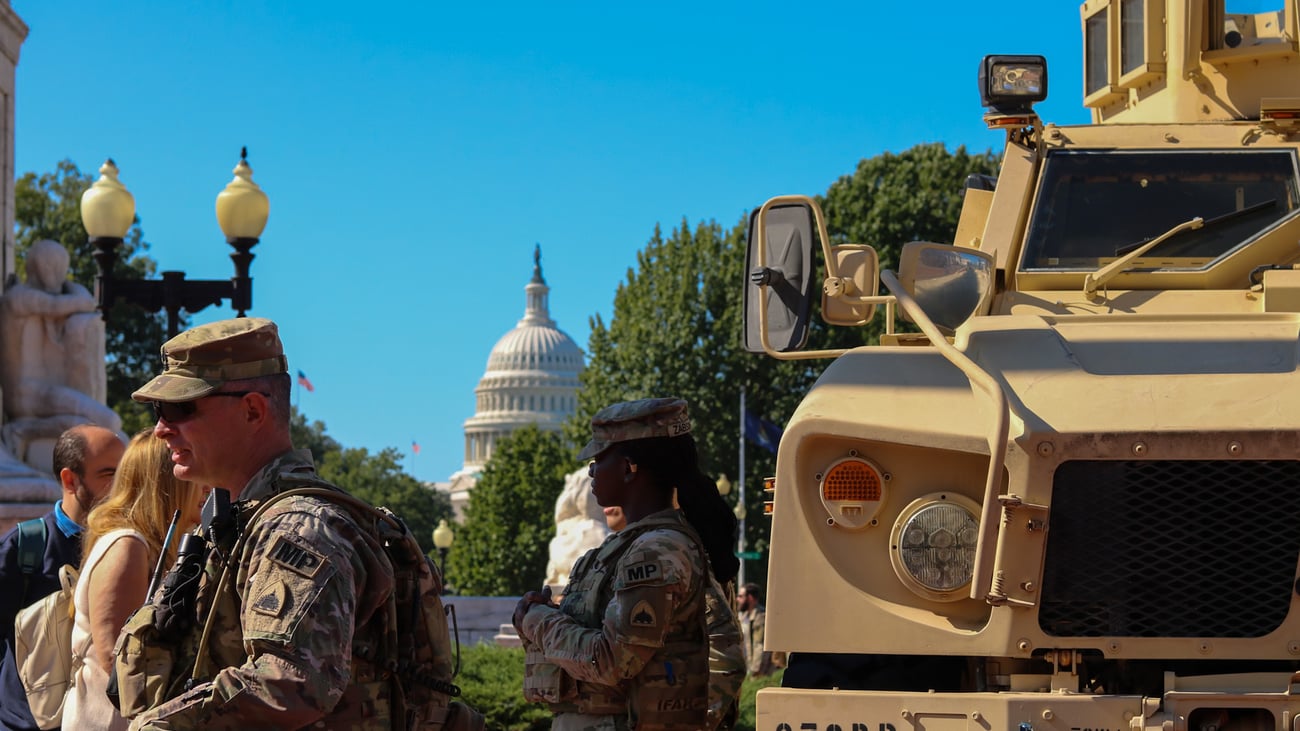
The Trump administration last summer staged a takeover of Washington’s Metropolitan Police Department, citing what the White House called out-of-control crime in D.C. The unprecedented coup of the city police force was coupled with a surge of federal law enforcement into the District, as well as an extended deployment of National Guard troops who remain stationed in the city one year later and are expected to remain through the end of Trump’s second term.
Republicans in Congress have also taken a more aggressive stance toward D.C. law. Lawmakers have undertaken expansive efforts in recent months to roll back criminal justice reforms passed by the D.C. Council and have even moved to fire the city’s elected attorney general and replace him with a presidential appointee.
Funding cuts and federal workforce reductions have also hit D.C.’s economy hard, and like in many political races across the country, “affordability” has become a central part of the mayoral platform. Candidates have laid out plans to increase investment in the capital city, stimulate housing development and increase wages for residents.
This month’s primary election will also be D.C.’s first to implement ranked-choice voting, a ballot-casting system that will allow voters to rank their preferred candidates and which proponents say supports better election outcomes.
And while experts say it’s hard to predict the effects the new system will have on the capital’s Democratic primary, ranked-choice voting could help close the gap between the top mayoral candidates in what’s already a tightly contested race.
Here’s what you need to know about the D.C. mayoral primary: the candidates, the issues and how the race reflects the state of national Democratic politics.
A Mamdani for D.C.?
Leading primary polls in the weeks ahead of the June 16 election is Janeese Lewis George, a juvenile prosecutor and current member of the D.C. Council. A self-described democratic socialist, Lewis George has drawn some comparisons to New York Mayor Zohran Mamdani.
On the campaign trail, she’s dialed in on municipal issues — primarily the cost of living and childcare in D.C. Lewis George has released a plan to expand affordable childcare and raise the pay of early childhood educators to match that of D.C. public school teachers. She has said that no family in the capital city should spend more than 7% of their income on childcare.
The candidate has also committed to lowering housing costs for tenants and reforming city zoning laws to incentivize residential construction. Lewis George has proposed a program that would build publicly owned, rent-stabilized housing in D.C.
“We are facing an affordability crisis in this city,” Lewis George said during a mayoral debate held last month at Georgetown University. “People from the middle class, the margins, are feeling the squeeze.”
She also committed to lowering utility costs for D.C. residents by expanding solar energy capabilities and taking on new artificial intelligence data centers that have cropped up in northern Virginia and which have spiked energy bills for people living in the capital.
Lewis George has opposed plans by Mayor Muriel Bowser to implement permanent youth curfews in certain areas of D.C. And she’s vowed to protect the capital city’s doctrine of home rule from the federal government. If elected, Lewis George has said that she will rescind an order allowing local police to work with U.S. Immigration and Customs Enforcement and that she’ll work more closely with both grassroots organizers and Congress.
Running just behind Lewis George is Kenyan McDuffie, a former D.C. councilmember, former Justice Department attorney and one-time staffer for D.C. congressional delegate Eleanor Holmes Norton. And though he and Lewis George share opinions on key issues, he’s broadly viewed as a more moderate Democratic foil to his primary rival.
McDuffie has also promised to expand affordable housing in the District, championing expanded home purchase assistance programs and streamlined regulatory approvals for new residential construction. He’s also proposed to bring energy costs down by standing up a D.C. “utility help center” that would automatically enroll residents in energy discounts, as well as slapping new limits on fixed monthly charges and other utility rate changes.
On public safety, McDuffie has said D.C. police should hire more officers and that the city should establish a neighborhood-based crime prevention initiative. Much like Lewis George, the candidate has also promised to end Metro Police cooperation with ICE and has said he’ll bolster efforts to secure D.C. statehood.
But McDuffie and Lewis George have sparred over juvenile curfews. During last month’s debate, McDuffie argued the D.C. government needed to treat “teen takeovers” in some city neighborhoods “like the public safety emergency that they are.” He slammed Lewis George for opposing Bowser’s effort to implement permanent curfews.
“She put politics over public safety,” McDuffie said. “That’s not the way that we keep people safe. We don’t need the federal government helping us with law enforcement — we need trust.”
Chris Warshaw, a professor of political science at Georgetown University, told Courthouse News in an interview that housing and criminal justice reform would likely be two of the biggest issues for voters as they head to the polls later this month.
“You’ve seen a lot of new housing in D.C. over the last couple of years, so it will be interesting to see if that continues or if they ramp down on housing and new development,” he said. “And I think criminal justice reform is arguably the biggest issue in D.C. over the last half a dozen years.”
Warshaw also cautioned against comparisons between Lewis George and Mamdani, arguing he hadn’t seen the kind of “movement” behind the D.C. mayoral candidate like the one that propelled Mamdani to Gracie Mansion.
“He ran a really high-quality campaign effort, and that’s hard to replicate,” said Warshaw.
Ranked-choice debut
Recent polling data shows Lewis George with a slight lead over McDuffie, capturing roughly 39% of the vote to her competitor’s 34%. But D.C.’s move to ranked-choice voting could help to close that gap.
Under ranked-choice voting, residents can select up to five candidates in descending order of preference. Votes in ranked-choice elections are counted in rounds — if no candidate nets more than 50% of first-choice votes, the candidate with the fewest number of first-place votes is struck from the ballot. The second ballot then includes the second-place rankings from voters who listed the dropped candidate as their first choice.
A winner is declared once a candidate secures 50% of the vote.
Warshaw said “the jury’s still out” on whether ranked-choice voting is an improvement on the U.S. election process because there are still so few examples, and he argued the small sample size made it hard to predict how it might affect the outcome of D.C.’s mayoral primary.
“It’s hard to see a signal,” he said. “There’s been some early academic work that maybe there’s been a decrease in turnout as ranked-choice voting is rolled out, but there haven’t been enough elections for a signal to come through the noise.”
Depending on how primary election ballots shake out, ranked-choice voting could see McDuffie’s polling disadvantage evaporate as second-choice votes for the third Democratic candidate — businessman Gary Goodweather — are counted. Goodweather is currently polling around 7%.
The D.C. Democratic Party did not return a request for comment on the candidates or ranked-choice voting.
National implications
The mayor of Washington, D.C., occupies an unusual niche in American politics — as head of a federal district and not a state, they wield less power than a governor but more than the mayor of any other U.S. city.
“The D.C. mayor is an unusually important mayor, both because of D.C.’s national importance but also because it’s in some ways more like a quasi-state than a city,” said Warshaw. “I think that’s particularly true in the age of Trump.”
Whoever takes the reins after Bowser, he pointed out, will be “embroiled” in national political debates and intrigue from a White House that has taken significant steps to reshape the capital city — whether that’s in taking over law enforcement duties or renovating local parks and public spaces.
The next mayor will need to strike a careful balance between advocating for home rule and cooperating with a federal government that in many ways controls D.C.’s destiny, Warshaw opined.
“The federal government has lots of carrots and sticks it can use over D.C., so I think they’re going to pick their battles,” he said.
Warshaw was also skeptical about whether the D.C. mayoral race — with one candidate an avowed socialist and one tracking more closely to the Democratic establishment — would serve as a bellwether for the party’s direction on the national stage. He pointed out that the capital city’s status as a liberal stronghold made it difficult to analyze intra-party stratifications.
“There’s nowhere else that’s like it at the state level — it’s a pretty unique place, he said. “It would be like saying that the future of the Republican Party is going to be determined by a House primary in Wyoming.”
 Follow @BenjaminSWeiss
Subscribe to our free newsletters
Our weekly newsletter Closing Arguments offers the latest about ongoing trials, major litigation and rulings in courthouses around the U.S. and the world, while the monthly Under the Lights dishes the legal dirt from Hollywood, sports, Big Tech and the arts.