
 Search Articles



BRUSSELS (CN) — No troops for the strait, no breakthrough on Ukraine and a carbon market that lives to fight another day. EU leaders wrapped their Brussels summit Thursday with a package of energy relief measures — and little else resolved.
The EU leaders stopped well short of any military commitment, saying EU members would support freedom of navigation “once the conditions are met” — a formulation carefully designed to rebuff Washington without slamming the door entirely.
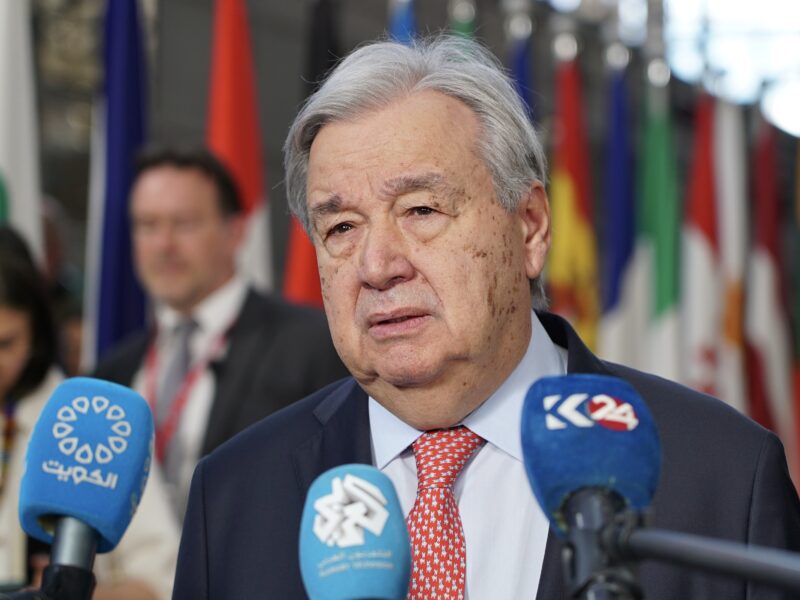
“It’s high time to end this war,” U.N. Secretary-General António Guterres, who sat down with leaders Thursday, told the U.S. and Israel. The Strait of Hormuz’s closure, he added, is causing “enormous pain” for countries with no stake in the fight.
No to the strait
European leaders arrived with a near-unanimous answer to Washington’s push for EU military involvement in the Middle East: no. The rebuff came despite pointed pressure from President Donald Trump, who posted on Truth Social Wednesday that nonresponsive allies should be “responsible for the so called ‘Strait’” — and floated the prospect of finishing off “what’s left of the Iranian Terror State” to get them moving.
“Europe will not allow itself to be blackmailed,” Austrian Chancellor Christian Stocker said Thursday on arrival. German Chancellor Friedrich Merz said Germany could help secure shipping lanes but only “when the weapons fall silent.”
Leaders called for more assets to the EU’s two escort naval missions in the region — Operation Aspides in the Red Sea and Operation Atalanta in the Gulf of Aden.
But European countries “do not have an appetite to go to this war,” said EU foreign policy chief Kaja Kallas, citing the lack of a U.N. Security Council resolution or self-defense case.
French President Emmanuel Macron said France was exploring ways to unblock the strait through “a U.N. framework,” an option he discussed with Indian Prime Minister Narendra Modi and Guterres. “We have started an exploratory process, we will see if it succeeds,” he said.
Markets react
Brent crude briefly surpassed $119 a barrel after Iran struck Qatar’s Ras Laffan gas complex Wednesday, knocking out 17% of the capacity of the state-owned company that produces a fifth of the world’s liquified natural gas.
Repairs will take three to five years, QatarEnergy CEO Saad al-Kaabi said Thursday, with force majeure declared on contracts supplying Italy and Belgium — which source roughly 30% and 8%, respectively, of their LNG from Qatar — as well as South Korea and China.
“The war in the Middle East is creating the largest supply disruption in the history of the global oil market,” the International Energy Agency said in its March 12 report. Flows through the strait had “plunged from around 20 million barrels a day before the war to a trickle.”
“If that becomes structural, we’re in deep trouble,” Belgian Prime Minister Bart De Wever said Thursday.
Brussels will give governments more room to subsidize energy costs for factories, cut the infrastructure fees industry pays to use the grid and lower taxes on electricity, said Ursula von der Leyen, head of the European Commission — the EU’s executive arm — after the gathering.
The bloc’s carbon pricing system — which makes polluting more expensive and has been a lightning rod for criticism — will be kept but retooled, with more free permits for industry and a new 30 billion-euro ($34.7 billion) fund to help companies clean up their operations.
The European Central Bank held rates unchanged Thursday — a unanimous call — as the war forced it to revise inflation up to 2.6% for 2026 and growth down to 0.9%. The projections factor in the conflict, though the latest eurozone data (1.9% in February) still predates its full impact.
Bank president Christine Lagarde, who briefed reporters in Frankfurt before flying to Brussels for the parallel Euro Summit, drew a deliberate contrast with 2022. “We are well positioned,” she said, citing inflation near target, anchored expectations and a labor market at a historic high. She declined to signal a next move. “We are not pre-committing to a particular rate path.”
Orbán in the hot seat
Hungarian Prime Minister Viktor Orbán arrived to an onslaught. Leader after leader accused him of backing out of a deal he helped negotiate in December, with the April 12 Hungarian parliamentary election as the backdrop.

Orbán has conditioned his support on restoring Russian crude oil deliveries through the Druzhba pipeline, hit by a Russian airstrike in January. “We are ready to support Ukraine when we get our oil, which is being blocked by them,” he told reporters Thursday on arrival. He is also holding up the bloc’s 20th sanctions package against Russia.
Few were sympathetic. “The loan remains blocked because one leader is not honoring his word,” said von der Leyen after the gathering, in an unmistakable reference to Orbán. “We will deliver one way or the other.”
Kallas warned Kyiv could run out of money as early as May and said Hungary was not acting “in good faith.” “I guess, you know, in the time of elections, people are not that rational.”
Merz, who the day before had accused Orbán of “setting up this blockade in Europe now for domestic political reasons,” said Thursday the bloc’s “guiding principle is one of loyalty and reliability. I am firmly convinced that this will leave a lasting mark.”
The 25-government statement called for first payments by early April and urged partners to help close a remaining 30 billion-euro gap in Ukraine’s financing needs, estimated at 135 billion euros ($156.3 billion) for 2026–27. Ukrainian President Volodymyr Zelenskyy addressed leaders by video conference earlier Thursday.
Courthouse News correspondent Yuval Molina is based in Brussels, Belgium.
Subscribe to our free newsletters
Our weekly newsletter Closing Arguments offers the latest about ongoing trials, major litigation and rulings in courthouses around the U.S. and the world, while the monthly Under the Lights dishes the legal dirt from Hollywood, sports, Big Tech and the arts.