
 Search Articles


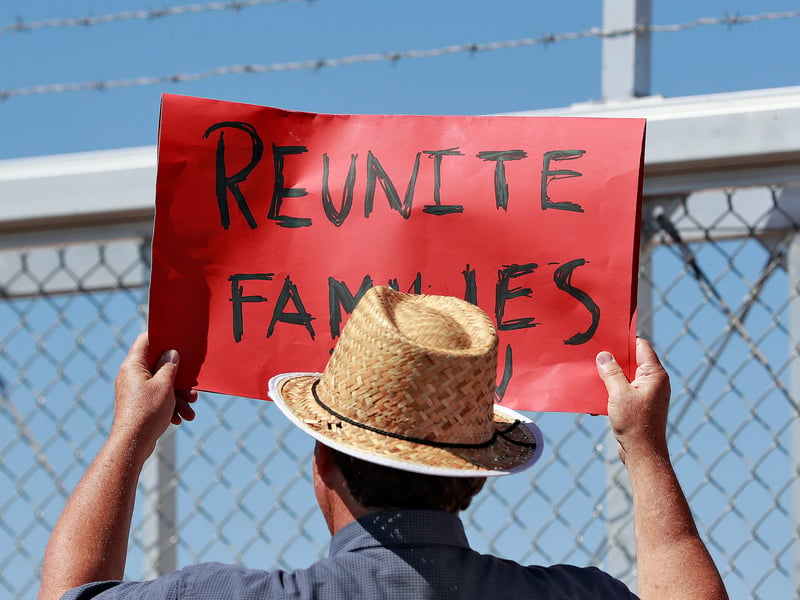
SAN DIEGO (CN) — The federal government can’t keep violating the settlement agreement that ended a policy that cleaved migrant parents from their children at the border just because the Trump administration thinks it’s too expensive or doesn’t want to follow it, a federal judge in San Diego ruled on Thursday.
The government had argued that it should be given temporary relief from having to comply with aspects of the 2023 settlement because new policy directives following the changeover in administrations makes the court’s previous orders not equitable anymore.
“Notably, defendants fail to cite any authority to support this argument, and at least one other court has rejected it,” U.S. District Judge Dana Sabraw, a George W. Bush appointee, wrote in his order denying the government’s motion.
Citing a case from earlier this year in the Northern District of California — where the federal government tried to argue that it should be allowed to modify an existing settlement agreement on the basis of a change in presidential administration — Sabraw wrote that the other court didn’t buy that argument and neither did he.
“According to the court, that would run counter the government’s ‘long history of entering into consent decrees that bind future administrations, and of abiding by those agreements.’ That reasoning applies squarely here, and leads this court to the same conclusion, namely that a change in presidential administration does not constitute the sort of ‘significant change’ in either fact or law sufficient to show that prospective application of a court order ‘is no longer equitable,’” Sabraw wrote.
The government also tried to argue that a legal services and advice program the settlement mandated be provided to plaintiffs and their families in the case to help them apply for asylum and other things is now “an unfavorable cost-to-output ratio at the taxpayer’s expense.”
But the Department of Justice negotiated with The Acacia Center for Justice, the service provider, on a pricing structure of $4,605,843.86, or an average of approximately $3,841 per class member during settlement negotiations, Sabraw wrote. During those negotiations, the government never expressed any concerns about additional anticipated costs, he added.
The court has repeatedly told the government it can look for another contractor to provide legal services to the class members, but “what defendants are not free to do, however, is ignore their obligations to provide the legal services promised in the settlement agreement,” Sabraw wrote.
The government also claimed they can’t abide by the settlement’s provision to provide outreach, behavioral health and medical services to the separated families because the contractor was referred by the Department of Homeland Security to the Department of Labor for possibly violating Trump’s anti-diversity, equity and inclusion executive order from earlier this year.
But the referral is not a finding of fact that the contractor violated any law, it’s just a referral “and nothing more,” Sabraw wrote.
The basis of the referral is something on the company’s website, which has been in existence since 2020, before the settlement was signed and a contract was entered into, which means the company’s conduct has not changed since the settlement was approved, Sabraw said.
Sabraw wrote that it’s not clear that the executive order would even apply to the company, but even if it did, it doesn’t constitute a change in law because the “the executive branch cannot ‘unilaterally create the change in law that it then offers as the reason it should be excused from compliance with a consent decree.’”
Sabraw ordered the government to recontract with the company to provide behavioral health and medical services to the family.
“The settlement agreement, which was the result of painstaking negotiations between plaintiffs and the government, aimed to address that damage by providing these families with certain services at the government’s expense, including the behavioral health services, assistance with certain medical costs, and housing assistance at issue here,” Sabraw wrote.
“The court correctly told the Trump administration that it cannot simply abandon the settlement, including provisions critical to helping the families subjected to the horrific separation policy during Trump I,” wrote American Civil Liberties Union attorney Lee Gelernt, representing the asylum-seeking migrant families, in an email.
A spokesperson for U.S. Immigration and Customs Enforcement said the agency does not comment on pending litigation.
Sabraw first found the federal government breached the settlement agreement in June and ordered it not to deport any asylum-seekers involved in the suit after Gelernt notified the court that a child plaintiff had already been deported from the country with little time for their attorneys to respond to try to stop it, which violated the provisions of the settlement agreement.
The asylum-seeking family members have repeatedly filed motions asking the court to enforce the settlement.
The settlement between some 9,000 class members and the government mandates that Trump’s “zero-tolerance” first-term policy on immigration, or a similar policy, can’t be reenacted by a presidential administration for eight years. It also funds efforts to reunite some 4,500 to 5,000 children separated as a result of the policy with their parents in the U.S. and calls for a pathway for asylum in the U.S.
It further requires certain benefits — like work authorization, housing, medical care and legal services and advice — to be provided for those affected by the policy.
Subscribe to our free newsletters
Our weekly newsletter Closing Arguments offers the latest about ongoing trials, major litigation and rulings in courthouses around the U.S. and the world, while the monthly Under the Lights dishes the legal dirt from Hollywood, sports, Big Tech and the arts.