
 Search Articles


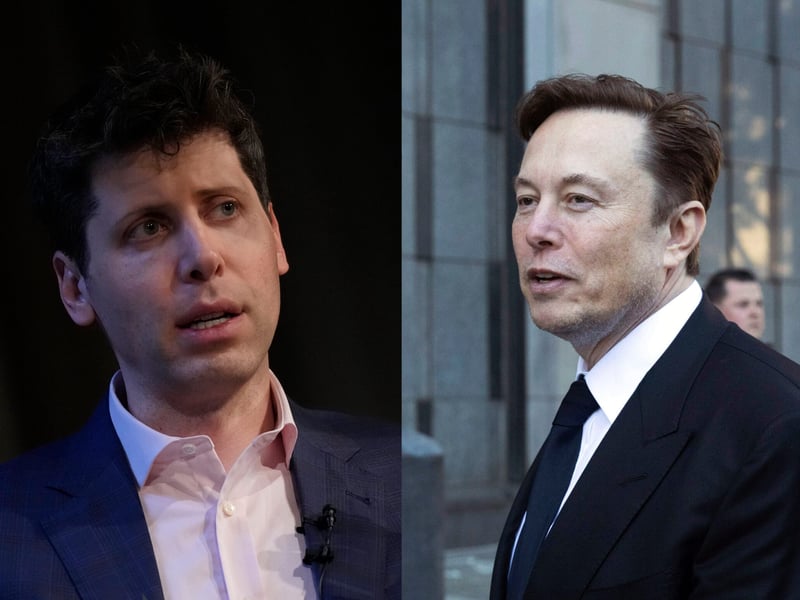
OAKLAND, Calif. (CN) — A federal judge dismissed numerous claims but allowed fraud claims to survive Thursday afternoon in a fight between Elon Musk and OpenAI, the developers of ChatGPT.
Musk, an early investor and cofounder of OpenAI, is suing OpenAI CEO Sam Altman and his company, seeking a court order to prevent it from going through with for-profit restructuring. Musk claims that move violates OpenAI’s nonprofit mission and breaches the terms of his previous donations to the company, approximately $45 million.
Musk also accuses OpenAI of violating multiple antitrust laws, including the Sherman Act, through its close partnership with Microsoft and other noncompetitive behaviors, including exclusivity agreements with investors to not fund other competitors in the AI market. The billionaire argued that to deprive companies of investors — like his own xAI — was “obviously harmful” in the still-emerging AI market.
Musk is joined in his lawsuit by Neuralink Director Shivon Zilis, with whom he recently welcomed his 14th child, and his company xAI.
On Thursday, U.S. District Judge Yvonne Gonzalez Rogers, a Barack Obama appointee, dismissed many of Musk’s claims but allowed fraud claims to survive.
“For purposes of the instant motion, Musk adequately alleges that the defendants promised to maintain OpenAI’s non-profit status and structure in order to obtain his contributions, and that they intended to do so in order to obtain the capital needed to create a for-profit venture to enrich themselves,” Gonzalez Rogers wrote. “The statements identified as inducing such commitment are actionable non-puffery that meet Federal Rule of Civil Procedure 9(b)’s heightened pleading standards.
OpenAI argued that the fraud claims were barred by a three-year statute of limitations because Altman disclosed the existence of the first for-profit entity in 2019, which started the clock on Musk’s fraud claims.
“That email, however, did not relate to OpenAI, Inc., the primary corporate entity that Musk now alleges is at the heart of the allegedly fraudulent promises. The court therefore finds that it cannot, on this record, determine that the claim is barred by the statute of limitations,” Gonzalez Rogers wrote.
However, the judge dismissed breach of contract claims along with a handful of Musk’s other claims.
Breach of contract claims were tossed because there is no proof of any contract that Musk can point to, the judge wrote.
“Here, the parties agree that there is no one single document that consists of a contract. At best, Musk argues that emails exchanged with various defendants between 2015 and 2019 constitute an express contract. The court disagrees. Therefore, the motion to dismiss Count I is GRANTED,” she wrote.
Breach of implied-in-fact contract claims survive, however, because even though there is no express contract, Musk has adequately pleaded that there was an implied-in-fact contract based on the conduct of the OpenAI defendants.
“The FAC also adequately alleges Musk’s performance, defendants’ breach, and the resulting harm to Musk,” Gonzalez Rogers wrote.
Musk’s claims that OpenAI and Microsoft engaged in racketeering by exploiting Musk’s donations were dismissed.
“These allegations fail to identify how the named defendants operated the entity through a pattern of racketeering activity. The development of technology and creation of various corporate subsidiaries are not predicate acts, and the other allegations are not tethered to the enterprise’s conduct,” Gonzalez Rogers wrote, adding that she will give Musk leave to amend the claims but that he “must demonstrate how the defendants named under Section1962(c) conducted OpenAI’s affairs in a manner RICO was intended to reach.”
Musk’s false advertisement claims against OpenAI also failed because, Gonzalez Rogers said, there is no proof Musk relied on any of OpenAI’s public statements to his detriment and that Musk himself helped author some of the statements he is now opposed to.
“The FAC notes the OpenAI website published a statement on December 11, 2015, which included promises ‘to benefit humanity as a whole, unconstrained by a need to generate financial return.’ Under the timeline as pled, however, the FAC states that ‘in June 2015, Musk agreed to commit funding and help recruit the top scientists necessary to make Altman’s project a success provided that, as promised, OpenAI, Inc. would be a nonprofit . . . .’The exhibits submitted in support of the FAC further demonstrate that Musk himself helped author the December 2015 statements,” Gonzalez Rogers wrote.
Lawyers for Musk and OpenAI did not respond to requests for comment before publication.
Subscribe to our free newsletters
Our weekly newsletter Closing Arguments offers the latest about ongoing trials, major litigation and rulings in courthouses around the U.S. and the world, while the monthly Under the Lights dishes the legal dirt from Hollywood, sports, Big Tech and the arts.