Search Articles


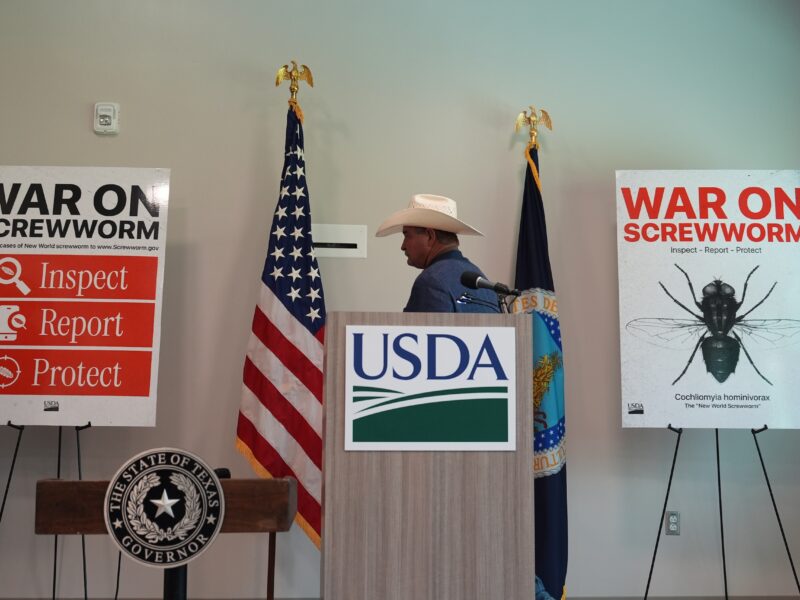
AUSTIN, Texas (CN) — Federal officials leading the charge against the spread of New World screwworms in Texas met with state lawmakers at the state Capitol Thursday to talk strategies on stopping the parasite’s spread.
The meeting before the state’s House Agriculture and Livestock Committee came just two weeks after the first reported case of screwworm was detected in South Texas.
“For Texas, this is no longer a distant concern,” State Representative Ryan Guillen, a Republican from Rio Grande City and the committee’s chairman, said in an opening statement.
“The recent detection and confirmation of 11 cases within our state’s borders has transformed what was once viewed as a foreign pest into a clear and present threat to our livestock industries, our wildlife populations, our companion animals, our landowners, and the rural communities whose livelihoods depend on agriculture and wildlife resources,” he said.
Contrary to its name, New World screwworms are the maggots of flies that feast on the sensitive tissue of livestock, wild animals, pets and, in rare cases, humans. If left untreated, cases can turn fatal.
The U.S. Department of Agriculture’s associate administrator of the Animal and Plant Health Inspection Service, Michael Schmoyer, told the committee that the agency has been working closely with its state partners to increase surveillance of domestic and wild animals.
“Wildlife cases will be reported if detected,” Schmoyer said. “So far, none have been found. This likely supports the evidence that the current population of fertile flies in the United States is very small.”
Regardless of that glimmer of good news, Schmoyer — along with Dudley Hoskins, USDA’s undersecretary of marketing and regulatory programs, and Timothy Schell, director of the U.S. Food and Drug Administration’s Center for Veterinary Medicine — told the lawmakers that much is being done within their agencies to help the state address the spread of New World screwworm.
One tool many of the lawmakers on the panel were interested in was the use of ivermectin, an antiparasitic drug, to bolster animals’ resistance to the larva.
During an earlier panel, Charles Eckel, a partner at Lyssy and Eckel Feeds — an animal feed producer — spoke about the company’s goal to get emergency approval from the FDA to use the drug in feeds for livestock and wildlife.
While complementary to Lyssy and Eckel’s work, Schell expressed trepidation about the idea, saying the FDA has not fully evaluated ivermectin’s use as a feed.
“I’m not saying that ivermectin does not work,” Schell said. “What I’m saying is that we have not fully evaluated it in this particular manner.”
Guillen followed up by asking if using ivermectin in wild animal populations could harm the response to screwworm, to which Schell said it could, due to parasites developing a resistance to the drug.
Lawmakers also discussed the possibility of releasing male screwworm flies that have been sterilized after being irradiated as pupa. Sterilization has been a key method to control screwworm populations throughout North America, including in the late 1960s, when the United States formally declared indigenous screwworms had been eradicated.
Schmoyer repeatedly told the committee that the need for more sterile flies could not be understated. While many projects are underway to increase the U.S. supply of sterile flies, the Screwworm Barrier Maintenance Program in Pacora, Panama — a joint program run by the USDA and Panama’s Ministry of Agricultural Development — has become an ever more important asset for the Lone Star State.
Moreover, private industry has taken note of the need for sterile flies and looked for ways to step in. Nathan Moses-Gonzales, CEO of M3 Agriculture Technologies, a company that specializes in sterilizing pest insects, told the committee that with public and private financial support, his company could increase the supply of sterile flies in the hemisphere.
In addition to hearing from federal and private partners, the committee also heard from the heads of state agencies coordinating the state’s response to New World screwworms.
One message that both the federal and state agency officials had for the general public was to stay vigilant and report any suspected cases.
The USDA’s website providing information on the New World Screwworm directs people in Texas to report possible cases in livestock to the Texas Animal Health Commission and report cases in wildlife to the Texas Parks and Wildlife Department. Anyone who suspects their pet may be infected is encouraged to see a veterinarian.
Earlier in the day, Texas Governor Greg Abbott announced several Texas universities as recipients of grants from the USDA to bolster detection and eradication efforts of the parasitic larva.
“Texas is no stranger to the New World screwworm threat and we are prepared to push this danger out of our state for good,” Abbott said. “These grants will empower Texans on the front lines to eradicate the screwworm and protect our livestock industry.”
As of Thursday, the USDA reported 12 confirmed detections of New World screwworm in seven counties across Texas and one in New Mexico, according to its online dashboard.
 Follow @KirkMcDanie1
Subscribe to our free newsletters
Our weekly newsletter Closing Arguments offers the latest about ongoing trials, major litigation and rulings in courthouses around the U.S. and the world, while the monthly Under the Lights dishes the legal dirt from Hollywood, sports, Big Tech and the arts.