
 Search Articles



PARIS (CN) — Roughly one hour after Iran declared the Strait of Hormuz “completely open” on Friday for the remainder of a two-week ceasefire, European leaders announced a neutral defense mission to secure lasting freedom of passage through the critical shipping route.
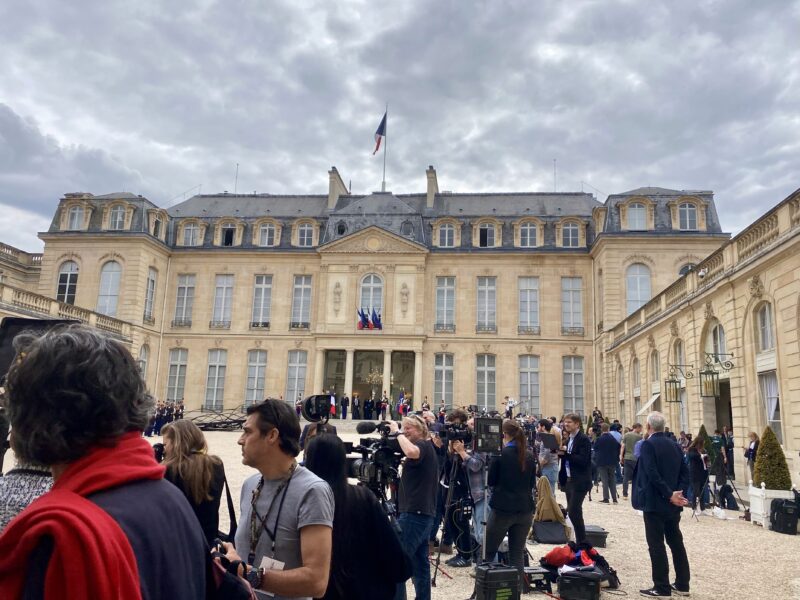
“We welcome the announcement that was made during our meeting, but we need to make sure that that is both lasting and a workable proposal,” U.K Prime Minister Keir Starmer told a crowd of reporters at the Élysée Palace on Friday. “And if anything, it reinforces the need for the work we’ve been doing this afternoon, because we’re very clear that the mission that we’re putting together is a defensive mission that comes after a ceasefire.”
While French President Emmanuel Macron and Starmer were convening 40 countries in a video conference — including EU member states, South Korea, Iraq and others — the Iranian foreign ministry announced passage for “all commercial vessels” will be completely open until April 22, when the current ceasefire with the U.S. and Israel is set to end.
Oil prices dropped and futures markets rose on the news.
U.S. President Donald Trump initially expressed unconditional gratitude over the announcement on Truth Social, before turning to some conditions that would still be imposed on Iran.
“IRAN HAS JUST ANNOUNCED THAT THE STRAIT OF IRAN IS FULLY OPEN AND READY FOR FULL PASSAGE. THANK YOU!” he said, before posting another series of statements minutes later. “[The Strait of Hormuz is] COMPLETELY OPEN AND READY FOR BUSINESS … BUT THE NAVAL BLOCKADE WILL REMAIN IN FULL FORCE AND EFFECT AS IT PERTAINS TO IRAN, ONLY, UNTIL SUCH TIME AS OUR TRANSACTION WITH IRAN IS 100% COMPLETE.”
When Macron addressed reporters Friday, he said although recent announcements indicate things are “moving in the right direction,” the reopening of the strait is still contingent on a route “coordinated by the Iranian authorities themselves,” and the U.S. has indicated it will continue to block Iranian ships.
It’s unclear how any plans will play out. But countries are scrambling to find a solution. When Iran announced the closure of the strait on March 27, it effectively cut off one-fifth of the world’s oil and refined gas supply, and left 20,000 workers stuck on the water.
These numbers hit close to home in Europe on Thursday, when the International Energy Agency’s Executive Director Fatih Birol announced that Europe has maybe “six weeks or so” of jet fuel remaining amid the global energy crisis triggered by the strait’s closure. Airlines like KLM have already canceled scores of flights in response.
On Friday, Macron and Starmer stood alongside Italian Prime Minister Giorgia Meloniand German Chancellor Friedrich Merz to explain how roughly 40 countries have vowed to play a “defensive” role in keeping the strait open, now and in the long run.
“I can confirm that, along with France, the U.K. will lead a multinational mission to protect freedom of navigation as soon as conditions allow,” Starmer said. “This will be strictly peaceful and defensive as a mission to reassure commercial shipping and support buying and clearance … . We invite all nations with an interest in the free flow of global trade to join us.”
Starmer also announced a military planning conference in London next week, when there will be more details about the plan. He said over a dozen countries have already offered to contribute assets.
Marius Stubenhoff, a policy analyst at the Center of European Politics, said it’s unclear how this mission will unfold in the long term, especially because the end of the war would likely imply an opening of the strait.
“If you’re talking about a mission that would be deployed after the end of a war, I still don’t quite understand in what scenario you would need such a mission. I mean, presumably an end to the war would then involve some kind of American-Iranian agreement that would also address freedom of navigation in the Strait of Hormuz,” he said. “I still struggle to kind of see the sort of the rationale beyond the symbolic nature of this.”
Merz expressed broader, more existential concerns in his address on Friday.
“The war must not turn into a translantic stress test,” he said. “If we don’t succeed … then there’s the threat of a multinational global war.”
Merz added that Iran must ensure the strait remains open in a way that is “lasting, secure and toll-free,” and thanked the U.S. for its “apparently successful” efforts brokering a ceasefire.
The European-led operation is partly a response to Trump, who has berated allies for failing to join the war. The president called allies “cowards,” said NATO “wasn’t there when we needed them” and told Britain: “You don’t even have a navy.”
The U.S. president appeared dismissive of offers of help Friday, though he referred to NATO rather than the coalition led by France and Britain.
“Now that the Hormuz Strait situation is over, I received a call from NATO asking if we would need some help. I TOLD THEM TO STAY AWAY, UNLESS THEY JUST WANT TO LOAD UP THEIR SHIPS WITH OIL," he posted on social media. “They were useless when needed, a Paper Tiger!”
When the press briefing concluded, the four European leaders lingered under the tricolored glass ceiling of the Élysée, and Meloni put her arm on Macron’s shoulder. After escorting the leaders out of the palace, Macron turned to reporters.
“We’re making progress!” he said with a thumbs up, before casually walking back inside.
 Follow @lilyradz
Subscribe to our free newsletters
Our weekly newsletter Closing Arguments offers the latest about ongoing trials, major litigation and rulings in courthouses around the U.S. and the world, while the monthly Under the Lights dishes the legal dirt from Hollywood, sports, Big Tech and the arts.
Additional Reads

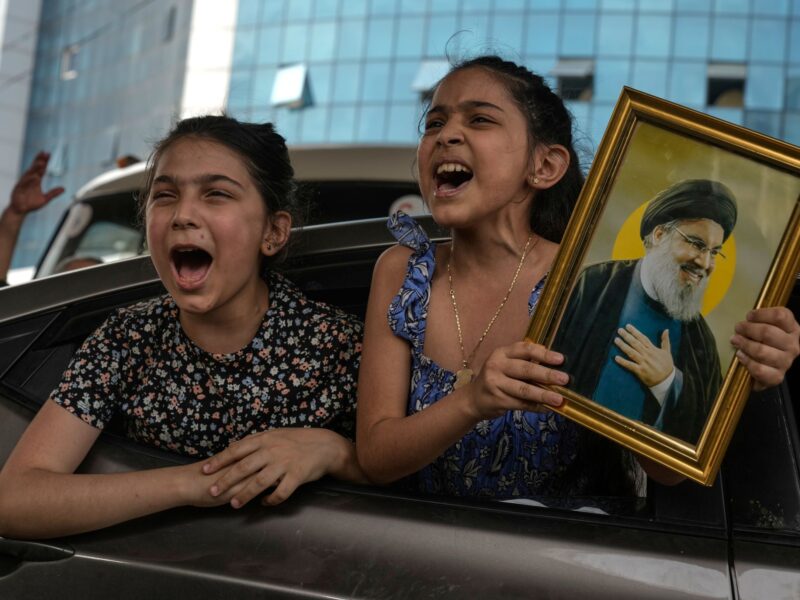 Destruction, hope in south Beirut as Lebanese return home April 17, 2026