
 Search Articles


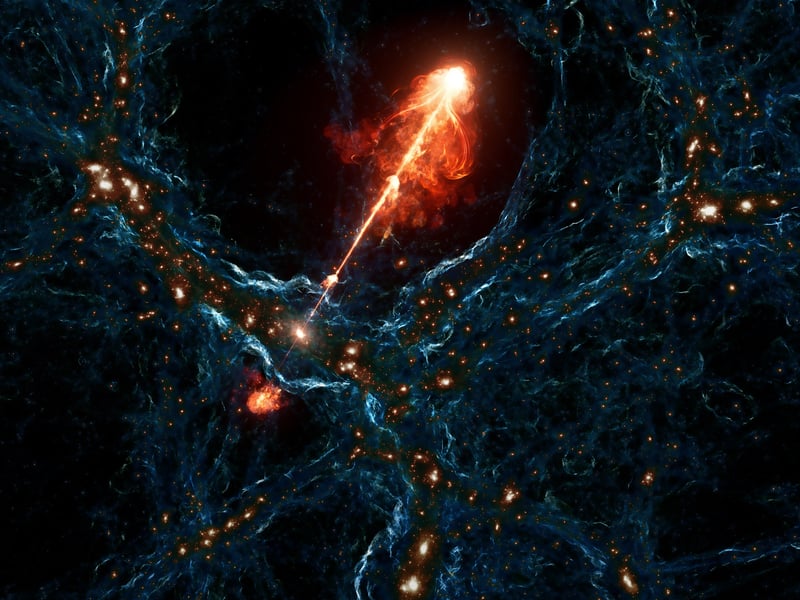
(CN) — Astronomers have found something massive — literally. The discovery takes the form of the largest pair of black hole jets ever recorded, stretching an astounding 23 million light-years across.
Martijn Oei, a postdoctoral scholar at Leiden Observatory and lead author of the paper on the findings published in the journal Nature on Wednesday, explained just how huge the discovery is.
“This pair is not just the size of a solar system, or a Milky Way — we are talking about 140 Milky Way diameters in total,” said Oei in a statement. “The Milky Way would be a little dot in these two giant eruptions.”
The megastructure, nicknamed Porphyrion after a giant in Greek mythology, formed when the universe was still relatively young at around 6.3 billion years old, less than half its current age.
The jets burst from a supermassive black hole at the center of a distant galaxy, with a total power output that could rival trillions of suns.
Before Porphyrion’s discovery, the largest known jet system was Alcyoneus, also named after a Greek mythological giant. Alcyoneus, discovered in 2022 by the same team, spanned about 100 Milky Way lengths, making it smaller than Porphyrion.
Even the well-known Centaurus A jets, the closest significant jet system to Earth, only span 10 Milky Ways by comparison.
These jets are not just big for the sake of being big. Scientists think they may have played a major role in shaping the universe during its younger years.
At that time, the cosmic web — the filaments that connect galaxies — was more tightly woven. Porphyrion’s jets likely spread across vast portions of this web, influencing the formation and growth of galaxies far beyond its own host galaxy.
“Galaxies and their central black holes co-evolve, and one key aspect is that jets can spread huge amounts of energy that affect the growth of their host galaxies and others nearby,” said George Djorgovski, co-author of the study, in a statement. “This discovery shows that their effects can extend much further out than we thought.”
Porphyrion is just one of over 10,000 giant jet systems spotted during a sky survey using Europe’s LOFAR radio telescope. Previously, scientists thought large jet systems were rare, but LOFAR’s wide field of view and high sensitivity has uncovered far more than expected.
Oei’s team first stumbled upon these enormous jets while studying the cosmic web back in 2018. Initially, they were focusing on the faint filaments connecting galaxies. But as they pored over the radio images, they began noticing the long, impressive jets popping up.
“When we first found the giant jets, we were quite surprised,” said Oei. “We had no idea that there were this many.
To pinpoint the origin of Porphyrion’s jets, the team used the Giant Metrewave Radio Telescope in India, along with data from the Dark Energy Spectroscopic Instrument project in Arizona.
They traced the jets back to a galaxy about 10 times more massive than our Milky Way, sitting 7.5 billion light-years away from Earth.
Interestingly, Porphyrion’s black hole was in what’s called a radiative-mode state, which is more common in the distant universe. This was unexpected, as radiative-mode black holes weren’t thought to produce such huge jets.
This revelation opens up the possibility that there could be many more of these colossal systems yet to be discovered.
Looking forward, Oei and his team hope to explore how these jets influence the universe, particularly how they might spread magnetism throughout the cosmos. Understanding this could give us better insight into how conditions that support life — like magnetism — developed across the universe.
As for how these jets remain so stable over such vast distances, that’s still a mystery.
“We may be looking at the tip of the iceberg,” Oei said. “Our LOFAR survey only covered 15 percent of the sky. And most of these giant jets are likely difficult to spot, so we believe there are many more of these behemoths out there.”
Subscribe to our free newsletters
Our weekly newsletter Closing Arguments offers the latest about ongoing trials, major litigation and rulings in courthouses around the U.S. and the world, while the monthly Under the Lights dishes the legal dirt from Hollywood, sports, Big Tech and the arts.