Search Articles


(CN) — Finding a rocky planet in the habitable zone isn’t enough for it to support life as we know it. It also needs an atmosphere.
Astronomers say they’ve detected one for the first time around a rocky world orbiting within the habitable zone of another star.
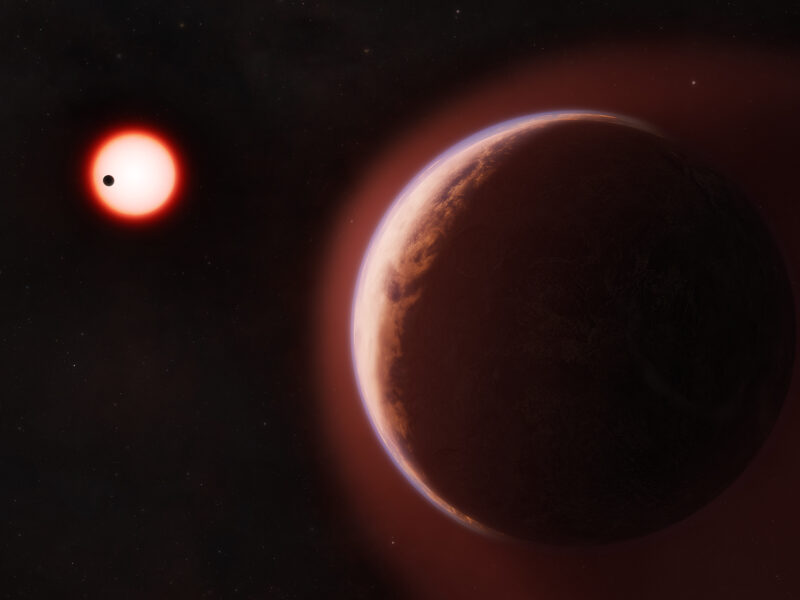
The atmosphere surrounds LHS 1140 b, an Earth-sized planet about 48 light-years away orbiting within its star’s habitable zone, where temperatures could allow liquid water to exist.
Researchers say this discovery, published Thursday in the journal Science, is the strongest evidence yet that rocky planets with Earth-like conditions can retain atmospheres beyond our solar system.
Astronomers have discovered thousands of planets beyond the solar system, including several rocky worlds orbiting within their stars’ habitable zones. But determining whether those planets have atmospheres has remained one of the field’s biggest challenges.
Using the Warm Infrared Echelle, or WINERED, spectrograph at the Magellan Observatory in Chile, researchers detected helium escaping from LHS 1140 b, providing evidence that the planet has an atmosphere that has likely survived for more than 3 billion years.
“An atmosphere is essential for a planet to support life as we know it,” lead author Collin Cherubim said in a news release. “This is the first time anyone has found an atmosphere on a rocky planet in the habitable zone of another star.”
The discovery stemmed from a theoretical model predicting that LHS 1140 b would have an upper atmosphere rich in helium that slowly escapes into space.
To test the idea, researchers observed a rare alignment in which LHS 1140 b and another planet crossed in front of their star on the same night. While the second planet showed no signs of an atmosphere, LHS 1140 b produced the telltale signature of escaping helium.
The finding could also give astronomers a new way to search for atmospheres around distant rocky worlds. Researchers say ground-based telescopes may be able to detect gases escaping from exoplanets, making it easier to identify promising targets for future study.
“Twenty years ago we wondered whether other terrestrial-type planets even existed,” Robin Wordsworth, a Harvard University professor and study co-author, said in the news release. “Then we learned they’re common, and found some in the habitable zone. The next question was whether any of them had managed to keep an atmosphere. Now we know at least one has.”
Researchers say the atmosphere has likely persisted for billions of years, making LHS 1140 b an important target for future observations.
The next step is to determine what the atmosphere is made of and whether the planet has additional features associated with habitability, such as surface oceans. Researchers also plan to use the same modeling approach to search for other rocky planets that may have retained atmospheres.
“This has been a model validation, and hopefully it’s just the first of many more observations to come,” Cherubim said.
Subscribe to our free newsletters
Our weekly newsletter Closing Arguments offers the latest about ongoing trials, major litigation and rulings in courthouses around the U.S. and the world, while the monthly Under the Lights dishes the legal dirt from Hollywood, sports, Big Tech and the arts.