
 Search Articles


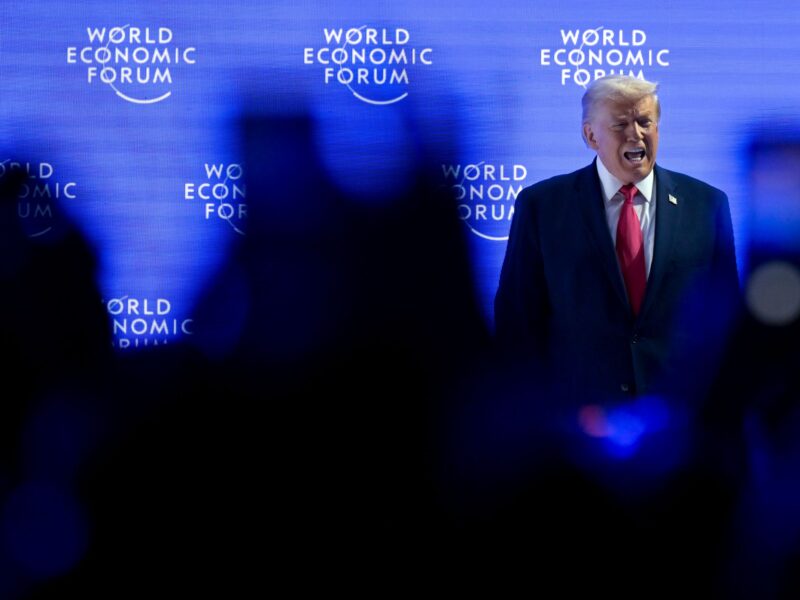
(CN) — In a Wednesday speech at Davos, U.S. President Donald Trump blasted European nations as unreliable and weak NATO allies as he made his case for why the United States should seize Greenland for “world protection.”
However, the president also eased nerves by saying the U.S. would “not use force” to take Greenland away from Denmark. Instead, he called for “immediate negotiations” to begin over America’s acquisition of the world’s largest island.
“I don’t have to use force. I don’t want to use force. I won’t use force,” he said, speaking at the World Economic Forum in Davos, Switzerland.
He added: “We have acquired many other territories throughout our history, just as many of the European nations have acquired [territories]. There’s nothing wrong with it.”
Still, Trump’s antagonistic stance over Greenland, including a threat of tariffs against European countries opposed to America’s seizure of the island, and new expressions of doubt about the worth of NATO likely would only deepen a dramatic rift that’s opened between Washington and Europe.
Playing tough, Trump warned European leaders of serious consequences if they impeded the U.S. from possessing Greenland, a semiautonomous island in the Arctic Circle that is part of the kingdom of Denmark.
“So, we want a piece of ice for world protection, and they won’t give it,” Trump said. “You can say ‘Yes,’ and we will be very appreciative, or you can say ‘No,’ and we will remember.”
To the astonishment and outrage of European leaders, Trump has made seizing Greenland a focus of his foreign policy since he ordered the raid on Venezuela and capture of its leader Nicolas Maduro on Jan. 3.
In going after Greenland, Trump has been widely accused of completely disregarding international law and seeking to usher in a new age of imperial conquest where bigger nations can dominate smaller ones.
Faced with Trump’s Greenland threats, European leaders are speaking forcefully and openly about the possibility, and even necessity, of breaking with the U.S. and ending an alliance that’s endured since World War II.
These misgivings and fears have taken center stage at this year’s Davos, an annual gathering of political and business leaders in the Swiss mountains.
On Tuesday, French President Emmanuel Macron said Europe needed to ask itself whether it wanted to “passively accept the law of the strongest,” “vassalization” and a “new colonial approach” or stand up for “effective multilateralism.”
Canadian Prime Minister Mark Carney, one of Trump’s fiercest critics and leader of the center-left Liberal Party, reflected the state of angst in Davos during a speech Tuesday.
“Today, I’ll talk about the rupture in the world order, the end of a nice story, and the beginning of a brutal reality where geopolitics among the great powers is not subject to any constraints,” he said.
Carney said the “fiction” about the benefits derived from a U.S.-led international rules-based order had been laid bare by a series of crises in finance, health, energy and geopolitics in the past 20 years.
“This fiction was useful, and American hegemony, in particular, helped provide public goods: open sea lanes, a stable financial system, collective security and support for frameworks for resolving disputes,” he said. “We participated in the rituals. And largely avoided calling out the gaps between rhetoric and reality. This bargain no longer works. Let me be direct: We are in the midst of a rupture, not a transition.”
The Canadian leader accused “great powers” of “using economic integration as weapons, tariffs as leverage, financial infrastructure as coercion, supply chains as vulnerabilities to be exploited.”
On Wednesday, Trump doubled down on his criticism of NATO allies for not spending more on defense and he questioned whether they would come to the aid of the U.S. in the event of an attack.
“The problem with NATO is that we’ll be there for them 100% but I’m not sure that they will be there for us,” he said.
He said getting Greenland would be a “very small ask compared to what we have given them for many, many decades.”
Greenland, he said, would play a pivotal role in defending the U.S. from an attack by Russia and China because it would be incorporated into the Golden Dome, a complex missile defense system Trump has proposed building. Experts question this argument, saying the U.S. already has a deal with Denmark that allows it to station more equipment and troops on Greenland.
“The fact is no nation or group of nations is in any position to be able to secure Greenland other than the United States,” Trump said.
In making his pitch, Trump also reached back to World War II and said the U.S. positioned forces on Greenland after Denmark fell to Nazi Germany.
“Denmark knows that we literally set up bases on Greenland for Denmark,” Trump said. “We were fighting to save it for Denmark. Big, beautiful piece of ice. It’s hard to call it land. It’s a big piece of ice, but we saved Greenland and successfully prevented our enemies from gaining a foothold in our hemisphere.”
He said the U.S. was “stupid” to return Greenland to Denmark after the war.
“But how ungrateful are they now?” he said.
Speaking to an audience of mostly Europeans, Trump quipped that without America’s entry into World War II, “you’d all be speaking German and little Japanese, perhaps.”
While saying he “loved” Europe, he portrayed it as “not heading in the right direction” due to weak economies, overreliance on government spending, “unchecked mass migration,” “endless foreign imports” and its support for Green Deal initiatives.
Courthouse News reporter Cain Burdeau is based in the European Union.
 Follow @cainburdeau
Subscribe to our free newsletters
Our weekly newsletter Closing Arguments offers the latest about ongoing trials, major litigation and rulings in courthouses around the U.S. and the world, while the monthly Under the Lights dishes the legal dirt from Hollywood, sports, Big Tech and the arts.