
 Search Articles


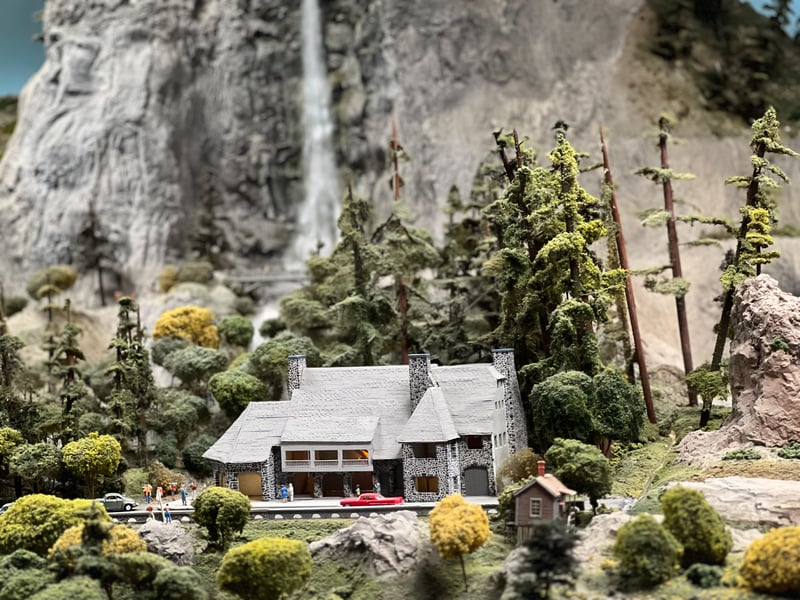
PORTLAND, Ore. (CN) — All around are iconic landmarks of the Pacific Northwest. Crooked River High Bridge. Multnomah Falls. Downtown Portland and the logging routes of Washougal, Washington.
In the real world, it’s geographically impossible to see all these sights at once.
At the Columbia Gorge Model Railroad Club, they’re all steps away. This model train club is the biggest of its kind in the region and one of the oldest in the country, having been founded in 1947.
This club is normally only open to members — but for a couple weeks each year, Portland residents can wander through the immersive layout for a small fee.
The club’s annual open house started last weekend and will run every weekend through Dec. 7. Wedged between hospital campuses and a freeway on North Vancouver Avenue in North Portland, its unassuming white building is designed to look like a train depot.
Passing by outside, few might suspect that the entire Columbia Gorge is recreated in intricate detail within these walls.
One might wonder how that’s even possible.
That sense of wonder is part of the design.
“To me, the hobby is the art,” Mark Hynson, president of the Columbia Gorge Model Railroad Club, said while looming over a miniature amusement park. “The hobby is, how much can you put into two feet? And if the trains aren’t running, what do people have to look at?”
There’s no shortage of things to look at here.
When visitors first walk in, they’re greeted by windowed displays showing model trains through history. And as they step into the main display, detailed replicas of familiar Northwest landmarks fill the pickleball court-sized room.
“Are we fanatical? Yes. Do we need to be committed? Probably,” Hyson said. But “this is stuff that you can’t do at home.”
“I’ve got people who are absolute craftspeople,” he added.
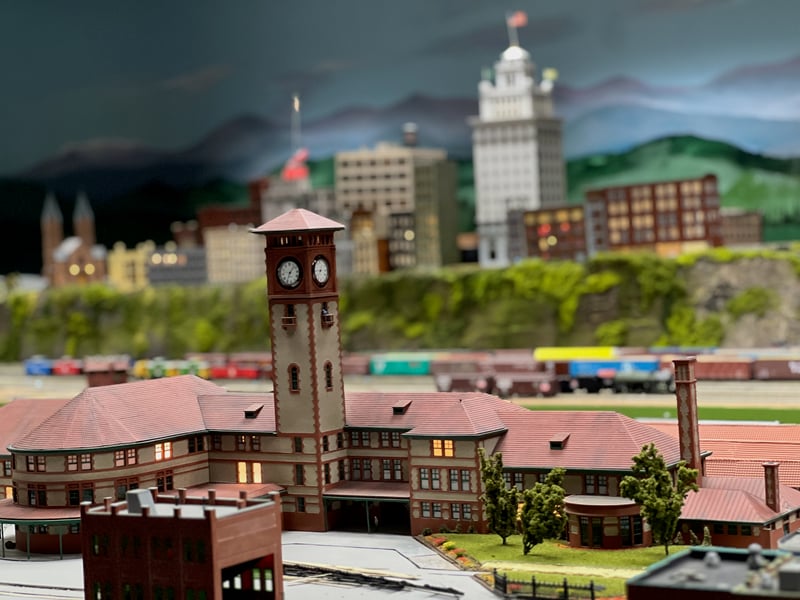
Some club members come from art backgrounds, including the professional architectural modelers who recreated Portland’s Union Station and its eyecatching Romanesque Revival clock tower.
“If there’s ever a fire, you grab that and head for the exits,” Hynson joked.
Other members are simply dedicated hobbyists. The skilled artisan who modeled the Steel Bridge — then equipped it to function just like the real one, with an operational lift — works by day as a doctor.
“Everybody kind of finds their niche,” Hynson said, “or what they like to do.”
Some have just the right skillsets for model railroads. Randy Nelson, a 55-year veteran of the club, joined when he was 18 and spent years working for BNSF Railway as a dispatcher.
Nelson says his career isn’t what drew him to this hobby.
Rather, it was the other way around.
“Oh, I was a train buff before,” Nelson explained. “I’ve had trains since I was three.” He adjusted his blue-and-white striped bib overalls, a calling card for any train enthusiast.
The club boasts upwards of 70 active members. The majority are retired white men — about what one might picture when thinking of a model train club. But leadership wants to appeal to all demographics and has been pulling in a more diverse and (slightly) younger crowd in recent years.
“It’s just nice to have a good cross section of people with different interests,” said Kirk Middleton, the club’s membership director.
The club is also open to kids. With so much to take in here, grabbing their attention isn’t exactly a hard task.
“One of the things I tell parents who’ve got their kids is, membership starts at 12,” Middleton said. “But if you’re not careful, you’ll make an engineer out of them.”
Over the last decade, the Columbia Gorge Model Railroad Club has upgraded its setup from analog to digital. While dispatchers still call the shots from an underneath control room, modern innovations mean the trains can now be controlled by cellphones.
The entire display is modeled to reflect the Gorge as it was in the 1950s, a golden era for railroading.
Middleton, who comes from an engineering background, says it reminds him of simpler times.
“There’s kind of a folk art element to it,” Middleton said. “It’s kind of romantic to look at the caboose.”
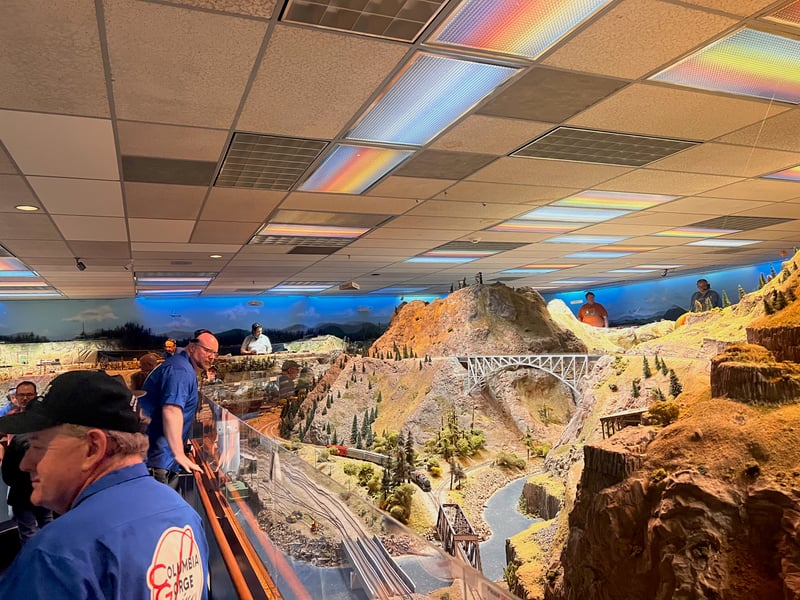
Cabooses have been largely phased out of modern railroading operations. Middleton has to remind himself that in real life, the train operators who used these rear cars had a tough job.
“What was it like for the person who was there 16 hours a day every day?” he said. “As enjoyable as it is for some people, was it a prison, or was it one of those necessities you had to do?”
The model set up shows iconic leisure scenes of the ’50s. Between Multnomah Falls and the Vista House at Crown Point, for example, there’s a drive-in movie theater with a working screen that plays public domain movies. During this year’s open house, tiny motorists can be seen enjoying a screening of ’50s sci-fi flick “Tobor the Great."
Much of the trackage is dedicated not to R&R but to the daily grind of working on the rails. One section showcases timber trains, highlighting an industry that defined Oregon for decades. As model trains tow lumber on the tracks, logs float down a miniature river.
Going forward, the club plans to lean further into these historical elements.
The plan is to transition to a nonprofit, dropping “club” from the name in favor of “historical society.” Hyson, the club’s president, says they’re thinking about “what can we do to provide education to the public about railroading, but more importantly about modeling and stuff like that.”
Upstairs, a club library will be turned into a research center. Among their collection: Every edition of Model Rail Magazine going back to 1941.
Window displays in the entry room will become permanently available as a museum for the public. Although it’s already the biggest club of its kind in the Pacific Northwest, leadership is always looking for ways to further grow and sustain it.
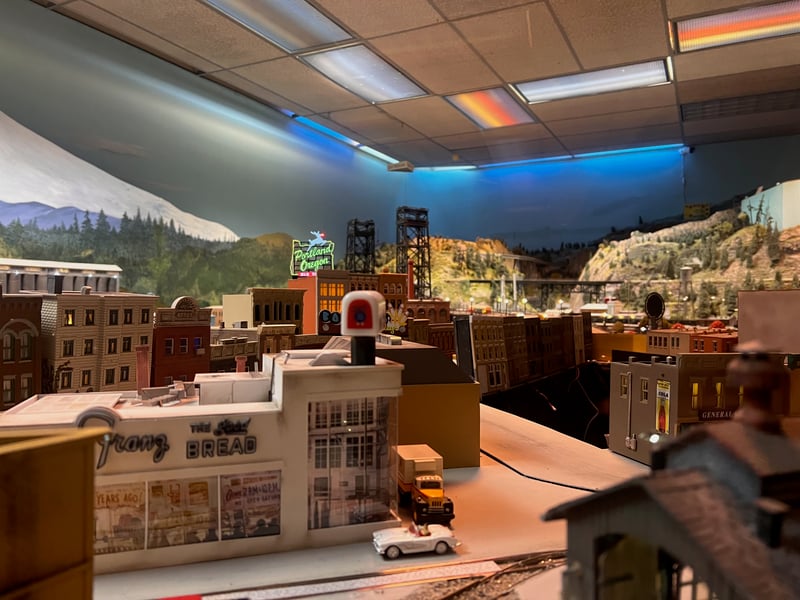
As for the model itself, members are constantly tinkering with the layout, changing the sights in subtle ways. This year, they added a landmark that many Portlanders have no doubt smelled before: the famous Franz Bakery in inner Northeast Portland. (Alas, the aromas of warm, fresh bread could not be easily captured in replica format.)
The changing layout is part of the appeal for repeat visitors like Theo Caldwell, who has been attending the seasonal show for about four years with their boyfriend. There’s always something new to spot, and they were happy to support the club, including by buying lots of train merch at the gift shop.
“ This is a really cool place,” Caldwell said. “It’s nice to see that in an overcorporatized world, a group like this still gets to exist.”
For new visitors like Tricia Forsi, who had come with family including her 4-year-old son, the scavenger hunt was part of the draw.
Each year, members hide easter eggs like Bigfoot and Pikachu throughout the display. Visitors see if they can (to put it in Pokémon terms) catch them all.
In an interview with Courthouse News, the Forsi family had so far found a dinosaur and a Starship Enterprise, the famous spaceship from the “Star Trek” franchise.
“Finding all those was really fun,” Tricia Forsi said.
So detailed in the display, and so constantly is it changing, that even Hynson notices new details — and he’s been a member for 25 years. “I go, ‘What? Did we put that in? Did I notice that before?’”
Subscribe to our free newsletters
Our weekly newsletter Closing Arguments offers the latest about ongoing trials, major litigation and rulings in courthouses around the U.S. and the world, while the monthly Under the Lights dishes the legal dirt from Hollywood, sports, Big Tech and the arts.