
 Search Articles


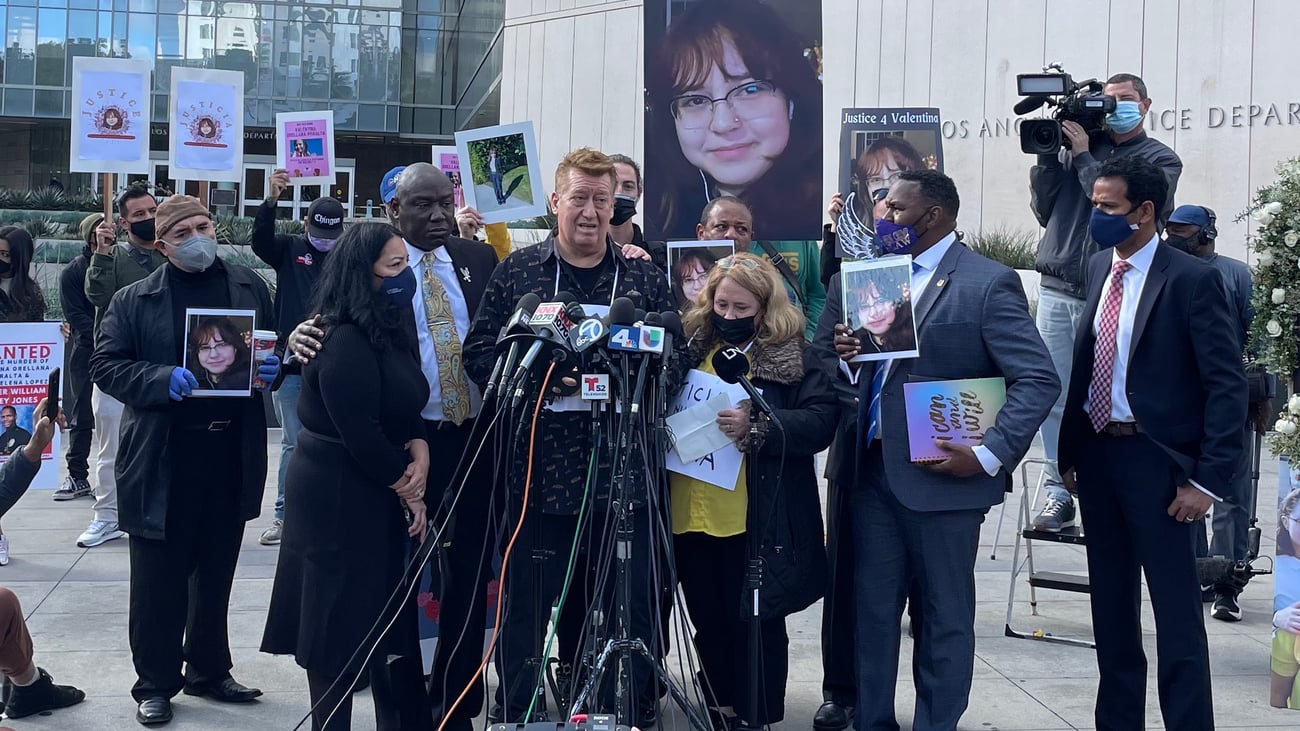
LOS ANGELES (CN) — Attorneys gave closing arguments to a jury Monday in the civil trial over the death of 14-year-old Valentina Peralta, who was killed by a stray bullet from an LAPD officer’s gun in a department store in 2021.
Two days before Christmas, police were called to the Burlington Coat Factory in North Hollywood, responding to reports of a man attacking customers with a bike lock. One of the LAPD officers, William Jones, fired three shots from his AR-15 rifle in quick succession. The first bullet hit the suspect, 24-year-old Daniel Elena-Lopez, in the back, killing him. Another ricocheted off the ground, through the thin wall of a fitting room, and struck Peralta, who died in her mother’s arms. Peralta’s parents are suing the city of Los Angeles, claiming wrongful death and negligence. To win, they’ll have to convince a jury that Jones failed to use reasonable care when he fired his three shots.
Jones testified last month that he thought he was about to confront a shooter and that when he first spotted Elena-Lopez, standing in the aisle, he thought the suspect was holding a gun. In his closing argument, plaintiffs’ attorney Haytham Faraj excoriated Jones for shooting Elena-Lopez on sight without taking time to assess whether or not the man, who had taken off his pants and was holding a Superman poster and a bike lock, posed an imminent threat to customers or the police.
“It wasn’t a mass shooter event until he showed up,” Faraj told the jury, referring to Jones. “He’s responsible for a mass shooting.”
Even if he was justified in taking the first shot, Faraj said, Jones was “negligent” in firing the second two. All three were fired in .65 seconds, he said.
Faraj pointed to Jones’ own testimony, in which he said he “thought the suspect was possibly going to shoot me.”
“Officers can’t shoot someone because they possibly have a weapon,” Faraj argued. “Otherwise, they’d be shooting everyone.”
In his closing argument, Assistant City Attorney Christian Bojorquez praised Jones for “trying to help people, putting himself in a position of peril,” adding, while appearing to get choked up, “He was just trying to do the right thing for society.” At this point, Jones, who has been in court throughout the trial, could be seen wiping tears from his eyes.
Much of the monthlong trial has revolved around video footage from officer-worn body cameras, which was played over and over again throughout the trial, showing different officers’ views of the incident, which lasted mere minutes. The footage shows LAPD officer Michael Mazur, the lead officer at the scene, organize a team of three other officers into a tight diamond formation. He placed an officer holding a shotgun at the tip of the diamond and ordered another officer, who held a less-than-lethal weapon capable of firing specialized rounds like bean bags, to shoot the suspect. Jones and his partner arrived at the scene a few minutes behind the others. Footage shows Jones, holding his assault rifle, rush to the front of the organized formation, taking the point position without being ordered to do so. Mazur and others can be heard shouting “Slow down!” to Jones a number of times.
When Jones sees a customer lying on the ground, with blood smeared on the aisle floor, he shouts, “She’s bleeding! She’s bleeding!” At that moment, body camera footage shows him taking the safety off his weapon.
“That’s when he formed the intent,” Faraj told the jury. “He didn’t evaluate. He decided he was going to shoot when he saw the woman on the ground.”
Bojorquez, though, argued the presence of a bleeding woman changed the equation for the police, rendering Mazur’s initial plan obsolete.
“Things start to change when you hear ‘victim down,’” Bojorquez told the jury. “You can’t look at a case as a vacuum.” He went on to sarcastically mock the plaintiff’s assertion that everything would have been fine if the police had fired a less-than-lethal round at Elena-Lopez, saying everyone would then “join hands, sing and do backflips.”
Bojorquez will finish his closing argument on Tuesday. After that, plaintiff’s attorney Nick Rowley is expected to give his rebuttal argument. Then the case will be in the hands of the jury, which will decide if Jones was negligent, if Elena-Lopez was negligent and if Elena-Lopez’s negligence contributed to Peralta’s death. They will then be asked to assign a percentage of responsibility to each of them.
Should they find Jones at least partially responsible, the trial will move to a second phase to determine the amount of money the city will have to pay the Peraltas, who did not testify in the first part of the trial but will take the stand in the damages phase. Early in the trial, Rowley suggested they will ask for an award of $100 million.
 Follow @hillelaron
Subscribe to our free newsletters
Our weekly newsletter Closing Arguments offers the latest about ongoing trials, major litigation and rulings in courthouses around the U.S. and the world, while the monthly Under the Lights dishes the legal dirt from Hollywood, sports, Big Tech and the arts.
Additional Reads
 OpenAI president testifies in Musk-Altman feud May 4, 2026

