Search Articles


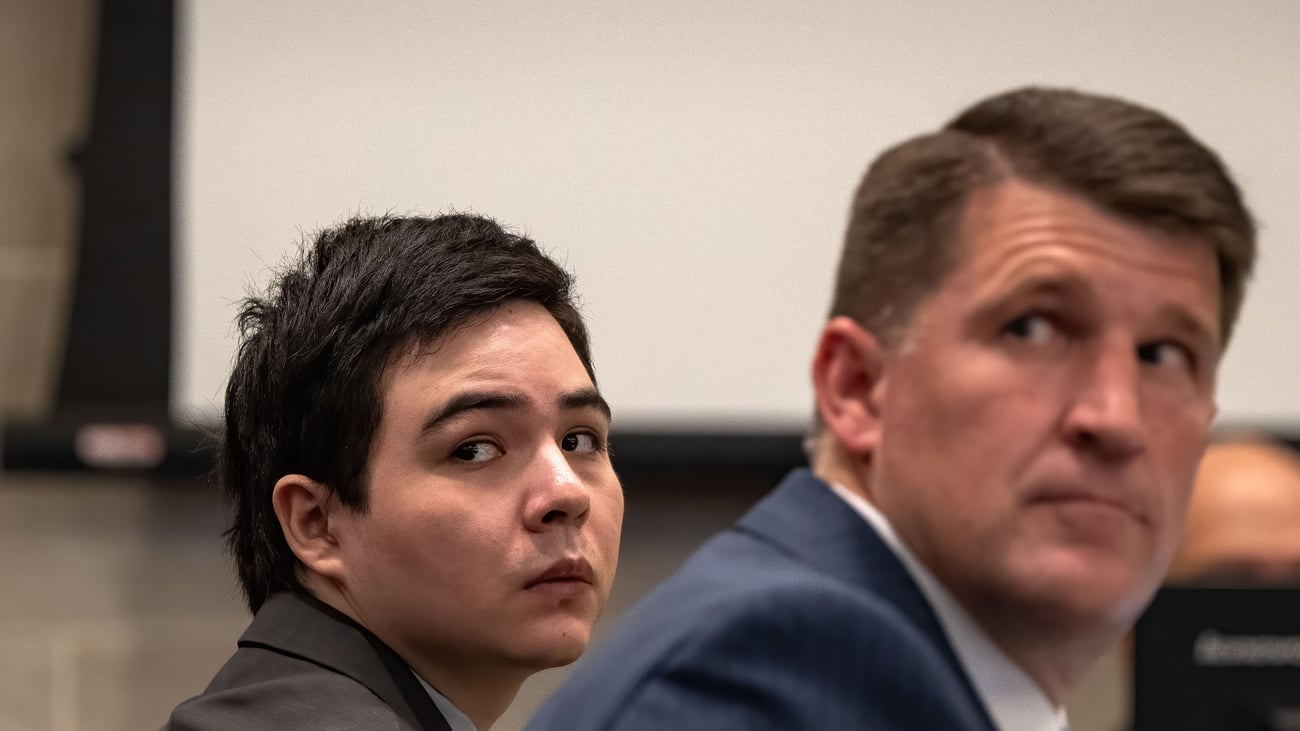
WOODLAND, Calif. (CN) — Attorneys in a high-profile California murder case against a man accused of fatally stabbing two people and injuring a third verbally brawled this week over legal objections as the case nears jury deliberations.
This is the second time Yolo County prosecutors have taken Carlos Reales Dominguez, 23, to trial. Jurors last year acquitted the former UC Davis student of first-degree murder in the spring 2023 slayings of David Breaux, 50, and Karim Abou Najm, 20. However, they reached no verdict on charges of second-degree murder, involuntary manslaughter and the attempted murder of Kimberlee Guillory.
Dominguez has pleaded not guilty by reason of insanity.
The acquittal set the stage for a second trial featuring Dominguez’s former college colleagues, girlfriend and a handful of psychiatric experts testifying over several weeks. Deputy Public Defender Dan Hutchinson has argued Dominguez suffered from schizophrenia at the time and saw “supernatural shapeshifters, shadow people” that he attacked. Prosecutors countered that Dominguez had experienced a cannabis-induced psychosis, and use of the drug sparked his dormant mental illness but that he could still reason at the time.
Closing arguments, heard Tuesday and Wednesday, are set to continue Thursday morning.
Deputy District Attorney Alex Kian in his closing argument pointed to Dominguez’s cannabis use as evidence showing he had goal-directed behavior and organized thought. Kian said Dominguez made choices that led him to the stabbings, including rushing a fraternity a prioritized drugs over academics.
“I would say that was the first bad choice that he made,” Kian added. “He needed guidance, but he didn’t get it. They had ‘High Night.’”
Hutchinson challenged that characterization, calling it a violation of the California Racial Justice Act. The fraternity is predominantly Filipino, though it accepts other nationalities.
Yolo County Superior Judge Sam McAdam agreed with Hutchinson, saying cannabis had a narrow purpose in the case.
Kian in turn said Hutchinson had three times during the trial accused his side of prosecutorial misconduct, at least once in front of jurors. McAdam instructed jurors to disregard Kian’s statement about the fraternity, telling the prosecutor outside the jury’s hearing that he’d need to file a motion about the misconduct claims.
Continuing his closing argument, Kian walked jurors through the details of the stabbings. He pointed to the dozens of stab wounds the victims suffered. He said that after Breaux’s death, Dominguez returned home and made music on his computer.
“But he makes no recollection of the actual stabs,” Kian said, adding later: “He didn’t choose to run away. He chose to attack. Inability to remember doesn’t mean lack of intent.”
Kian added that Dominguez opted to attack Najm, who was on a bicycle, but fled when a nearby resident with a flashlight approached to help the victim in the Davis park.
Dominguez’s organized thoughts again were present when officers arrested him in early May 2023, Kian said. Jurors saw camera footage of that arrest, and the prosecutor pointed to what he called Dominguez’s regular speech with officers. It’s only when later confronted with the stabbings that Dominguez falls silent, the attorney said.
Pivoting to cannabis use, the prosecutor said doctors testified about Dominguez’s marijuana use every day in the weeks before the slayings. Kian compared schizophrenia to asthma — someone can have asthma but feel no symptoms unless they’re near dust.
Dominguez used cannabis, which essentially inflamed his mental illness, Kian argued. However, the drug didn’t remove his ability to make decisions, the attorney added.
Getting his chance to stand before the jury, Hutchinson slammed the prosecution and investigators in the case, calling their efforts “amateur hour.” He expressed surprise that Kian only mentioned schizophrenia near the end of his argument.
That happened because prosecutors wanted the jury to believe Dominguez was healthy at the time of the slayings, he added.
“Carles Reales Dominguez has schizophrenia,” Hutchinson said. “This is not a close question.”
That mental illness was is key to understanding Dominguez’s intent — a critical element to secure a conviction. Someone must intend to kill a human, not a shadow shapeshifter, to be convicted of murder, Hutchinson said.
The public defender also caustically dismissed the prosecution’s arguments about his client’s cannabis-induced psychosis. According to Hutchinson, that theory came from prosecutors, not doctors.
In fact, it was only last autumn that a psychiatrist and four prosecutors discovered this “missing piece,” that Dominguez’s cannabis use spurred his psychosis, Hutchinson said.
“At the time of the charged offenses, he actually had ‘Reefer Madness,’” he added, referring to the 1930’s anti-marijuana movie. “This is the argument they gave you in this case.
Three medical experts determined Dominguez suffered from psychosis at the time of the slayings, Hutchinson said. He experienced delusions and hallucinations at the time.
Prosecutors kept emphasizing the number of stab wounds the victims suffered because of their brutal nature, the defense attorney said. But those wounds, and details like Dominguez’s ability to sometimes speak rationally or buckle a seat belt, don’t mean prosecutors proved the case beyond a reasonable doubt, Hutchinson said.
“This is a case for people who will follow the law even when it’s difficult,” Hutchinson told jurors. “And what does the prosecution have? The number of stab wounds.”
Subscribe to our free newsletters
Our weekly newsletter Closing Arguments offers the latest about ongoing trials, major litigation and rulings in courthouses around the U.S. and the world, while the monthly Under the Lights dishes the legal dirt from Hollywood, sports, Big Tech and the arts.