
 Search Articles


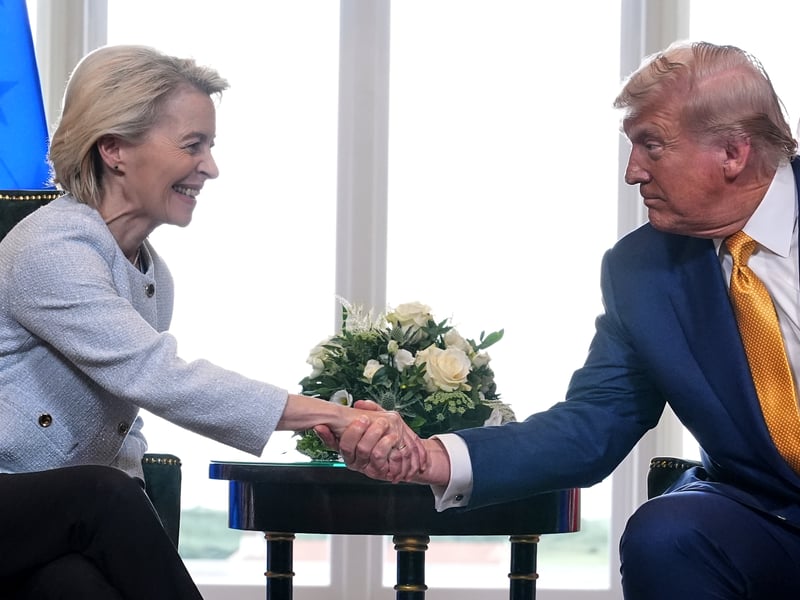
(CN) — The optics were terrible: Ursula von der Leyen, the European Union chief, flew to Scotland on Sunday and put on a brave face as she shook hands with President Donald Trump and agreed to a trade deal that, on the face of it, saw Europe fold.
The backdrop was humiliating: She met Trump at a luxury golf course the billionaire and anti-EU American president owns in Scotland. It was bad enough that she was at his private resort and it really stung that she was in Great Britain, the country that abandoned the EU with Brexit.
To top it off, the deal’s contents were very hard to stomach for Europeans: They agreed to let the U.S. slap a 15% tariff on most goods from the EU without retaliating in kind and they pledged to spend oodles of money ($1.35 trillion) on American natural gas, crude oil and advanced weapons in coming years.
As for optics, the score was clearly Trump 1, EU 0.
But opinions are divided about what Sunday’s deal will actually mean in the long term when it comes to geopolitics and economics and which side may, at the end, say it came out ahead. Nonetheless, there’s general consensus on one outcome: All sides are bound to lose because Trump’s tariffs policy makes for bad economics.
“It’s a bad deal, but it’s the best deal the EU can get in bad circumstances,” said Scott Lucas, a professor of international politics at University College Dublin, in a telephone interview.
Faced with Trump’s unpredictable bullying tactics and the EU’s reliance on the U.S. export market, many experts said the EU chose to avoid a deeply damaging trade war and appease Trump. Trump was threatening to impose 30% tariffs on August 1 unless the EU struck a deal. Currently, EU goods face on average a 4.8% tariff in the U.S.
“Trump operates an extortion racket,” Lucas said. “Sometimes when you deal with an extortion racket, you got to give some ground …. The EU’s played for time, it’s accepted that it has to take some damage economically.”
But he said Europe’s decision to bite the bullet shouldn’t be viewed as a capitulation.
“Sometimes you have to pay a bit of protection money in the short term while you find your security elsewhere,” he said.
He said Trump’s disruptive tariffs policy is forcing the rest of the world to look beyond the U.S. for new markets and alliances.
“What these tariffs have done, what Trump has done, is that you’re getting a realignment of economic relationships,” he said.
He pointed to last week’s landmark trade deal between the U.K. and India to lower tariffs. The EU is eyeing new trade deals too, including with India, Canada and Australia.
“Companies are realigning because they know they might have to deal with the U.S. being a damaging force economically,” he said. “You have to find partnerships elsewhere. That’s what the EU is also going to be doing.”
Others, though, saw the EU as surrendering too much.
On Monday, a chorus of European leaders, politicians, business leaders, experts and commentators decried the deal as a major defeat for the EU that exposed its weaknesses as an overly divided and cautious 27-member bloc dependent on U.S. military might and crippled by feeble economic growth.
“It is a dark day when an alliance of free peoples, united to affirm their values and defend their interests, resolves to submission,” French Prime Minister François Bayrou said on social media, reflecting deep misgivings in France over the deal. Spanish Prime Minister Pedro Sanchez echoed that sentiment, saying he accepted the deal “without any enthusiasm.”
Mark Vail, a political economist and Europe expert at Wake Forest University, said the EU should have been tougher in dealing with Trump, for instance by threatening to hit back against American companies that make huge profits in Europe through technological and financial services.
“This is a capitulation by the EU that will serve neither its economic interests nor its political ones,” Vail wrote in an email. “The EU had leverage that it did not use.”
He said many EU states wanted a deal to reduce uncertainty and avoid “worse outcomes.”
“But they really allowed themselves to be bullied without pushing back much on American pain points,” he said. “They had a lot more latitude than it appeared and chose not to use it.”
He said entering the deal showed the EU remains shackled by a “least-common-denominator politics.” By failing to fight back, he said the EU may have exposed itself to further attacks by Trump.
“There’s zero reason to assume that this ‘deal’ will stick,” he wrote. “It won’t stop here — once Trump identifies weakness (which is what I think this move reflects), he will likely prey on it.”
The details of the deal still have not been released and it remains uncertain whether there is agreement on key areas, including whether the U.S. may still impose higher tariffs on pharmaceuticals and semiconductors.
The EU also said both sides agreed to not impose tariffs on a “number of strategic products,” including all aircraft and component parts, some chemicals, certain agricultural products, natural resources and critical raw materials. However, Trump’s move to place 50% tariffs on steel and aluminum will remain.
Trump and his economic team believe tariffs are needed to revitalize American manufacturing and remedy America’s massive and unparalleled trade deficit, which reached $918 billion in 2024, according to U.S. data. Trump has even said the word “tariff” is one of his favorites, right after “God, religion and love.” During his presidential campaign, Trump repeatedly pledged to tax imports and end what he views as unfair trade relations.
The trade relationship between the EU and the U.S. is the largest in the world, standing at about $1.55 trillion in 2023 when both goods and services are combined, according to EU figures. Added to that are huge investments European and American companies have made in each other’s markets, amounting to more than $5 trillion.
But the EU sends far more goods — cars, machines, wine, bicycles, pharmaceuticals and more — to the U.S. than it imports from America, and that is Trump’s main bone of contention. In 2024, the EU had a goods surplus worth about $235.6 billion, according to data from the U.S. Census Bureau.
However, the trade deficit shrank to $125 billion in 2023 when services, including financial, technological, legal, accounting and engineering work, were taken into consideration, U.S. data shows. The U.S. had a $76.5 billion surplus when it came to services sold in the EU, according to U.S. figures.
But most economists say tariffs are not going to be the panacea that Trump describes and in fact do much the opposite — they hurt America’s economy.
Lorenzo Codogno, an economist at the London School of Economics, said that U.S. consumers “will bear the brunt of the costs through higher inflation and reduced disposable income” if Trump stubbornly carries through with his tariffs policy.
“EU exports are expected to decline, but not massively,” he wrote in a briefing note. “Therefore, Europeans should not be overly worried about the misguided 15% tariffs that have just been negotiated.”
Unlike in the past, he said European exporters may be inclined to not absorb the cost of tariffs by reducing profit margins because their competitors around the world also are facing higher tariffs as Trump turns the U.S. into a protectionist state.
“The incentive for U.S.-bound exporters to lower prices to offset higher tariffs is minimal this time,” he said. “All exporters to the U.S. will encounter tariffs to varying degrees, placing them in a similar position, meaning no one has a massive competitive edge (with possibly the negative exception of China).”
He said the main competition to European companies will be from U.S. producers, but he doubted whether American businesses will be able to replace that many imported goods with domestic ones.
“I believe this ability is limited, at least in the short term,” he wrote, estimating that less than 10% of imported goods would be replaced by domestic production.
“The bottom line is that for the remaining 90% of goods unlikely to be replaced by domestic production, consumers will probably bear the cost of higher tariffs,” he wrote.
He said Trump’s tariffs will end up hurting American consumers as prices go up.
“EU exporters may experience a slight reduction in export volumes, but the impact on their profit margins is expected to be limited,” Codogno said. “So, there’s no need to panic.”
Lucas said Trump’s tariffs are badly misguided.
“There is no economic rationale here that this is going to wind up rebuilding the American automobile industry or the American steel industry,” he said. “It’s absolute nonsense.”
For example, cars made in the U.S. will end up being more expensive because so many components, including steel and aluminum, come from outside the country, he added.
Since the end of World War II and the advent of an international trading system, the point was to make global trade easier and more profitable, he said.
“That’s not the way the Trump administration operates,” he said. “What is unprecedented is that it is effectively a deal which is not on the basis of a win-win for trade. It’s on the basis of an extortion racket …. It is a lose-lose deal and that needs to be emphasized.”
“It’s first and foremost a loss for American importers, for American manufacturers, for American consumers because they’re going to have to pay more,” he said. “European companies don’t pay the tariffs, that’s a falsehood, but the demand for their products can decrease, so it’s a loss for them too, their prices may go up in the U.S.”
But he said European leaders, who are largely opposed to Trump, may wind up benefiting politically because he believes the U.S. tariffs will backfire.
“They’re realizing that it’s Americans that are going to get hit,” he said about European leaders. “It is going to increase American inflation. It’s going to, I think, prevent the U.S. from lowering interest rates. It’s going to cause economic pain and that, of course, would hurt Trump politically.”
Courthouse News reporter Cain Burdeau is based in the European Union.
 Follow @cainburdeau
Subscribe to our free newsletters
Our weekly newsletter Closing Arguments offers the latest about ongoing trials, major litigation and rulings in courthouses around the U.S. and the world, while the monthly Under the Lights dishes the legal dirt from Hollywood, sports, Big Tech and the arts.