
 Search Articles


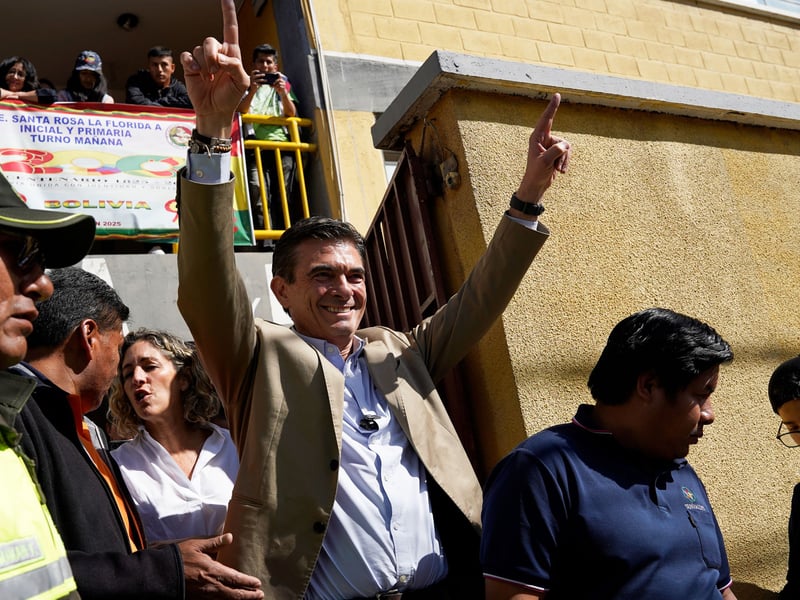
(CN) — Bolivia’s 20-year cycle of socialist governments, which defined an era in South American progressive politics, came to a close after Sunday’s elections in the Andean nation, where the left-leaning candidates lagged behind their centrist and right-wing rivals.
Jorge “Tuto” Quiroga, 65, a former right-wing president, will face Rodrigo Paz Pereira, 57, a centrist senator with a hybrid agenda, in a runoff Oct. 19. The next president will take office Nov. 8.
The center‑left Movement Toward Socialism, or MAS — in power for nearly two decades — suffered its worst showing in years. MAS candidate Eduardo del Castillo garnered barely over 3 % of the vote, and Senate President Andrónico Rodríguez received only about 8 % despite significant support from former MAS leaders, effectively shutting the party out of contention.
In a historic high, about 20% of the votes cast were blank or null, as supporters responded to a call from MAS’ founder, former President Evo Morales, to spoil their ballots as a rejection of the round’s legitimacy after he was barred from running.
A loss for the MAS candidate and its left-wing alternatives was foreseeable, but Paz Pereira’s result— finishing first with nearly 33% of the vote, according to preliminary results— came as a surprise. An economist and son of former President Jaime Paz Zamora, a leftist leader who later became an ally of the dictator Hugo Banzer, Paz Pereira has served as mayor of Tarija and a local legislator.
A critic of MAS and Morales, he was seen as less conventional than his right-wing competitors — Quiroga, who with 26% also made the runoff, and Samuel Doria Medina, a businessman who was expected to perform better but was eliminated from the race and endorsed Paz Pereira on Sunday night.
“Our project is for all Bolivians, because we want reconciliation and production for our country,” said Paz Pereira in a speech Sunday night after the preliminary results were in. “We want to produce change for that economy belongs to the people, and not the state.”
Hard to fit in general categories, Paz Pereira gained popularity among Christians and Evangelicals, as well as key rural indigenous areas that used to lean socialist. His agenda is a hybrid spanning from conservative to progressive ideas with a moderate tone but the proposal to change Bolivia radically.
“His win is a punishment to MAS, its fractions, and Doria Medina and Quiroga,” said Natalia Aparicio, a Bolivian political analyst. Voters who chose his ticket, she said, supported his vice president — Edman “El Capitan” Lara, a former policeman who was booted from the institution after he denounced internal corruption.
“The police is the most widely criticized institution in Bolivia,” said Aparicio. Therefore, Lara appears as a popular character who gained traction over social media, making viral content on TikTok of himself campaigning across the country, touring areas unreached by many candidates.
Their ticket capitalized on the vote of those who felt orphaned politically after the decay of MAS: It stood out as the most unorthodox among a largely orthodox conservative field, yet still remained relatively close to traditional politics. In fact, Paz Pereira ran as a senator in Quiroga’s party in 2014.

According to the preliminary results, Paz Pereira’s Christian Democratic Party will also have the lead in the lower house and the Senate, followed by Quiroga’s force. Few seats were left for the opposition parties, who will most likely struggle in the upcoming legislative session.
MAS has faced years of fragmentation and decline following successive political crises and deepening internal conflict between Morales and the incumbent president, Luis Arce, Morales’ former economy minister and handpicked successor.
Despite low unemployment — 3.1% as of March — Bolivia continues to grapple with deep-rooted economic challenges. Nearly 40% of the population lives below the poverty line, a figure that reflects long-standing structural inequality despite past gains under socialist governments.
While Quiroga proposes a more neoliberal, orthodox economic agenda — including taking a loan from the International Monetary Fund — Paz Pereira focused his proposal on increasing efficiency and registered work, which remains at low levels across the country. A popular capitalism, in his words, with patches of moderate to conservative ideas.
The current leadership recently lost control of inflation, which surged from 2% last year to 25% this year, fueling economic turmoil. The deepening crisis is marked, too, by severe shortages of fuel and foreign currency. This economic instability has strengthened opposition voices and alienated the MAS supporter base, which, weakened by internal divisions, has fractured, splitting its votes among right-wing candidates, spoiled ballots, and leftist alternatives that no longer capture the once-dominant socialist voters in the country.
Morales blames Arce for his disqualification and political persecution in connection with a sexual abuse case, which has led the cocalero leader to retreat to his tropical stronghold in the Chapare region, where he is originally from.
Now officially out of the race, there’s evidence that the MAS infighting led to a general fatigue toward traditional politics.
“Bolivia has, in a way, followed the global trend of voting for political outsiders,” said Aparicio. “But ours is more centrist than the rest.”
Courthouse News reporter Lucía Cholakian Herrera is based in Buenos Aires, Argentina.
 Follow @luciacholakian
Subscribe to our free newsletters
Our weekly newsletter Closing Arguments offers the latest about ongoing trials, major litigation and rulings in courthouses around the U.S. and the world, while the monthly Under the Lights dishes the legal dirt from Hollywood, sports, Big Tech and the arts.