
 Search Articles


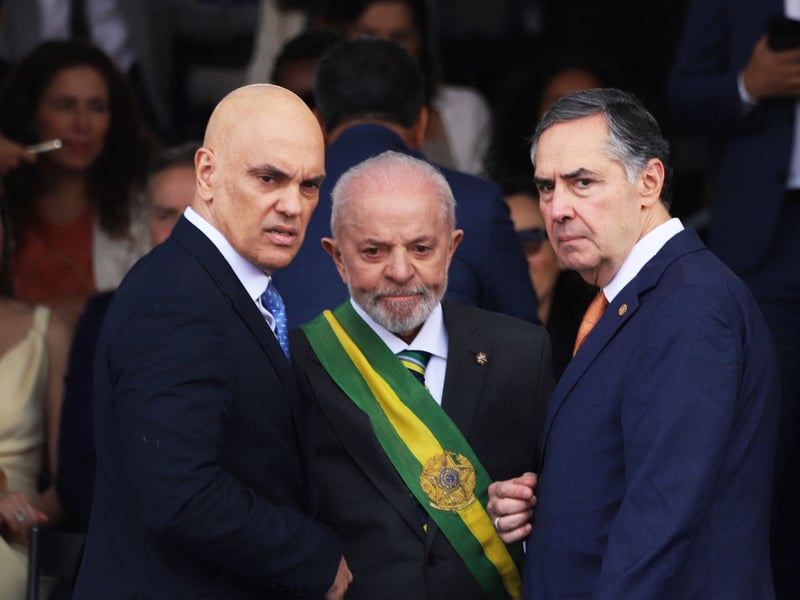
RIO DE JANEIRO (CN) — A controversial hike in Brazil’s federal tax on financial transactions can proceed after a Supreme Court justice upheld a presidential decree raising the revenue-boosting measure, known as IOF. The ruling came a day after a conciliation hearing between the executive, legislative and judicial branches ended without agreement.
Wednesday’s injunction reinstated nearly all provisions of the decree issued by President Luiz Inácio Lula da Silva on May 22, which Congress overturned on June 25. It also has retroactive effect, meaning transactions made since the congressional repeal must now be taxed under the new, higher rates.
“The federal Constitution grants the president the power to issue a decree modifying IOF rates, as it is a crucial instrument for regulating the financial market and monetary policy, provided it strictly adheres to legal limitations,” Justice Alexandre de Moraes wrote. “After the submission of the requested information and the arguments presented during the conciliation hearing, no evidence was found of any misuse of power in the president’s decision to raise the rates.”
The only exception was a government attempt to tax a type of reverse factoring transactions known locally as “risco sacado.” In this arrangement, a supplier receives upfront payment from a financial institution for a sale made on credit, and the buyer repays the bank later. Moraes found that such transactions do not constitute traditional credit contracts and therefore cannot be taxed without explicit legal provision.
“The decision reaffirms the limits of the executive’s regulatory authority and the legislature’s power to annul acts that overstep those boundaries,” said Caio Ruotolo, a tax attorney and partner at Silveira Advogados in Rio de Janeiro, and an alternate judge on São Paulo’s State Tax and Fees Court.
Moraes’ ruling will be reviewed by the full court, though no date has been set for a final decision. According to Cristiano Araújo Luzes, a tax attorney and partner at Serur Advogados, the justices may still rule on how to handle the retroactive tax effect, which affects transactions from recent weeks.
“The justice was consistent with the reasoning behind his ruling,” Luzes said. “The problem is that the Federal Revenue Service can now charge IOF on transactions that have already occurred. Since the tax is levied on financial institutions, they may pass it on to customers, who are likely not expecting it. To me, this is the cost Brazilian society pays for the legal battle between the executive and legislative branches.”
The interim ruling is a partial win for the federal government, which is seeking to boost revenue and meet its target of zero fiscal deficit in 2025. With the injunction in place, the new IOF rates apply to international credit card purchases, corporate loans, foreign currency purchases, investment funds and other operations.
However, the exclusion of “risco sacado” affects a sizable portion of the expected revenue. According to the Finance Ministry, taxing that type of transaction would have brought in $90 million in 2025 and $700 million in 2026 — roughly 10% of the projected total under the decree.
The IOF dispute comes amid growing fiscal pressure. Treasury Department estimates show the government will need to raise $17.26 billion in extraordinary revenue to meet its 2026 fiscal target. That number rises to $21 billion in 2027 and $35.14 billion in 2028. Even with current revenue measures, official projections show gross public debt could reach 84.3% of GDP by 2028.
Lawmakers argued that the IOF hike was driven by fiscal, not regulatory, motives and insisted that Congress has the authority to strike down executive decrees that exceed their legal scope. The federal government, in turn, claimed the congressional repeal violated the separation of powers.
Luzes noted that Congress could still introduce a bill to redefine the limits of executive power over IOF rates but warned that such a move would not be simple.
“Congress would face the political burden of justifying this reduction in the legal tax base, in addition to going through the legislative process,” he said. “In my view, Justice Alexandre de Moraes is reinforcing the rules of the game and now opens the door for a more appropriate institutional debate within Brazil’s legislature.”
Subscribe to our free newsletters
Our weekly newsletter Closing Arguments offers the latest about ongoing trials, major litigation and rulings in courthouses around the U.S. and the world, while the monthly Under the Lights dishes the legal dirt from Hollywood, sports, Big Tech and the arts.