Search Articles



BARBACENA, Brazil (CN) — Twenty-five years after Brazil adopted a landmark psychiatric reform law, a 21-year-old man accused of stabbing his mother to death has spent weeks in a jail waiting for a bed in the kind of institution the country’s judiciary is now seeking to close.
Arrested May 23 and held in Barbacena, he became the first case in the city of about 130,000 people in the southeastern state of Minas Gerais to test how local authorities would implement a national policy replacing forensic psychiatric hospitals with treatment through the public health system.
In Brazil, people with mental illness are not usually identified to protect their privacy.
A court opened a mental competency proceeding June 2 to assess whether he can be held criminally responsible. Prosecutors requested his temporary hospitalization, but the transfer depends on the Minas Gerais Justice and Public Security Department making a bed available. A psychosocial evaluation is scheduled for Friday.
He remains jailed while a judicial program for people with mental illness in the criminal justice system coordinates his care with Barbacena’s health services.

The case exposes a national impasse over National Council of Justice Resolution 487, adopted in 2023, which ordered the gradual closure of forensic psychiatric hospitals. It also requires people with mental illness who enter the criminal justice system to receive treatment through the public health system rather than in institutions that function as both prisons and psychiatric hospitals.
Brazil’s Psychosocial Care Network includes primary care facilities, community mental health centers, therapeutic residences, community centers and mental health beds in general hospitals.
The policy is grounded in 2001’s Law 10,216, which redirected mental health treatment and prohibited hospitalization in asylum-like institutions.
Resolution 487 also requires periodic reviews of court-ordered treatment and individualized care plans. Hospitalization should be based only on clinical need, last for the shortest possible period and preferably take place in general hospitals.
Four challenges to the resolution remain pending before Brazil’s Supreme Court. Justice Flávio Dino requested additional time to review the cases in July 2025 and returned them for judgment in November. The court’s press office said there is no date for proceedings to resume.
The young man’s arrival in the system has shown the procedures envisioned by the resolution have not been defined in Barbacena.
Gustavo Ferreira de Souza, Barbacena’s health secretary, said community mental health centers lack specialized teams to evaluate people accused of crimes who may be experiencing psychiatric crises.
“How is this going to work? What is the procedure?” Souza said. “I don’t have a ready answer because this discussion began now, with this first case.”
The legacy of Hospital Colônia
The uncertainty is unfolding in a city that has occupied a central place in the history of Brazilian psychiatric care for more than a century.
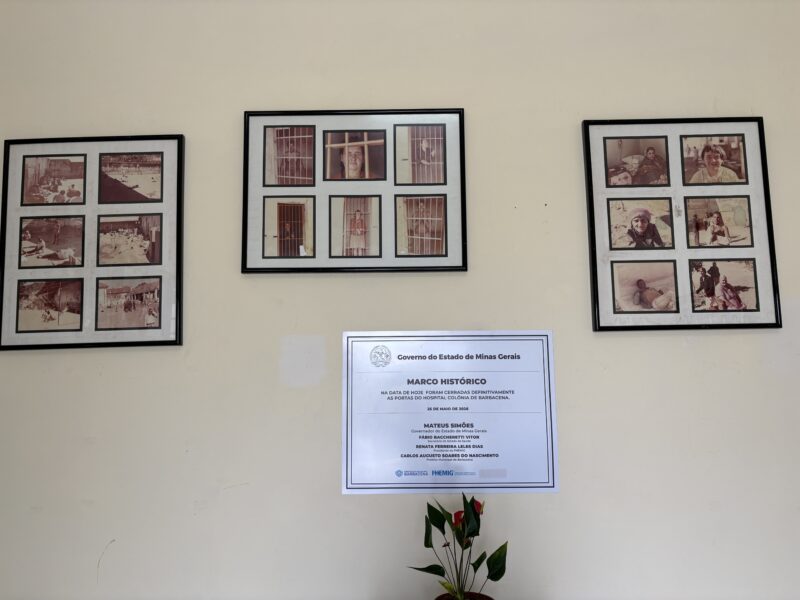
Barbacena Psychiatric Hospital Center still bears traces of its past as Hospital Colônia, where thousands of people were separated from their families and society. A study based on admission records counted 91,911 patients between 1903 and 1979.
On May 25, 14 remaining residents were transferred to a city-managed facility, marking the definitive end of its asylum model. Their departure completed a deinstitutionalization process that began decades earlier.

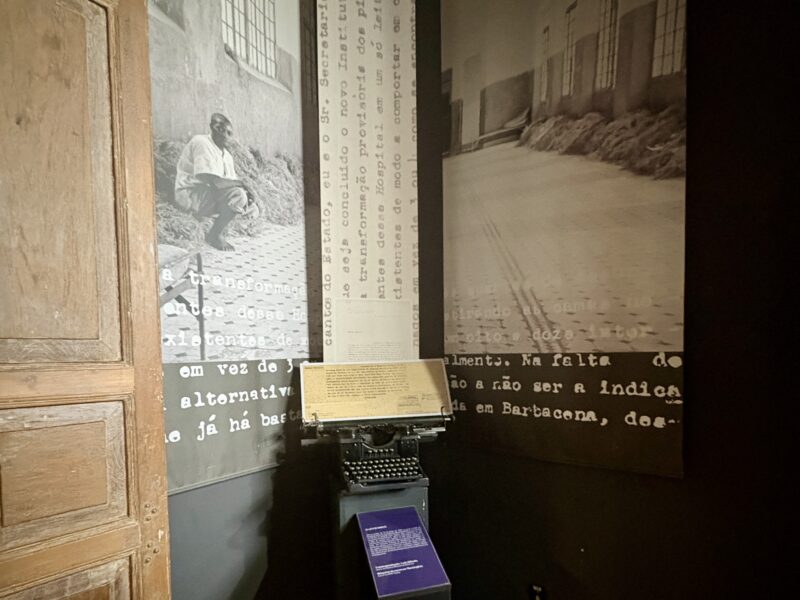
Within the hospital complex — which now operates as a general hospital, research center and teaching hospital — the Museum of Madness exhibits blue uniforms once worn by Colônia patients, electroshock equipment, large kitchen pots and documents related to the sale of corpses.
Another exhibit features a letter from a former state health secretary recommending the adoption of a “single-bed system.” The response to overcrowding consisted of removing beds and replacing them with grass spread across the floor, where patients slept without clothing even during Barbacena’s winter, when average temperatures are close to 55 degrees Fahrenheit.
In 1979, Italian psychiatrist Franco Basaglia, whose work led to the closure of psychiatric institutions in Italy, visited the Colônia and compared it to a concentration camp. News reports, books and documentaries later turned Barbacena into a national symbol of psychiatric abuse.

Cidinha Umbelino began working at the hospital at 18 and will complete 47 years there in August. The nurse said the abuses and overcrowding cannot be separated from government neglect and the conditions faced by workers.
“This was created to be a place that cared for mental health, and it ended up overcrowded,” Umbelino said. “Nobody talks about how this happened because of neglect and the government’s failure to take responsibility. They say it was our fault. It wasn’t.”
Umbelino acknowledged that care was poor at times, but said too few employees were responsible for hundreds of patients.
“I worked in a unit with 600 people, and there were three of us,” she said. “It is time for someone to report that this hospital did not only mistreat people, kill people and sell bodies. Since psychiatric reform began, we were always guiding this place toward where it eventually arrived.”
Waldir Damasceno, 73, coordinator of Barbacena’s municipal museum, has lived in the city since he was 7 and helped establish the first version of the Museum of Madness. At the time of its creation, some residents feared the museum would reinforce Barbacena’s stigma as Brazil’s “city of the mad.”
He said the label had become inseparable from the city’s history.
“I am not ashamed,” Damasceno said. Preserving that history, he said, is necessary to prevent such abuses from happening again.

Judicial and historical continuity
On June 3, Dino granted an injunction requested by Minas Gerais prosecutors, allowing new admissions at the Jorge Vaz Forensic Psychiatric Hospital in Barbacena and the Medical and Forensic Support Center in Ribeirão das Neves. Dino limited his ruling to the two hospitals and did not suspend the resolution elsewhere in the state.
The Minas Gerais Justice and Public Security Department denied Courthouse News access to the Jorge Vaz hospital, citing security concerns. The department declined a full interview but said it continues to comply with court orders governing the treatment of people in custody who need mental healthcare.
The closure of the Colônia and the continued operation of the Jorge Vaz hospital place two stages of Brazil’s psychiatric reform side by side.
Flávia Vasques, Barbacena’s mental health coordinator, said closing the Colônia did not mean the city had completely broken with the institutional culture built over more than a century.
“Barbacena is still permeated by asylum logic,” Vasques said. “Even the forensic psychiatric hospital here was a response to this entire hospital environment that existed in the city.”
Nestor Santiago, a criminal defense lawyer and professor at the University of Fortaleza and the Federal University of Ceará, said closing forensic psychiatric hospitals does not mean releasing or abandoning people under court-ordered treatment.
“When the state’s power to punish is combined with medicine’s power to confine, without oversight or a commitment to freedom, the result is barbarism,” Santiago said. “The judiciary’s current anti-asylum policy is a belated attempt to ensure that the justice system is never again complicit in abuses like those committed in Barbacena.”

Andréa Brito, an auxiliary judge at the National Council of Justice, said there is a historical continuity between the old psychiatric colonies and forensic psychiatric hospitals. Psychiatric reform reduced long-term institutionalization and replaced isolation with community-based care, she said, but largely left the forensic system behind.
“The judiciary’s anti-asylum policy seeks precisely to complete this historical process by extending deinstitutionalization to people with mental illness who are in conflict with the law,” Brito said.
The case of Damião Ximenes Lopes also helped shape the judiciary’s approach. On July 4, 2006, the Inter-American Court of Human Rights held Brazil responsible for failures in the investigation and judicial response in Ximenes Lopes’ 1999 death, which occurred three days after he was admitted to a psychiatric clinic in the northeastern state of Ceará.
It was the court’s first ruling against Brazil and its first decision involving the rights of people with mental illness.
“We are internalizing the standards of the Inter-American system by incorporating into the judiciary the principles of psychiatric reform, the Convention on the Rights of Persons with Disabilities and the case law of the Inter-American Court itself,” Brito said.
Brito said 10 states have closed their forensic psychiatric hospitals or equivalent institutions since Resolution 487 was adopted, and the number of teams connecting courts with the public mental health network has risen from five to 37, now operating in 25 of Brazil’s 27 federal jurisdictions.
About 1,200 people were hospitalized in forensic institutions during the second half of 2025, Brito said — half the 2023 peak of about 2,400.
But some groups — like the Brazilian Psychiatric Association, the National Association of Members of the Public Prosecutor’s Office and the center-right parties Podemos and União Brasil — argue that the National Council of Justice changed criminal law without congressional approval.
Antônio Geraldo da Silva, president of the Brazilian Psychiatric Association, called the resolution a setback in the care of people subject to court-ordered treatment.
“By proposing the replacement of specialized hospitals without an effectively prepared network to absorb these patients, the rule creates a real risk of lack of care, interruption of treatment and worsening clinical conditions,” Silva said.
Silva said Brazil’s 2001 psychiatric reform law does not require the closure of psychiatric or forensic hospitals and recognizes hospitalization as a treatment when medically indicated.
“It is a mistake to imagine that a single model of care can serve every patient,” Silva said.
Minas Gerais officials have raised similar concerns. During proceedings over Dino’s injunction, Paulo de Tarso Morais Filho, head of the state prosecutors’ office, said about 95% of the state’s municipalities lack the services needed to absorb forensic patients.
Brito said states claiming that their health networks are unprepared should provide data on available services, geographic distribution, coverage and the number of people requiring care.
She acknowledged persistent obstacles, including stigma and the risk of patients being moved to regular prisons or asylum-like institutions, but said state experiences show deinstitutionalization is possible.
Fábio Baccheretti, Minas Gerais’ health secretary, said forensic hospitals should be replaced but defended a slower transition.
Minas Gerais is expanding community mental health centers, therapeutic residences and primary care coverage. The state spends about 100 million reais ($20 million) a year on community mental health centers, Baccheretti said.
He warned that in some states, closing forensic hospitals merely transferred patients to conventional psychiatric hospitals that then became permanent housing.
“A hospital is not the best place to live,” Baccheretti said. “The best place to live is a home.”

Courthouse News reporter Marília Marasciulo is based in Brazil.
Subscribe to our free newsletters
Our weekly newsletter Closing Arguments offers the latest about ongoing trials, major litigation and rulings in courthouses around the U.S. and the world, while the monthly Under the Lights dishes the legal dirt from Hollywood, sports, Big Tech and the arts.