
 Search Articles


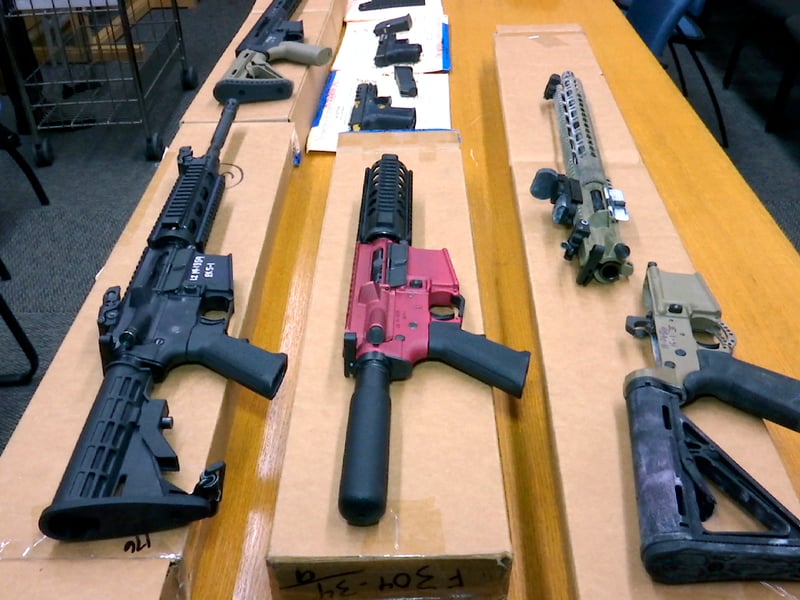
SAN FRANCISCO (CN) — A panel of Ninth Circuit judges questioned California’s push to ensure the U.S. Bureau of Alcohol, Tobacco, Firearms and Explosives regulates the production of ghost guns on Thursday.
In 2020, California Attorney General Xavier Becerra and the Giffords Law Center to Prevent Gun Violence sued ATF in order to force the agency to crack down on guns made outside of a regulated manufacturer, commonly from parts purchased online, that skirt laws requiring background checks and age verification.
Lacking a commercial serial number and purchasable without a background check, ghost guns are not considered firearms subject to ATF regulation under the Gun Control Act because a central piece remains unfinished — the receiver or frame of the weapon, which houses all internal components including the barrel and trigger mechanism.
In 2024, U.S. District Judge Edward Chen, a Barack Obama appointee, ruled ATF acted “arbitrarily and capriciously with respect to its categorical determinations that AR-type partially complete receivers that are not indexed or machined and not sold with a jig or tools are not firearms for purposes of the Gun Control Act.”
On appeal, U.S. Department of Justice attorney Sean Janda told the three-judge panel the agency had to “draw a line” somewhere along the regulatory framework without getting into a position that would require finding and regulating every online retailer that could potentially sell gun parts that, after several hours and expertise, may be made into a firearm.
The ATF seeks to reverse and vacate the lower court’s decision due to California’s inability to state an injury.
California claims it has to pay more for law enforcement to deal with crimes committed by those who use ghost guns.
“[It’s] exactly the sort of downstream cost theories and version or resource theories that the Supreme Court has twice recently rejected,” said Janda.
Lee Crain, representing the Giffords Law Center, said ATF’s failure to regulate all parts has caused problems even within its own agency.
“We don’t think it’s an exercise in line drawing, and if it is, particularly with the jig question, it’s an arbitrary, an irrational, it’s a capricious line drawing, because the agency itself has admitted that these same products are readily convertible,” he said.
U.S. Circuit Judge Consuelo Callahan, a George W. Bush appointee, tried to get into the details about where the state and ATF differ on its regulation of ghost guns based on sales of parts.
“Well so, if we talk about the merits, you propose that ATF could have decided to regulate all unfinished receivers, regardless of whether sold separately from any other items,” she said. “Why is it not a practical exercise of the line drawing authority for ATF to decide to focus on whether critical operations have been performed on the unfinished frame, rather than the entire universe of jigs, tools and other items available across the market?”
Crain said the factors that should be considered, including time to make a gun, should also include parts availability and if the equipment used to make ghost guns are “readily accessible.” He said it wasn’t a line drawing because purchasing a receiver with a jig is “the same piece of aluminum to the same degree of machining” that in “one context ATF says it’s a firearm. In another context it says it’s not.”
Asserting California’s standing, Crain said the state saw expenses increase to combat ghost guns starting around 2019 from “the loophole that remains open because of this problem in the law.”
In rebuttal, Janda noted the state and ATF agreed on “about 97% of the rule,” but said California lacked enough evidence of the particular products it wanted ATF to regulate.
U.S. Circuit Judge Anthony Johnstone and U.S. Circuit Judge Holly Thomas, both Joe Biden appointees, rounded out the panel.
Subscribe to our free newsletters
Our weekly newsletter Closing Arguments offers the latest about ongoing trials, major litigation and rulings in courthouses around the U.S. and the world, while the monthly Under the Lights dishes the legal dirt from Hollywood, sports, Big Tech and the arts.