
 Search Articles


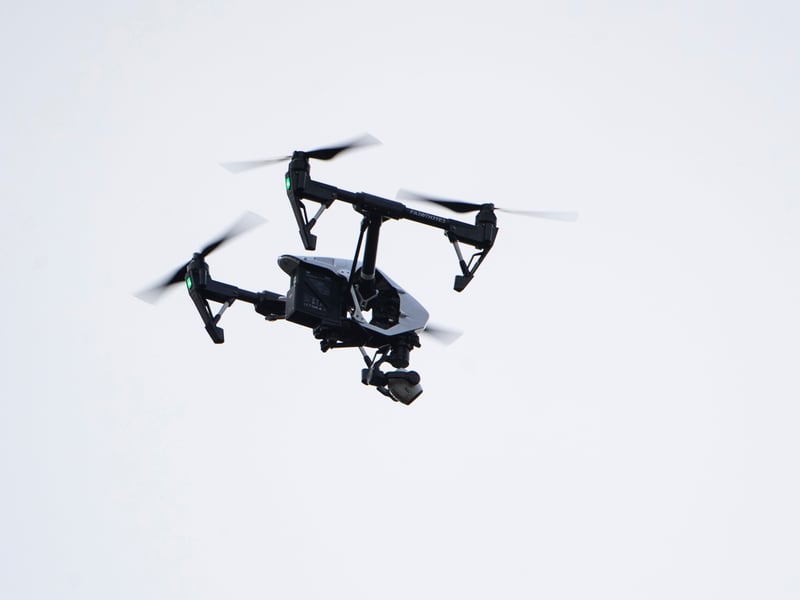
OAKLAND, Calif. (CN) — A federal judge on Monday dismissed a lawsuit filed by a Sonoma County resident who claims that local government is violating her constitutional rights by conducting warrantless searches of her property using drones.
In his ruling, U.S. District Judge Haywood S. Gilliam said that the 2024 lawsuit filed in the Northern District of California lacked the necessary detail concerning any injuries that resident Keni Mae Meyer claims to have suffered when county drones were flown over her property, supposedly to find violations of local building ordinances.
“Although the complaint includes information about the county’s drone program, there are not sufficient factual allegations about how the program affected plaintiff at all. The court therefore grants the motion to dismiss as to all plaintiff’s claims,” Gilliam said.
The Barack Obama appointee similarly criticized Meyer’s lawsuit for lacking critical information on the drone incidents she accuses the city of carrying out, including the nature of their surveillance, any drone’s proximity to her property or who was involved in flying the drone.
The judge also didn’t buy Meyer’s arguments that she had a “clearly established” right to be free from warrantless drone surveillance of her property, despite claims that her position was supported by two Supreme Court cases — Florida v. Jardines (2013) and Kyllo v. United States (2001).
“These cases, even taken together, thus offer little more than ‘a high level of generality’ about Fourth Amendment rights,” Gilliam said, adding that neither case involved drones or even aerial surveillance.
Things didn’t go so well for Meyer’s claims against individual county officials either. Even if she were to provide more information about the claimed violations of her privacy, Gilliam said that any individual defendants involved in drone surveillance in the case would likely be entitled to qualified immunity.
Additionally, the judge said that several of Meyer’s claims on personal injury grounds and violations of California’s constitutional right to privacy were time-barred by their relevant statute of limitations.
Overall, Gilliam said he was “skeptical” that the case could even be repaired. But despite its shortcomings, the judge still gave Meyer the chance to fix her lawsuit’s problems and refile. Meyer will have 21 days to repair and resubmit her lawsuit.
“Nevertheless, at this stage in the litigation, the court cannot say with certainty that amendment would be futile,” Gilliam said.
Attorney Herman Franck, who represented Meyer, said in an email that his client will be adding facts to the lawsuit that “should cure the various issues the court had with the fairly vaguely written initial complaint.”
Attorneys for Sonoma County did not respond to a request for comment by press time.
Meyer first filed her lawsuit against the county and several of its officials in December 2024, challenging Sonoma County’s policies regarding the use of drones for aerial surveillance of private property. Meyer claims that the city’s actions and drone policies violated her Fourth, Eighth and Fourteenth Amendment rights.
Meyer, a resident of the city of Sebastopol, claimed previously in March 2020 that Sonoma County began using drones intended for marijuana-growing enforcement to check on her property’s compliance with building permits without a proper warrant.
In February 2021, the county filed a complaint in state court against Meyer for failing to remedy code violations on her property and obtained a judgment against her in March 2022, including over $370,000 in penalties.
Meyer said that the most recent drone surveillance incident by the county occurred as recently as March 23, 2023.
Meyer also claims that the county took measures to cover its tracks when it came to drone use, such as not publishing its drone policies to the public.
Although the Supreme Court has issued rulings on similar privacy cases involving helicopter fly-bys and cannabis enforcement, there isn’t as much definitive case law in drone-based privacy law, and even less for their use in enforcing building permits.
Subscribe to our free newsletters
Our weekly newsletter Closing Arguments offers the latest about ongoing trials, major litigation and rulings in courthouses around the U.S. and the world, while the monthly Under the Lights dishes the legal dirt from Hollywood, sports, Big Tech and the arts.