
 Search Articles


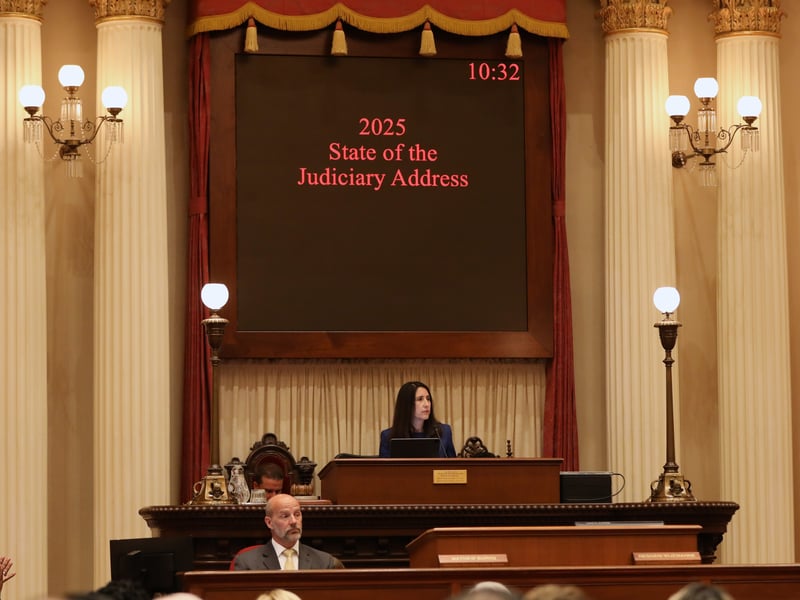
SACRAMENTO, Calif. (CN) — California’s chief justice pointedly delineated the state’s role in immigration during her Tuesday state of the judiciary address, emphasizing that the federal government has no power to compel states in that realm.
Chief Justice Patricia Guerrero’s remarks came almost two months into President Donald Trump’s second term amid a wave of deportations and pushback rocking the nation.
“Much has happened since I addressed you last year,” Guerrero said. “I decided to start with an understatement.”
Delivering her annual speech before a joint legislative session, Guerrero pointed to two state laws passed a handful of years ago targeting the issue of immigration. Senate Bill 54 prohibits state and local resources from assisting federal immigration enforcement. Assembly Bill 668 codified a common law privilege, restricting civil arrests from occurring in a California courthouse without a warrant.
“The federal government can focus on federal immigration enforcement,” Guerrero said. “Local officials can focus on local public safety. And our courts can focus on providing access to justice to all who come before us.”
Immigration policies and enforcement have led to what Guerrero called stress, anxiety and confusion. She noted that the federal government has the right to enforce immigration, adding that no state official has the intent to violate federal law. However, federal authorities cannot require California to enforce immigration law.
Lawmakers and state officials crowded into the state Senate chambers to hear Guerrero update the Legislature about the state’s judiciary. She touched on a handful of issues affecting the courts, including artificial intelligence, court budgets and the recent problems with the administration of the state bar exam.
Last year, Guerrero said that courts must face the reality of AI. Since then, she’s appointed a task force which has created a model use policy for using generative AI. That group continues to create direction for courts when adopting their own AI policy.
The chief justice began her address with budget cuts the courts have faced. Last May, the judicial branch faced a loss of $97 million for trial courts. Her branch found efficiencies, but also enacted what Guerrero called tough solutions.
Those solutions included shuttering some courtrooms and courthouses, as well as furloughs and fewer hours for clerks’ offices.
However, Governor Gavin Newsom’s proposed budget, released in January, restored some of that lost funding. The chief justice anticipated reducing some hiring freezes and service impacts, along with preventing or scaling back some furloughs.
“It is our hope that you will keep in mind the fundamental reason we seek our share of the budget,” Guerrero said.
That mission, she said, is to interpret and apply the law with consistency and impartiality, and to protect the rights enshrined in the United States and California constitutions.
“We need funding to properly fulfill this solemn responsibility — as a coequal, independent branch of government — to safeguard the constitutional rights and liberties of all Californians,” Guerrero added.
Remote court proceedings have enabled the state’s courts to meet their responsibility.
According to the chief justice, over 6,500 remote hearings occur every day — saving people some 1.5 million courthouse trips a year.
“You didn’t think I would get through this without mentioning remote proceedings?” Guerrero joked.
Both court staff and people who use the court system have praised remote proceedings, she added, as it provides a choice on how to access the courts.
Guerrero noted that courts now have the authority to perform remote proceedings until Jan. 1, 2027.
The chief justice also pointed to what she called challenges, noting issues in February with the administration of the state bar exam.
The state bar in a statement apologized for the exam rollout, pointing to issues with testing locations, technical missteps and communication problems.
Guerrero said she plans on heightening oversight, which will include the Committee of Bar Examiners, whose role she said has diminished in the past few years. She wants its importance restored, with more oversight of admissions and the administration of the bar.
Subscribe to our free newsletters
Our weekly newsletter Closing Arguments offers the latest about ongoing trials, major litigation and rulings in courthouses around the U.S. and the world, while the monthly Under the Lights dishes the legal dirt from Hollywood, sports, Big Tech and the arts.