
 Search Articles


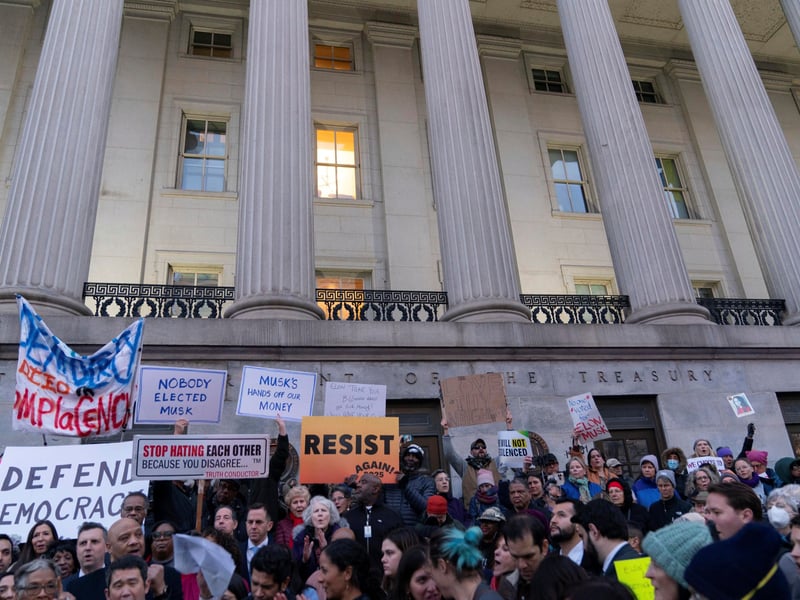
WASHINGTON (CN) — A wave of mass firings left federal government employees on edge Friday as thousands of civil service workers reported “performance-based” terminations.
The Trump administration purged rolls of probationary workers across several agencies Thursday night, sending out immediate termination notices to civil service workers who lacked job protections and the right to appeal.
These are typically new entrants into the service with only a year or two on the job. However, this can also apply to federal employees who take on new roles in the workforce.
Andrew Lennox, a veteran who worked for the Department of Veterans Affairs, was among those fired.
After a decade of service in the Marines with multiple deployments, Lennox joined the civilian workforce in 2023. A military employers conference connected him with VA employees who motivated him to join the civil service, and he started working in primary care health administration in Ann Arbor, Michigan, last December.
“This is my family,” Lennox said while describing working with veterans. “I could think of no greater job or no better position to continue doing this.”
At 7 p.m. on Thursday, Lennox received an email from a human resources representative firing him for “poor performance.” Lennox had never met the representative, who worked at the agency’s national headquarters, nor had he ever had a performance review.
“If they had just laid me off, through reduction of force, it’s protected, right,” Lennox said. “So by saying it’s performance-based, they avoid that kind of protection. But I literally haven’t even had an evaluation yet.”
Most civil service workers can only face immediate termination for poor performance or misconduct. The government can lay off employees to cut the workforce, but that requires a more arduous process and can take time.
Other terminated employees reported similar notices despite having positive performance reviews, according to several federal employees who spoke to Courthouse News on the condition of anonymity.
Adding to the confusion, terminated employees weren’t given information on their last paycheck or continuation of benefits.
Some employees received termination notices on Thursday night only to be called back Friday morning. One engineering employee, who spoke on the condition of anonymity, said their initial termination was rescinded due to the importance of their role in critical services like the power grid.
Workers who survived the purge said they felt like an ax was hanging over their heads.
“The news is terrifying right now,” a federal contractor from Idaho said. “I am so sick I can’t eat.”
Firing decisions appeared to come from higher-ranking officials. One human resources worker said a supervisor called them on their personal phone to find out if they’d received a notice.
“That’s mind-boggling in the HR organization,” the employee said.
Civil service members are nonpartisan and typically do not change based on the White House occupant. However, employees said recent rhetoric politicized their jobs and undermined their work.
“There are people who have been here for 5, 10, 15 years,” Lennox said. “This is their job, and then they’re being told that they’re lazy, they’re parasites, they’re doing unproductive jobs.”
The voluntary resignation offer sent to federal employees suggested they leave an unproductive job in the government for more productive work in private industry. A common concern shared by multiple workers was what culling the workforce would mean for veterans.
“They don’t realize that there’s a significant chunk of public workers who are veterans,” Lennox said. “The same people that will say, we support the troops, thank you for your service, are telling these people that their jobs don’t matter.”
Employees with disability accommodations shared similar concerns. The federal government, according to one worker, has been a place where people with disabilities could not only get a job but also receive the accommodations they needed to do their work. The worker, who is disabled themselves, said disabled Americans want to work, but those accommodations are critical to their role in the workforce.
“One of the things that I’m most concerned about is that this will be like the flushing of disabled Americans from the job force for no other reason than petty tyrannical crap,” the worker said. “Petty tyrannical crap is going to mean that a bunch of disabled people just don’t get to work anymore, not in the federal government, not anywhere, not with the contractors we’re just labeled useless, and that is one of my big fears.”
Despite the uncertainty, workers were resistant to abandoning the civil service. Those who were not fired said they planned to stay in the force. Several employees credited this loyalty to their belief that their work is important and impactful.
Lennox said he would work until his computer access was revoked.
“Once that happens and I can’t serve in my capacity as an administrative officer, I’m going to go downstairs to our volunteer service and volunteer and not get paid so I can still help veterans,” Lennox said. “I swore an oath as a Marine and as a civil servant, and I’m not letting some policy or anything get in between me and that.”
 Follow @KelseyReichmann
 Follow @kelseyreichmann.bsky.social
Subscribe to our free newsletters
Our weekly newsletter Closing Arguments offers the latest about ongoing trials, major litigation and rulings in courthouses around the U.S. and the world, while the monthly Under the Lights dishes the legal dirt from Hollywood, sports, Big Tech and the arts.