
 Search Articles


CHICAGO (CN) — The Chicago City Council on Wednesday approved a measure aimed at circumventing the mayor’s authority, and overturning his plan to end the city’s use of the controversial ShotSpotter gunshot detection technology.
The 33-14 vote came after a sometimes-heated floor debate in city hall that pitted progressive alders against council conservatives and moderates looking for ways to address gun violence in their wards.
“I know that in the 49th Ward, we don’t support ShotSpotter for the most part,” Alderwoman Maria Hadden said during that debate. “We’ve seen the data, we have similar concerns, I share concerns about this particular technology.”
“I know for a fact that this is helping… I’ve seen it,” Alderman David Moore, the measure’s primary sponsor and a major ShotSpotter booster, later rebutted. “I’m out there with the guys [who say], ‘dude, man, I’m glad that gunshot technology was out here because the police, yeah they showed up, but these guys were about to come back and hit us again.’”
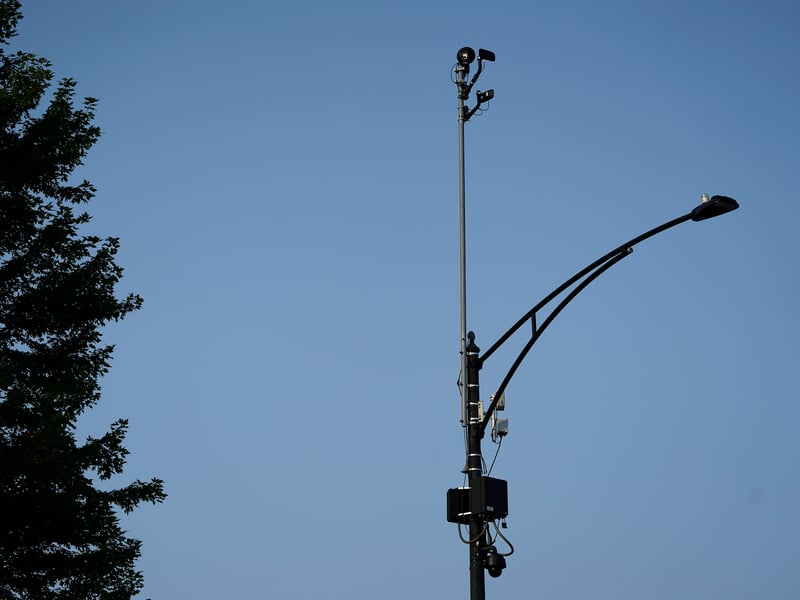
ShotSpotter’s surveillance posts, scattered in 12 of the city’s 22 police districts — primarily across South and West Sides neighborhoods — are meant to listen for suspected gun shots and alert police to where the shots were detected. But analyses by city and county offices have questioned the technology’s efficacy at preventing or punishing gun crime.
An August 2021 report from the city’s Office of the Inspector General found ShotSpotter rarely produces evidence of gun-related crimes. Earlier this year, a leaked internal analysis from the Cook County State’s Attorney’s Office arrived at similar conclusions, finding “ShotSpotter is not making a significant impact on shooting incidents,” while costing the city over $217,000 per incident arrestee.
“ShotSpotter is an expensive tool that provides minimal return on investment to the prosecution of gun violence,” the state’s attorney’s office concluded.
However, the same researchers also found in a study published last month that police responses to top-priority 911 calls “significantly” increased after the city adopted ShotSpotter, because police resources were being redirected from 911 call responses to ShotSpotter alerts. The study similarly found that given limited Chicago police resources, the system had little impact on crime reduction.
“City-wide counts of gun-related arrests, clearance, and victimization, each show little evidence of a significant change post implementation, thus calling into question ShotSpotter’s effectiveness as a crime-reduction tool,” the researchers wrote in August.
Progressives have also criticized ShotSpotter as an invasive police surveillance tool in already disenfranchised neighborhoods. A February investigative report in Wired found SoundThinking may operate over 25,000 clandestine ShotSpotter microphones across the country, concentrated in majority Black and Brown communities. A March 2021 ShotSpotter alert led to police fatally shooting 13-year-oldAdam Toledo.
Left-leaning Mayor Brandon Johnson promised to end the city’s $49 million contract with ShotSpotter’s parent company SoundThinking on the campaign trail. It was a promise he made good on: The contract, first enacted under former mayor Rahm Emanuel in 2018, expires Sunday.
But since Johnson announced the September sunset on SoundThinking last February, the technology’s supporters in city hall have worked to get around him. Wednesday’s vote was a successful Hail Mary attempt that had previously been referred to the city’s Committee on Public Safety and Committee on Committees and Rules. It allows Chicago Police Superintendent Larry Snelling to extend or sign a new contract for “acoustic gunshot detection technology services” without the mayor’s approval.
The Chicago Police Department declined to comment on the vote. Snelling has supported ShotSpotter in the past, but also owes his position to the mayor.
If the measure had failed, Moore and other pro-ShotSpotter alders planned to call for a special city council vote Wednesday evening, with the hope to pass contract approval powers to the director of the city’s Office of Public Safety Administration.
Many of the same alders who voted for Moore’s plan on Wednesday also voted in May for another measure meant to undercut the mayor’s authority on the SoundThinking contract. It stipulated that any decision to remove ShotSpotter from a city ward would have to go through a public safety committee meeting and a full city council vote. The mayor largely dismissed that move as empty, however. He insisted in May that his office alone had the final say on the city’s ShotSpotter contract and that he planned to end it.
“I canceled ShotSpotter. It’s canceled,” Johnson said in May.
He and his staff reaffirmed their commitment to ousting ShotSpotter at a post-council meeting press conference on Wednesday, calling Moore’s ordinance illegal.
“Clearly the legal dynamic of this ordinance has left me no choice but to veto it,” Johnson told reporters.
“The mayor referenced the veto because the thing that passed is in violation of the Separation of Powers Act,” Chicago Corporation Counsel Mary Richardson-Lowry said at the same press conference. “The legislative branch cannot compel the executive branch to act, hence the item is a vetoable item and the mayor is going to exercise that privilege.”
SoundThinking itself, eager to keep its product in Chicago and facing stock prices that have nearly been cut in half since the start of the year, also told Chicago’s government this week that it was willing to offer the city a nearly 50% discount on its contract so long as the technology remained in place through 2025.
Anti-ShotSpotter Alderman Andre Vasquez criticized that move Wednesday as desperation from a “shoddy” business.
“They were selling a bill of goods to try and get as much money as they could,” Vazquez said. “Which is why they go from Whole Food prices to your local corner store, and slashing it down 48% hoping they could lock in a contract. If they’re so easy to do that, why didn’t they start off at 48% of what they were charging us?”
But pro-ShotSpotter Alderwoman Monique Scott said she would rather have any type of gunshot detection technology in place, even shoddy technology, than none at all.
“It’s a detection. I don’t understand why we keep getting the issue of ‘saving a life’ versus a detection,” Scott said. “I would rather have a detection so that I know where the shots are coming from, because I hear them.”
 Follow @djbyrnes1
Subscribe to our free newsletters
Our weekly newsletter Closing Arguments offers the latest about ongoing trials, major litigation and rulings in courthouses around the U.S. and the world, while the monthly Under the Lights dishes the legal dirt from Hollywood, sports, Big Tech and the arts.