
 Search Articles


(CN) — A British parliamentary researcher has been arrested on suspicion of spying for the Chinese government, it was revealed Monday, sparking fresh debate over the United Kingdom’s relationship with the East Asian superpower.
The 28-year-old researcher, whom police did not name publicly, worked for Alicia Kearns, a member of Parliament who chairs the Foreign Affairs Select Committee. The researcher is also known to be close to Security Minister Tom Tugendhat.
While police did not elaborate on the allegations, the researcher has strongly denied he was involved in spying for China, issuing a public statement Monday afternoon describing himself as “completely innocent” and accusing the media of “misreporting.”
“I have spent my career to date trying to educate others about the challenge and threats presented by the Chinese Communist Party,” the researcher’s statement said. “To do what has been claimed against me in extravagant news reporting would be against everything I stand for.”
Before his arrest in March of this year, the researcher was a key figure in the establishment of the China Research Group, which advocates the U.K. taking a more aggressive stance toward China. The Chinese embassy in London has described the allegations as “malicious slander,” while parliamentarians have largely refused on comment on the matter as inquiries are ongoing.
The arrest comes two years after British security services issued a public “interference alert” against parliamentary staffer Christine Lee, accusing her of being influenced by the Chinese Communist Party. Insufficient evidence of espionage meant that prosecutors did not bring charges against Lee, who also denied the claims against her. Lee is now suing the security services, accusing them of breaching her human rights.
China-sceptic Conservative members of Parliament jumped on the news of the arrest, amplifying what is already a deep division within the governing party.
A large cohort of parliamentarians, including former party leader Iain Duncan Smith and former Prime Minister Liz Truss, are strong advocates of a far more hawkish approach to China in British foreign policy. The China hawks are heavily influenced by U.S. foreign policy and frequently express opposition to policies that deviate from those of the State Department.
During Truss’s short-lived premiership, China’s formal status in British foreign policy was reclassified from “strategic competitor” to “threat” — echoing language used to categorize the Russian state.
Prime Minister Rishi Sunak’s current administration has taken a more doveish approach to China, instead dubbing the state an “epoch-defining challenge.”
British Foreign Secretary James Cleverly made his own trip to Beijing last month. He called for “a pragmatic, sensible working relationship with China.” And Sunak himself has repeatedly defended his government maintaining ties with China, stating last month his belief that “the right thing to do [is] take the opportunity to engage, to raise concerns specifically, rather than just shouting from the sidelines.”
The government’s position is more in line with other western European nations, which have sought to maintain strategic ties with China — though the U.K. remains more aloof than France or Germany, whose leaders have both visited Beijing and met with Chinese Premier Xi Jinping over the past 12 months.
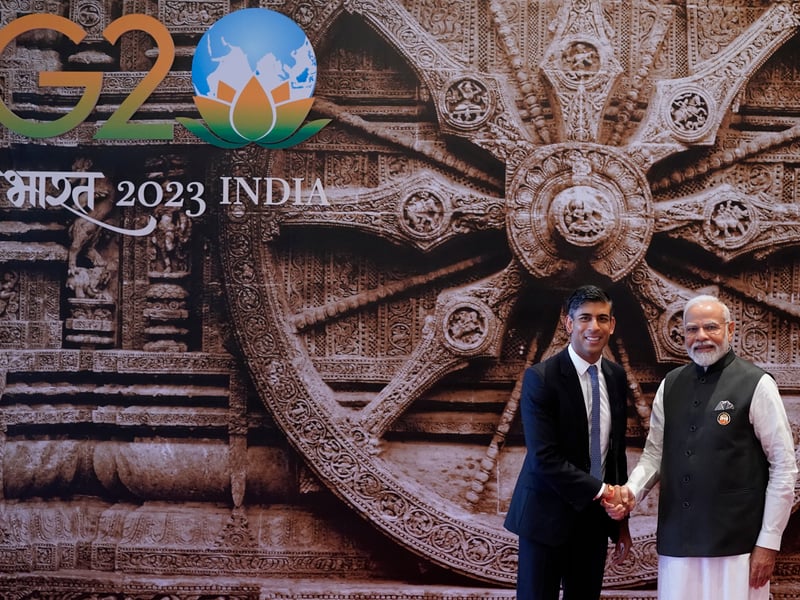
Given the arrest took place months ago, the timing of the spying accusation becoming public is advantageous for China hawks seeking to place pressure on Sunak as he attends this week’s G20 summit along with China’s second-in-command, Li Qiang.
On the sidelines of the summit, Sunak told reporters he had raised with Li his “very strong concerns about any interference in our parliamentary democracy, which is obviously unacceptable.”
The hand-wringing over relations with China is a far cry from less than a decade ago, when Xi conducted a five-day state visit in Britain that included dining with the Queen and giving a speech in the Houses of Parliament — the latter a rare honor for a foreign leader. At the time, then-Prime Minister David Cameron hailed the beginning of “a golden age” in China-U.K. relations.
Since then, the shifting U.S. position toward China has heavily influenced U.K. policymaking, with the British government under pressure from the U.S. to take a tougher line towards Beijing.
The introduction of new U.S. sanctions in 2020 prompted a ban on the involvement of China-based multinational technology company Huawei in the U.K.’s 5G network, and a requirement to remove previously installed Huawei equipment by 2027. At the time China’s ambassador to the U.K., Liu Xiaoming, called the decision disappointing and disheartening, adding, “The way you treat Huawei will be followed very closely by other Chinese businesses.”
Relations then deteriorated notably after a crackdown on protesters and the introduction of new security laws in Hong Kong, a former British colony. The British government publicly opposed the national security laws, saying they violated the terms of the 1984 Sino-British Joint Declaration, the treaty under which Britain ceded control of the territory to China.
What followed was an angry response from Beijing, which accused Britain of interfering in Chinese affairs.
As a result of the crackdown, Britain withdrew its judges from Hong Kong’s top court. The presence of the judges, who remained sitting on Hong Kong courts after the Chinese handover in order to maintain the rule of law, only served to legitimize oppression, the U.K. reasoned.
In 2021 China’s TV network in the U.K. was fined and forced off the air by media regulator Ofcom, leading to a tit-for-tat retaliation from Chinese regulators who banned BBC World News from broadcasting in its territory. A year later Chinese firm Nexperia was forced by the government to divest from the British semiconductor industry, while China’s General Nuclear lost its role in the construction of a major nuclear power station. The government is also under pressure to nix China’s involvement in other major infrastructure projects.
But while economic separation might be bad for business, it is at least consistent with the government’s designation of China as a “challenge.” The two very public accusations of espionage now aimed at the Chinese state point towards a more adversarial dynamic at play — and while the government continues to hold firm against China hawks for now, relations seem set to sour further.
Subscribe to our free newsletters
Our weekly newsletter Closing Arguments offers the latest about ongoing trials, major litigation and rulings in courthouses around the U.S. and the world, while the monthly Under the Lights dishes the legal dirt from Hollywood, sports, Big Tech and the arts.