
 Search Articles


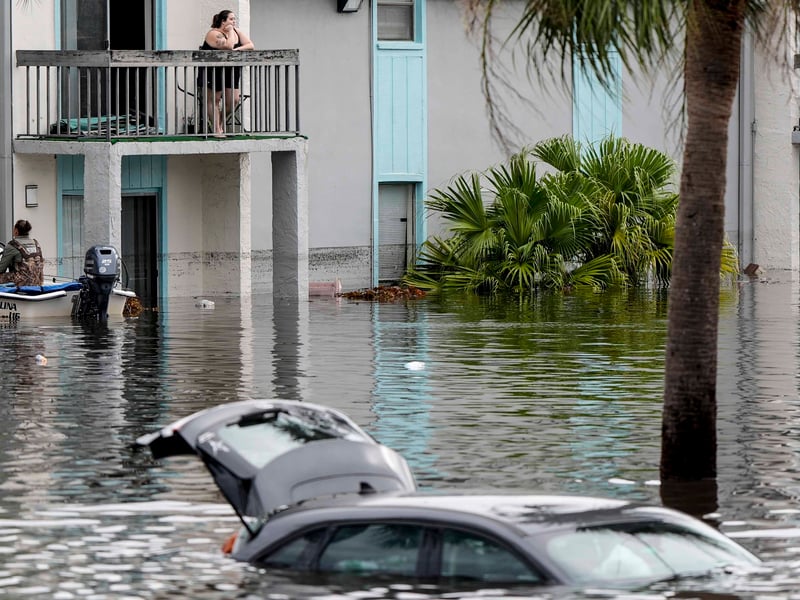
(CN) — Hurricane Milton’s rapid intensification and widespread damage was amplified by human-caused climate change, according to weather observation data reviewed and analyzed by a collaborative organization of scientists.
Milton, which made landfall Oct. 9 at Siesta Key, Florida, as a Category 3, is credited for causing at least 13 deaths, along with tornadoes and widespread flooding across the central part of the state. Notable as well for briefly becoming one of the strongest storms ever recorded in the Gulf of Mexico, Milton generated as much as 30% more rain and 10% more wind because of the influences of climate change, researchers with World Weather Attribution said in a report Friday.
In pre-industrial times, before an exponential increase in human-caused CO2 and ozone emissions, a storm in similar atmospheric and oceanic conditions would have likely made landfall as a weak Category 2. But conditions for stronger storms have grown more favorable in the decades since, amid a global temperature increase of more than 2 degrees Fahrenheit and a mean water temperature increase of at least 1.8 degrees.
A different World Weather Attribution rapid study focusing on the deadly flooding from Hurricane Helene reached a similar conclusion: Climate change is the key driver of more catastrophic impacts from hurricanes.
“Without climate change, Hurricane Milton would have hit as a Cat 2, not a Cat 3," Jeff Masters, a meteorologist and co-founder of the Weather Underground forecasting service, said in a statement accompanying the report.
Climate scientist Michael Mann said both reports used simple scientific approaches likely to understate the actual impacts, but he told the Associated Press climate change is “the difference between a modest effect and a major effect.”
To analyze the data, World Weather Attribution researchers assessed trends in observations for 10-year and 100-year rain events in the affected regions. To determine whether human-induced climate change may have contributed to heavier rainfall, the researchers attempted to identify a trend in those observations.
“In three out of the four analyzed datasets we find that heavy 1-day rainfall events such as the one associated with Milton are 20 to 30% more intense and about twice as likely in today’s climate,” the report noted. “We are confident that such changes in heavy rainfall are attributable to human-caused climate change.”
The researchers claim the results are further supported by comparing the early data to more comprehensive reports from previous storms and historical data. Altogether, such studies show “a similar increase in intensity of between 10 and 50% and about a doubling in likelihood” of stronger storms because of human-caused climate change, according to the report.
The report also cites other research to conclude that “on a global scale, recent decades have seen an increase in more intense [hurricanes], but no change in the overall number.”
Separate attribution studies on recent hurricanes in the North Atlantic basin show that rainfall from these hurricanes were all amplified by anthropogenic climate change, the report says: Katrina in 2005 by 4%, Irma in 2017 by 6%, Maria in 2017 by 9%, Florence in 2018 by 5%, Dorian in 2019 by 5-18%, Ian in 2022 by 18%, Harvey in 2017 by 7-38%, and Helene in 2024 by 10%.
“There is also growing evidence that hurricanes are now intensifying more rapidly, becoming more intense and will continue to do so with further warming, and that storm surges are causing extra damage due to sea level rise,” the report said.
The organization advises that the results of such studies can be considered while planning for new development or rebuilding in coastal or flood prone areas, as well as low income communities and minority areas.
 Follow @gabetynes
Subscribe to our free newsletters
Our weekly newsletter Closing Arguments offers the latest about ongoing trials, major litigation and rulings in courthouses around the U.S. and the world, while the monthly Under the Lights dishes the legal dirt from Hollywood, sports, Big Tech and the arts.