
 Search Articles


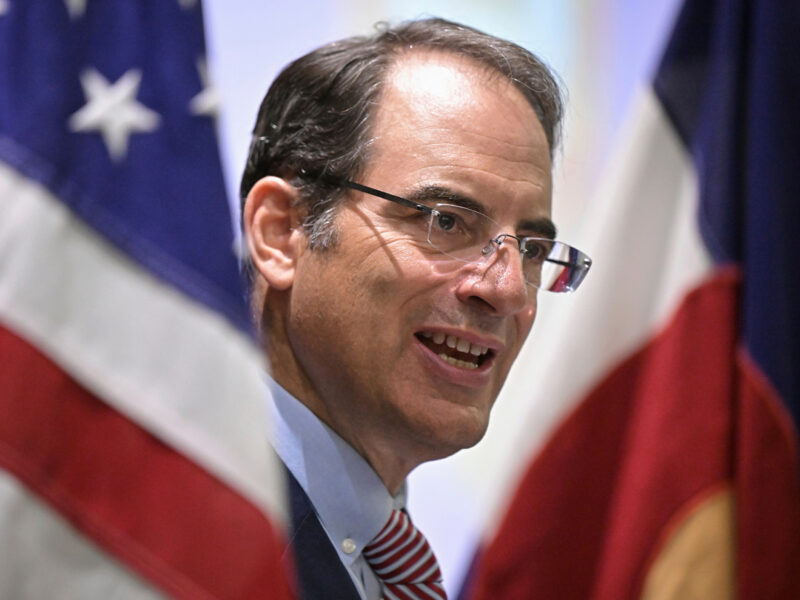
DENVER (CN) — Colorado will have a new governor in November. If past trends continue, Phil Weiser is expected to move across Civic Center Park from the attorney general’s office to the governor’s seat after winning 56% of the Democratic primary vote Tuesday night.
Who Weiser is running against remains unclear, with less than half a percent of Republican primary voters split between state Senator Barb Kirkmeyer and All Things Possible Ministries’ Victor Marx.
With 39.94% of the vote and 186,274 ballots cast in her favor, Kirkmeyer took a narrow lead over Marx, who stood with 39.65% of the vote and 184,918 ballots Wednesday morning. With 95,208 votes, state Representative Scott Bottoms earned 20.41% of the count, prompting Marx to tell supporters he successfully united the Republican Party — against him.
“We have stood up against the establishment,” Marx said on a live feed. “Remember the RNC chair said one of the things you have to do is unite the party, and I did; I united them against me."
A controversial political outsider, Marx claims to have “led more than 150 high-stakes missions across some of the world’s most dangerous regions,” befriended the late Charlie Kirk and earned a black belt in Keichu-Do, a “Cajun Christian” martial art developed by his father. His endorsements include Congresswoman Lauren Boebert, who ran unchallenged Tuesday night, and musician Ted Nugent.
Both Marx and Bottoms catered to the state’s far-right MAGA voters, while Kirkmeyer’s policy proposals spoke to moderate and fiscal conservatives.
A self-proclaimed “common sense conservative,” Kirkmeyer broke with her party in backing the results of the 2020 election and rejecting Governor Jared Polis’ decision to commute former Mesa County clerk Tina Peters’ prison sentence in May.
The Colorado secretary of state’s office counted 1.5 million ballots, including 597,888 ballots filed by unaffiliated voters who may participate in either the Democratic or Republican Party’s primary.
Although the election may head to a recount, Kirkmeyer isn’t waiting to pivot to the general election.
“Tonight is not the finish line, it’s the starting line,” Kirkmeyer told supporters at her watch party. “I’m looking forward to debating Phil Weiser; I’m looking forward to those debates.”
Divides between left-leaning urban voters and rural conservatives often drive Colorado politics. While Kirkmeyer earned support from voters along the Front Range and Denver, Marx won over the Western Slope.
Wynn Howell, the state director for Colorado Working Families Party, credited an influx of urban voters for driving Colorado’s shift from a purple state to deep blue.
“Ultimately it’s a result of urban and suburban population growth that we’ve seen over the last decade,” Howell said. Along with the demographic shift, Howell sees Coloradans consistently voting against Republican President Donald Trump.
“We see Dems and Unaffiliated and even moderate Republicans revolted, frankly, by what the Trump administration is doing,” Howell said. “This is not a popular regime in Colorado, and that is certainly going to color a lot of races here.”
In vying for the governor’s seat, U.S. Senator Michael Bennet and Attorney General Weiser competed on who stood up to Trump more.
Robert Preuhs, chair of the political science department at Metropolitan State University of Denver, ultimately sees the outcome of the Democratic gubernatorial primary as “a tinge of anti-Washington establishment.”
In his victory speech, Weiser alluded to out-of-state efforts to influence Colorado politics, including millions of dollars in ads purchased by political action committees, or PACs, in several contested primary races.
“The future of Colorado will not be decided by out-of-state billionaires, by corporations or special interests,” Weiser told supporters. “Colorado’s future belongs to all of us. I am excited for the work that we can do here in Colorado, including getting corporate money out of our politics and making sure that government delivers for all of us, not only the wealthy few.”
Likewise, Denver voters in the 1st Congressional District overwhelmingly supported 29-year-old political newcomer Melat Kiros over 15-term incumbent Diana DeGette. Besides voters supporting Kiros’ position as a Democratic socialist, Preuhs pointed to other contributing factors behind her 10-point lead, including the candidates’ age gap, mounting criticism of Washington and DeGette’s late efforts to actively campaign for reelection.
All added up to “strong enthusiasm by progressives and anti-establishment folks, particularly when the general election seems fairly safe,” Preuhs said.
Far-left enthusiasm did not translate to the statewide U.S. Senate race where voters picked moderate incumbent John Hickenlooper over progressive state Senator Julie Gonzales — even though the former declined to debate the latter.
Most of Colorado’s primary seats were uncontested and considered safely partisan districts, but the 8th Congressional District is an exception to both.
Drawn to be competitive by a nonpartisan committee, the 8th District has flipped in both of its elections, changing from Democrat Yadira Caraveo — who beat out Kirkmeyer in 2022 — to Republican Gabe Evans in 2024.
Spanning three Front Range counties and the population centers of Thornton, Commerce City and Greeley, the 8th District voted in favor of Democrats for state office across the ballot in 2022. In 2024, however, 50% of voters cast ballots in favor of Trump.
On Tuesday, 62% of Democratic primary voters chose single-term state Representative Manny Rutinel over experienced state Representative Shannon Bird to run for control of the 8th Congressional District against incumbent Evans.
Evans’ ability to maintain control of the district may be more reflective of how his constituents feel about national politics than his own policies and messaging. With 40% of the 8th District’s population identifying as Latino, voters will be weighing Evans’ support of the Trump administration’s immigration enforcement with Rutinel’s promises to push back.
“I think this November is going to be a vote for or against the Trump administration,” Preuhs said, cautioning that it’s too early to make solid predictions. “Particularly in this state, it depends on how much those policies really amplify right the need to the perceived need to push back.”
 Follow @bright_lamp
Subscribe to our free newsletters
Our weekly newsletter Closing Arguments offers the latest about ongoing trials, major litigation and rulings in courthouses around the U.S. and the world, while the monthly Under the Lights dishes the legal dirt from Hollywood, sports, Big Tech and the arts.
Additional Reads



 Trump sues Virginia over assault weapons ban July 1, 2026