Search Articles



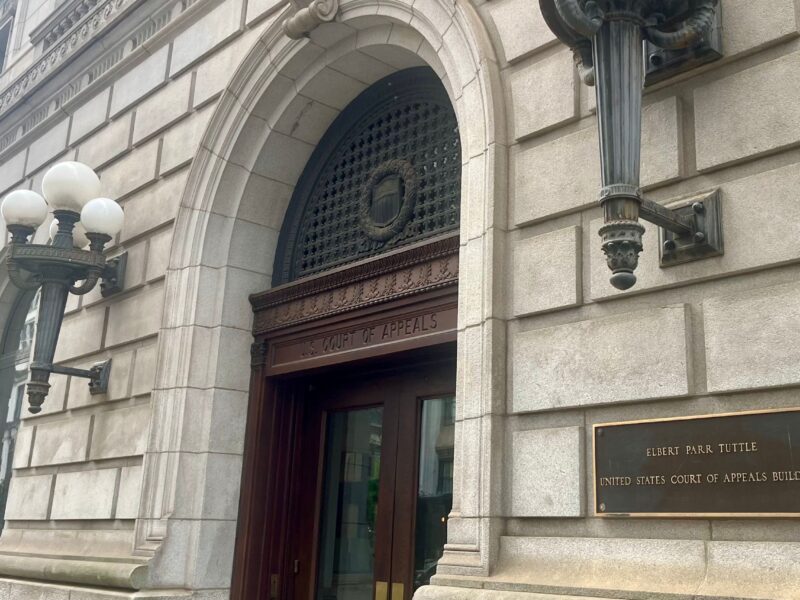
MIAMI (CN) — Two cryptocurrency creators sought reversal of their sentences at the 11th Circuit on Friday, challenging the first federal convictions labeling cryptocurrency as a security and its manipulation as securities fraud.
The case stems from an investigation into Hydrogen Technology, its CEO, Michael Kane, and head of engineering, Shane Hampton, who prosecutors say used automated bots to inflate the price of the company’s Hydro cryptocurrency token and attract investors.
According to the indictment, the bots executed more than $300 million in “spoof trades” designed to induce investment, generating nearly $3 million in profits over a 10-month period in 2017 and 2018.
A federal jury convicted Hampton and Kane in February 2024 of conspiracy to commit securities price manipulation and conspiracy to commit wire fraud. Hampton was sentenced to two years and 11 months in prison, while Kane received three years and nine months.
“For the first time, a jury in a federal criminal trial found that a cryptocurrency was a security, and the manipulating cryptocurrency prices was securities fraud,” said Justice Department criminal division chief Nicole Argentieri after the convictions.
During arguments Friday before a three-judge panel, Hampton’s attorney, Freddy Funes, argued the sale of Hydro tokens was not an investment contract subject to federal securities laws. He said a key element of a security is that investment returns depend on the promoter’s management of funds, not merely investor speculation.
U.S. Circuit Judge Nancy Abudu pushed back.
“You don’t have just investor speculation,” the Joe Biden appointee said. “You have comments from co-conspirator telling potential investors, ‘You’re going to make good money back and you’re going to see some returns on your investment.’”
“But I think what the gap is there’s nothing in the record showing that you as somebody who owns a token would have any expectation of profit,” Funes responded.
U.S. Circuit Judge Britt Grant, a Donald Trump appointee, jumped in.
“Why are people buying these then?” Grant asked. “What do you think this is if not an investment?”
“So I’m not saying it’s not an investment,” Funes answered, “but I don’t think it’s an investment that objectively and reasonably is based on the efforts of others.”
The attorney used the analogy of buying a jersey of soccer star Lionel Messi – a nod to the World Cup games currently being hosted in Miami.
“I think in 20 years, the market is going to increase, and somebody is going to want to buy that Messi jersey for a lot more than what it’s worth today,” Funes explained. “There’s no question that that’s an investment on my part. But the value of that jersey, just like a value of a token here, is completely not dependent on the efforts of others.”
When the judges seemed unconvinced, Funes took a different tack.
“So I think if we take away, sort of strip crypto tokens out of all the esoteric mystery of what a crypto token is, and just substitute it in for something else, like a Beanie Baby,” Funes said. “If I have a Beanie Baby store and I’m like, ‘I want to market these things, it’s going to be amazing. You buy a Beanie Baby and we’re going to take this to the top of the world.’ I don’t think anybody would say just because I’m making those statements that this is some sort of investment.”
In his comments to the court, Justice Department attorney David Lieberman said the jury correctly ruled the Hydro token was an investment contract because the company managed the profits and promised buyers future earnings based on its business plan.
“A reasonable jury could easily conclude that the folks who purchased these tokens expected that any future profit or returns that they might see would have been based on the efforts of the company to develop the token,” Lieberman said.
Grant seemed to agree.
“And even if they actually had no true intentions to create a usable product, it’s enough that they created the impression or attempted to create the impression among investors that it would be a valuable usable product, right?” the judge asked.
“That’s correct, your honor,” Lieberman said.
The attorney for Hampton’s co-conspirator, Kane, took a different approach before the appellate panel, arguing that the Hydro token was created for a purpose, not the expectation of profit, which eliminates another key definition of a security under federal law.
Robert O’Donnell explained the token was given to developers interested in creating application programming interfaces, or APIs, that allow applications to communicate with each other.
“Hydro is the token that you use to play the game, like an arcade token,” O’Donnell said, giving yet another analogy. “There may be a secondary market for an arcade token, but the essential quality is allowing your entry into the arcade. The accidental quality, the secondary qualities of the token are perhaps that it was very pretty, you can sell it on eBay, you may even wish to speculate on it.”
“The Hydro token was allowing other developers in this decentralized platform to develop their own things. And so, there is no reliance on the work of others,” O’Donnell continued.
Grant interrupted the attorney, reminding him that his client had taken a plea deal.
“So, it seems hard post-plea to get engaged in all these kind of factual evaluations,” the judge said.
In his rebuttal, the Justice Department attorney agreed.
“At least with respect to the indictment challenge, we think that that claim starts and ends with the unconditional guilty plea,” Lieberman said.
U.S. Circuit Judge Barbara Lagoa, a Trump appointee, joined Grant and Abudu on the panel. The judges did not indicate when they will issue a decision.
 Follow @alexbpickett
Subscribe to our free newsletters
Our weekly newsletter Closing Arguments offers the latest about ongoing trials, major litigation and rulings in courthouses around the U.S. and the world, while the monthly Under the Lights dishes the legal dirt from Hollywood, sports, Big Tech and the arts.