
 Search Articles


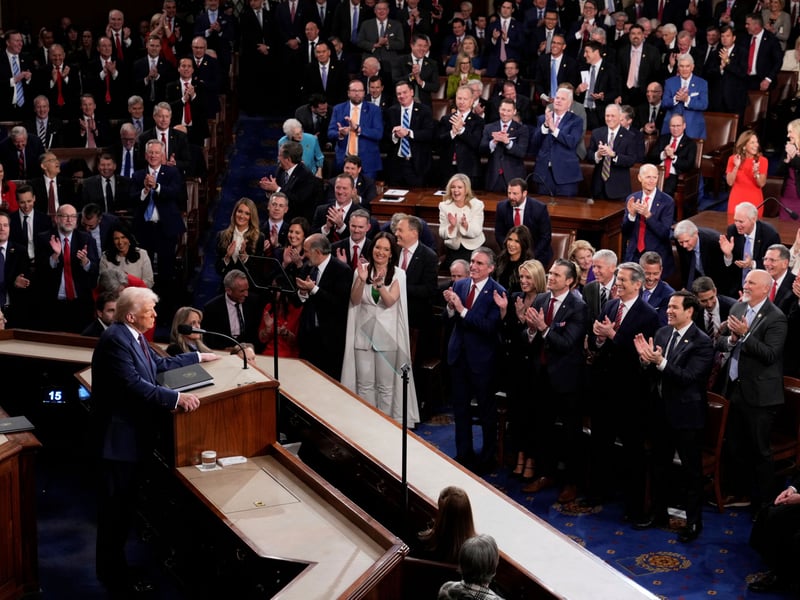
WASHINGTON (CN) — Senate Minority Leader Chuck Schumer appeared to close the door on a Democratic effort to rein in President Donald Trump’s controversial spending freezes Thursday night, when he dropped plans to filibuster a spending bill — leaving the courts as the sole backstop against the impoundment of appropriated funds.
Schumer initially vowed to fight Republicans’ short-term funding resolution, with Democrats saying it gives Trump and his billionaire adviser Elon Musk the latitude to make major policy moves without input from Congress.
As passed by the House this week, the bill keeps most government programs funded at current levels through September, except for poison-pill cuts to federal rental assistance and veterans’ health care.
Democrats fear the stopgap bill creates an opening for Trump and Musk to set policy and claw back further spending appropriated by Congress. Trump’s refusal to spend — impoundment — of congressionally appropriated funds has been a lightning rod for opposition, igniting dozens of lawsuits.
The Supreme Court weighed in on the issue of impoundment 50 years ago: In Train v. City of New York , the high court unanimously held that the executive branch cannot alter appropriated funding, upholding the statutory authority of the Congressional Budget and Impoundment Control Act of 1974. The Constitution meanwhile dictates that money can only be removed from the Treasury through appropriations, which is a power of the legislative branch.
But Musk’s so-called Department of Government Efficiency and its slash-and-burn tactics — and the president’s nearly 100 executive orders — have halted congressionally appropriated funding for clean energy investments, cancer and Alzheimer’s disease research, consumer protection operations, wildfire prevention and more. David Super, a professor of law and economics at Georgetown Law, called it a violation of the law.
“In a situation where the president isn’t even asking Congress for a rescission, then he’s in violation of the act by impounding money,” Super said in a phone call.
With no control in Washington, Democrats have little authority to hold Trump accountable for Impoundment Act violations. However, some saw the budget resolution — which requires a handful of Democratic votes to reach the 60-vote procedural threshold to pass — as one of the only paths of resistance.
“The only power I have in this process, the only way I can participate, is to vote,” Connecticut Senator Richard Blumenthal said in a video message posted to X on Thursday, lamenting the continuing resolution as a “personal slush fund” for the president.
Over the last decade, presidents have flexed their executive authority in ways that pushed the bounds of appropriations — President George W. Bush funded the war in Iraq, and President Joe Biden sought to forgive student debt. But Super said Trump is going beyond perceived loopholes and even ignoring joint explanatory statements — congressional directions on how money should be spent — with his chainsaw.
“President Trump is different in that he couldn’t care less what the appropriators think, and he has been disregarding even provisions of law and certainly the joint explanatory statements in how he’s been conducting things,” Super said. “It was sort of a handshake how the money would be spent, but Trump is not a handshake kind of president,” Super said.
Schumer’s acquiescence on the continuing resolution lowers the likelihood of a government shutdown but prevents Democrats from forcing Republicans into concessions to rein in Trump. That leaves the courts — which have been flooded with dozens of challenges to Trump’s cuts — to enforce congressional spending authority.
Last week, the Supreme Court ruled against Trump in the first of many funding fights, citing the Impoundment Control Act. Government contractors say Trump violated the act when he unilaterally paused billions in funding disbursements for U.S. Agency for International Development. The Supreme Court split 5-4 in favor of the contractors for now, allowing a federal judge to temporarily restart fundings while the legal fight continues.
While the justices didn’t reach the merits of the contractors’ claims, the dissent argued the ruling “imposes a $2 billion penalty on American taxpayers.” Justice Samuel Alito, a George W. Bush appointee, and three of his colleagues suggested that the government was not legally obligated to pay congressionally appropriated funds for already completed work.
“Alito’s dissent in the withholding funds case from this past week engaged in such a partisan endorsement of such a partisan set of talking points about presidential power that it written for not just a Fox News audience but for a MAGA audience,” Jed Shugerman, a law professor at Boston University, said.
The Supreme Court upheld Congress’ authority over the budget in Train , but the justices have never directly reviewed the Impoundment Act’s legality. Trump’s funding freezes will likely force the high court’s hand, possibly sooner rather than later.
While Trump may have more leeway to direct funds through the Republican-led budget legislation, he’d be limited during a government shutdown. Federal spending pauses if a continuing resolution isn’t signed, though the president has authority to “fund” essential services.
Super said that provision has always been understood to allow the president to direct activities while there’s no appropriations to pay them. Federal air traffic controllers, for example, are required to work without pay, with the understanding that their check will come after a funding bill is secured.
“I suppose, since he’s trying to drive many people out of federal employment, if you run a government shutdown long enough and ask for unpaid labor for people long enough, some of them may quit to get paying jobs in the private sector, and perhaps that would serve his purposes, but it doesn’t give him a slush fund of money,” Super said.
 Follow @KelseyReichmann
 Follow @kelseyreichmann.bsky.social
Subscribe to our free newsletters
Our weekly newsletter Closing Arguments offers the latest about ongoing trials, major litigation and rulings in courthouses around the U.S. and the world, while the monthly Under the Lights dishes the legal dirt from Hollywood, sports, Big Tech and the arts.