
 Search Articles


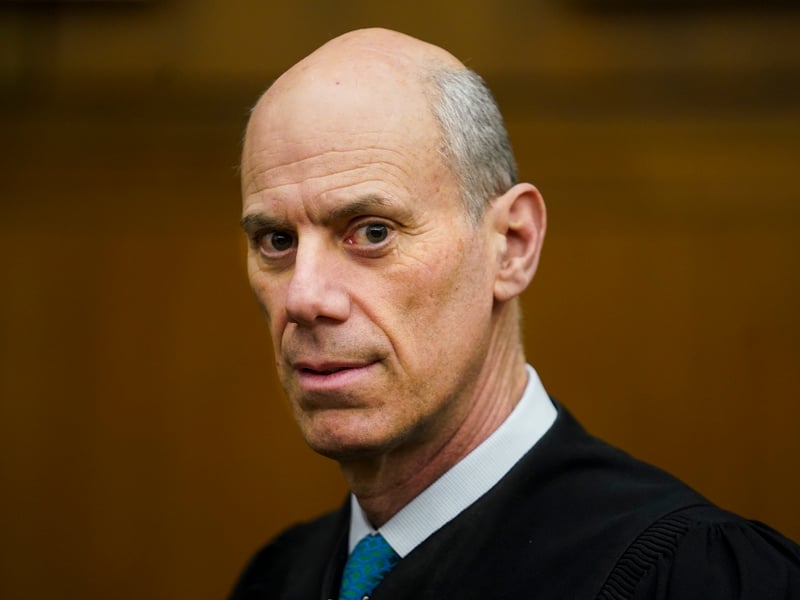
WASHINGTON (CN) — House Republicans, as they seek to malign some federal judges as political activists, have now called into question a D.C. court’s process for assigning cases to its jurists, suggesting that the court’s chief judge, James Boasberg, is overseeing too much high-profile litigation involving the Donald Trump administration.
But a Courthouse News review of such cases before the court revealed that, among the two dozen judges assigned litigation challenging Trump executive actions, Boasberg’s assignments are about average for the bench — and that some of his colleagues are assigned to twice as many cases.
Boasberg, the lead judge on the U.S. District Court for the District of Columbia and a Barack Obama appointee, has come under fire in recent weeks by Republicans furious about his rulings in Trump cases under his purview, such as his March order that blocked the White House from carrying out deportation flights for hundreds of Venezuelan migrants. The D.C. chief judge is also overseeing several other cases related to White House orders and activities, such as the “Signalgate” scandal involving Defense Secretary Pete Hegseth.
The D.C. district court, like many other federal courts, randomly assigns cases to judges on its bench. But now, House Republicans are casting doubt on that process, suggesting Monday that there were “concerns” about how Boasberg was being assigned such high-profile cases.
“While the District Court’s allocation process is intended to produce an ‘equal distribution of cases to all judges,’ in practice the distribution of cases can be unequal,” wrote Ohio Representative Jim Jordan, California Representative Darrell Issa and Texas Representative Chip Roy in a letter to D.C. district court clerk Angela Caesar. They contended that Congress could not “independently verify the randomness of case assignments” because the court keeps the inner workings of its process secret.
The Republicans demanded that the D.C. federal court describe the process by which Boasberg had been assigned to four cases, including the deportations case and the Signalgate litigation — and requested information on any “deviations” from that process when it came to the chief judge’s assignments.
“Restoring trust in the judicial system requires us to acknowledge and address the damage politicization and lawfare have done to the judicial system,” wrote Jordan, Issa and Roy. “We must understand the nature of the case assignment in the District Court — which is considering a number of cases challenging the Trump administration’s policy decisions — to consider and develop appropriate legislation.”
But despite the apparent suggestion that Boasberg had been assigned the cases in question outside the bounds of the court’s normal case distribution process, a survey of Trump administration litigation before the D.C. district court shows that the chief judge is handling about as many cases as his colleagues.
Courthouse News reviewed roughly 100 cases challenging Trump administration actions that have come before judges in the capital’s federal district court. They included litigation against the White House’s efforts to fire independent inspectors general from federal agencies, its move to shutter the U.S. Agency for International Development and the freezing of certain federal funding programs, among other issues.
Of the cases Courthouse News examined, Boasberg was assigned just the four that House Republicans pointed to in their Monday letter. Some of his fellow D.C. judges, including Judge Trevor McFadden, a Trump appointee, and senior Judge Royce Lamberth, a Ronald Reagan appointee, have presided over as many as six such cases. Judge Jia Cobb, appointed by Joe Biden, is overseeing eight cases challenging Trump’s actions.
Presented with this information on Tuesday, Jordan insisted that his letter to the court was more of a fact-finding mission.
“We just asked the question,” he told Courthouse News.
But Jordan also pointed out that Boasberg had previously served on the U.S. Foreign Intelligence Surveillance Court when they “approved a warrant to spy on [Trump’s] presidential campaign.” He was referring to the FBI’s 2016 investigation into Trump campaign aide Carter Page, which the agency’s inspector general later found lacked probable cause.
“He’s the guy who said, ‘Turn the plane around,’” Jordan said of Boasberg, alluding to the judge’s ruling in the recent deportations case. “And, of course, then he just gets randomly selected for the Signalgate case.”
Asked by Courthouse News Tuesday morning about his colleagues’ letter to the D.C. court, House Speaker Mike Johnson said that it was the first he was hearing of it but that he could not point to any evidence that Boasberg had been assigned Trump cases outside of the normal selection process.
“I don’t know all the allegations and concerns about it, but I haven’t seen any proof of that,” Johnson said during a news conference. But the top House Republican added that the issue of “activist judges” needed to be addressed and that there was “real concern” about Boasberg and his rulings.
“Everybody — Republicans and Democrats — should want fair judges,” said Johnson. “Our system of equal justice depends on that, and it’s gotten out of control.”
With federal courts so far proving to be the biggest impediment to the Trump administration’s executive agenda, congressional Republicans have already taken steps to rein in judges they claim have exhibited political bias in their rulings.
The House last month passed the No Rogue Rulings Act, sponsored by Issa, which, if made law, would restrict federal district courts’ ability to issue nationally binding injunctions. The measure is currently before the Senate, but it’s unclear that it has enough support in the upper chamber to pass.
Johnson on Tuesday called the measure a “silver bullet” for so-called activist judges.
 Follow @BenjaminSWeiss
Subscribe to our free newsletters
Our weekly newsletter Closing Arguments offers the latest about ongoing trials, major litigation and rulings in courthouses around the U.S. and the world, while the monthly Under the Lights dishes the legal dirt from Hollywood, sports, Big Tech and the arts.