
 Search Articles


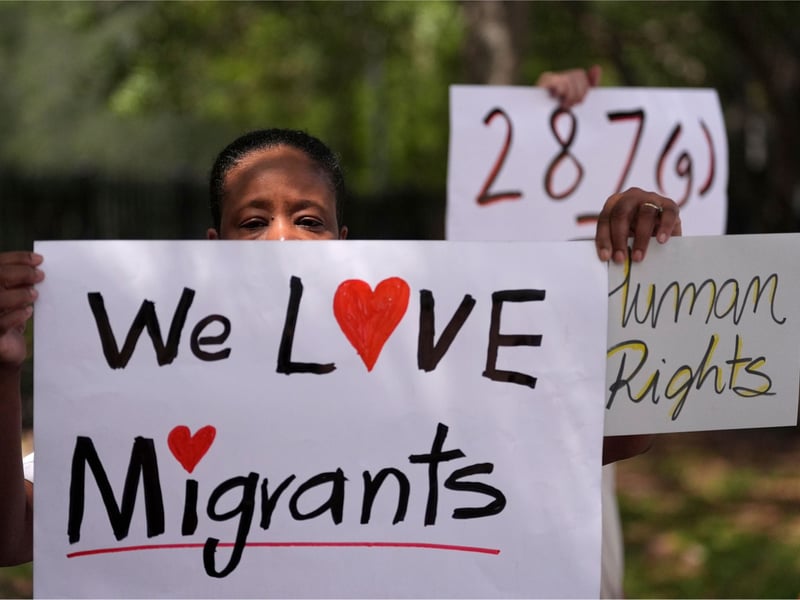
WASHINGTON (CN) — A D.C. Circuit panel on Tuesday declined to freeze the implementation of a universal national registry for noncitizens in the United States over 30 days, setting up further arguments before the appeals court in the fall.
In a per curium order, U.S. Circuit judges Karen Henderson, Robert Wilkins and Bradley Garcia — appointed by Ronald Reagan, Barack Obama and Joe Biden, respectively — the panel declined the immigrant rights groups’ request for a stay, finding they failed to satisfy the “stringent” requirements needed.
The rule, referred to as the “Alien Registration Requirement,” applies to everyone over 14 who enters the country without being documented, which the Department of Homeland Security estimated includes between 2.2 and 3.2 million people. Younger children would need to be registered by their parents or legal guardians, then reregister when they turn 14.
The main target of the measure is people who have crossed into the country without permission. Canadians, who are usually able to enter the U.S. without a visa for 180 days, must also register if they stay longer than a month.
The decision affirms U.S. District Judge Trevor McFadden’s ruling in April, where he found that the plaintiffs — the Coalition for Humane Immigrant Rights, United Farm Workers of America, Casa Inc. and Make the Road New York — failed to show the rule would “erode their core missions” and only provided speculative harms.
Since the plaintiffs didn’t have the needed standing, the Donald Trump appointee said he could not decide the merits of the case.
McFadden’s April 10 ruling allowed the registry to take effect the next day.
Several groups of immigrants, such as green card holders, people with removal orders, individuals with Employment Authorization Documents, those admitted with visas, boarding crossing card holders and certain others are already considered registered.
Carl Bergquist, general counsel for the Coalition for Humane Immigrant Rights, told Courthouse News Tuesday that the rule’s implementation has caused significant confusion amid the Trump administration’s wider mass-deportation agenda.
“It melds into the administration’s entire self-deportation plan of rolling out these [ICE] raids, repurposing the CBP One app into this CBP Home app with a self-deportation tool and trying to roll out some kinds of incentives for people to take action,” Berquist said, speaking on behalf of the organization. “Its part of that overall pressure that leads community members to face hard decisions about whether or not to register, but also how to face their futures.”
Bergquist — co-counsel in a lawsuit challenging the Trump administration’s use of expedited removal for migrants paroled into the U.S. after fleeing oppressive regimes — noted that this case was a “little bit below the radar” in comparison to other high-profile immigration cases. He said the harm was substantial nonetheless.
“It has a severe chilling effect on people’s activities,” Bergquist said. “It implicates their Fifth Amendment right not to self-incriminate; it also implicates their First Amendment right to assemble and to protest.”
Since the rule’s effective date, universities including Harvard — which has been embroiled in a legal battle over its right to enroll international students — began issuing notices informing future students of the registry’s requirements.
The Trump administration has argued that the immigrant rights groups cannot challenge the rule as a final agency action since it brings the nation’s immigration laws back in line with requirements set in the 1952 Immigration and Nationality Act.
The act supplanted its predecessor, the Alien Registration Act of 1940, and incorporated registration mandates, adding the requirement to carry identification and making failure to register punishable by a fine or six months’ imprisonment.
Bergquist slammed that assertion.
“There is no benevolent purpose behind a program like this,” Bergquist said. “There is a malevolent purpose, and one that is completely in sync with the stated goals of self-deportation and also deportation, trying to up those numbers.”
The new rule sparked sharp criticism from immigrant rights groups like the National Immigration Law Center, which warned that the rule policy would increase racial profiling.
“The Trump administration’s explicit goal with this rule’s publication is to create a hostile environment for immigrant community members,” the advocacy group wrote in an FAQ. “While their stated targets are undocumented immigrants, the very mechanics of enforcing registration expand the target to anyone who looks or sounds foreign to law enforcement.”
As part of the order, the panel set up an expedited briefing schedule in the case and ordered arguments be scheduled after Nov. 6, when the final reply brief is due.
Department of Homeland Security Assistant Secretary for Public Affairs Tricia McLaughlin defended the policy in an emailed statement, noting that failure to comply with the April 11 registration deadline could result in fines or imprisonment.
“The Trump administration will enforce all our immigration laws — we will not pick and choose which laws we will enforce,” McLaughlin said. “We must know who is in our country for the safety and security of our homeland and all Americans.”
 Follow @Ryan_Knappy
Subscribe to our free newsletters
Our weekly newsletter Closing Arguments offers the latest about ongoing trials, major litigation and rulings in courthouses around the U.S. and the world, while the monthly Under the Lights dishes the legal dirt from Hollywood, sports, Big Tech and the arts.