
 Search Articles


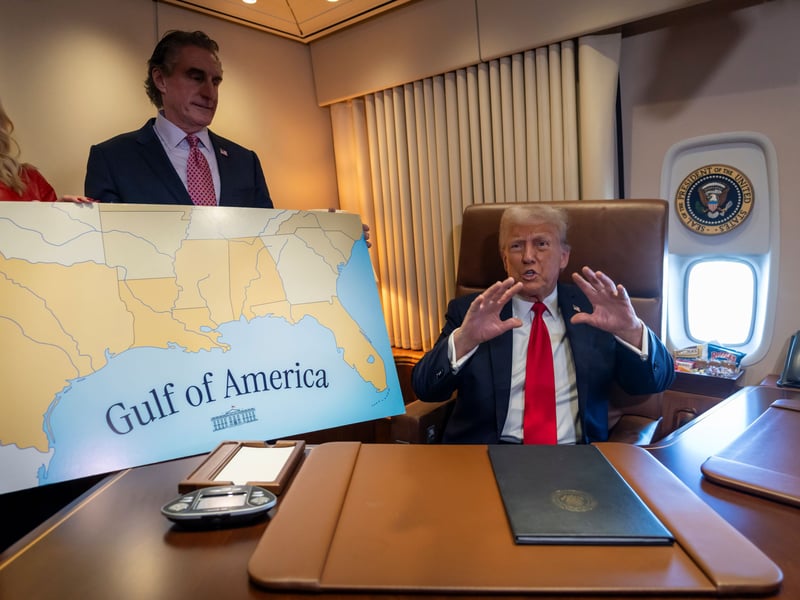
WASHINGTON (CN) — A D.C. Circuit panel seemed doubtful Monday that it could force the White House to allow Associated Press journalists back into Oval Office events, as it considered the Justice Department’s effort to limit access to the president.
The three-judge panel expressed concern that affirming President Donald Trump’s ban over the AP’s continued use of “Gulf of Mexico” in its reporting would empower Trump to block any individual from the White House for their speech, but worried any form of judicial enforcement would require an injunction against the president himself.
Monday’s arguments mark the first time the appellate court has fully considered the case on the merits — a nearly identical panel paused a court order that found the ban unconstitutional in June — and may bring an end to the 10-month ban.
U.S. Circuit Judge Neomi Rao, a Trump appointee, noted that federal courts have a general rule against issuing injunctions against the president and thus any order could only direct the actions of White House staff, potentially limiting its effect.
“It seems the AP can’t really get the relief it wants without an injunction against the president, because the president controls who enters the Oval Office and Air Force One,” Rao said. “If the president says, ‘I don’t care what my press secretary says, I don’t want AP on my plane,’ I don’t see how the injunction can actually get AP what it wants.”
She further suggested that such conduct by the president could not amount to violating a court order, unless he could be directly enjoined.
Charles Tobin, of Ballard Spahr and representing the AP, pushed back on the idea that the Oval Office and Air Force One belonged to the president, and argued that while the president cannot be enjoined, he was still obligated to obey the First Amendment.
“Just like the president is not above the law, the Oval Office is not a First Amendment-banned forum for the purposes of conducting the government’s business,” Tobin said.
U.S. Circuit Judge Robert Wilkins, a Barack Obama appointee, seemed alarmed by Rao’s suggestion that the president could supersede a court order against high-level government officials by effectively instructing them to disobey.
“If that’s the case, then why isn’t any injunction against a Cabinet secretary or any executive official problematic, because the president could disagree and order the Secretary of Health and Human Services to grant that Medicaid exemption to that hospital?” Wilkins asked.
Rao responded that, in her view, the only available options are, “enjoin the president and tell him that must let AP into his office, or the president can decide who he lets into his office.”
Justice Department attorney Yaakov Roth urged the panel to uphold its June 6 ruling freezing U.S. District Judge Trevor McFadden’s preliminary injunction, arguing that the Oval Office and Air Force One are not public forums whatsoever, and thus the president can use viewpoint discrimination when granting access.
He added that the AP could still attend the Brady Press Briefing Room with other White House passholders, drawing a distinction from the Oval Office and Air Force One.
The three-judge panel — made up of Rao and fellow U.S. Circuit judges Gregor Katsas and Cornelia Pillard, a Trump and Obama appointee, respectively — ruled 2-1 that the Trump administration would likely succeed on its position that restricted presidential spaces, like the Oval Office and the East Room, are not First Amendment forums that require “reasonable” speech restrictions.
McFadden, a Trump appointee, ruled on April 8 that the ban was clearly based on viewpoint discrimination, a textbook violation of the First Amendment, adding that the Trump administration had been “brazen” in stating the ban was because the outlet “refuse[d] to adhere to what the president believes” regarding the Gulf of Mexico’s name.
Wilkins pressed Roth on his theory with a hypothetical in which a family from Kansas has a White House tour — which were suspended temporarily following the demolition of the East Wing last month — canceled after an individual posted something critical of the president on social media.
“Does that family have a retaliation claim under the First Amendment?” Wilkins asked.
Roth, while hesitant to fully engage with the hypothetical, said that the White House could cancel a tour for an individual’s social media posts because the space was a nonpublic forum and should be allowed to restrict access based on an individual’s viewpoint.
He added that the president regularly invites politicians and activists with views he favors to certain relevant events within the White House.
Wilkins asked whether the president could also limit invitations to the annual Easter egg hunt to members of the public whose speech he agrees with under the First Amendment, which Roth said he could.
“Woe to the public,” Wilkins responded.
Katsas rounded out Monday’s panel.
 Follow @Ryan_Knappy
Subscribe to our free newsletters
Our weekly newsletter Closing Arguments offers the latest about ongoing trials, major litigation and rulings in courthouses around the U.S. and the world, while the monthly Under the Lights dishes the legal dirt from Hollywood, sports, Big Tech and the arts.