
 Search Articles


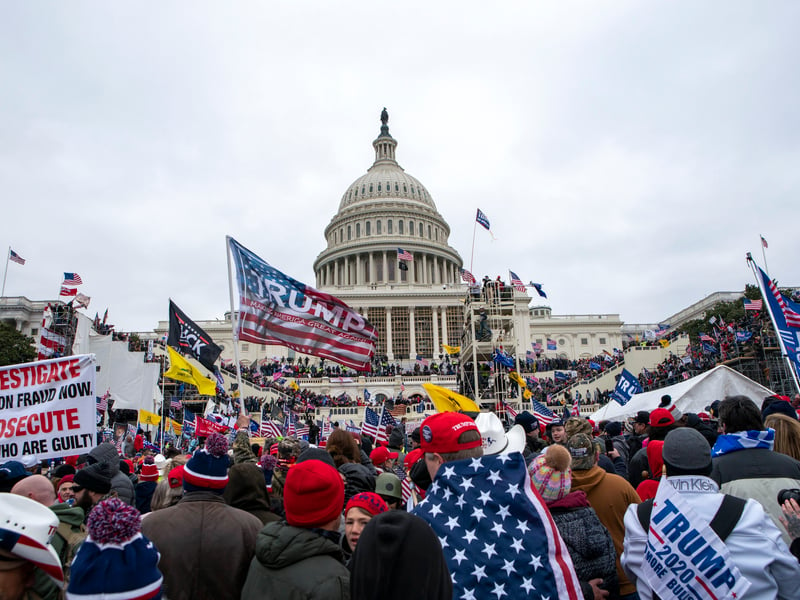
WASHINGTON (CN) — A D.C. Circuit panel on Tuesday seemed skeptical of claims by a Capitol rioter that his 28-month sentence should be overturned in part because his trial occurred during the televised hearings by the House Select Committee on Jan. 6, 2021.
Darrell Neely, a YouTuber and rare Washington resident who went to the U.S. Capitol on Jan. 6, said he was there as an observer. He was convicted at a bench trial of five misdemeanor counts, including entering a restricted building and disorderly conduct in a restricted building.
Prosecutors said Neely spent more than an hour inside the Capitol and stole four china plates, along with several items belonging to a Capitol Police officer, including the jacket bearing his badge.
Neely argued that U.S. District Judge John Bates was wrong to dismiss a request to transfer his case outside of Washington over concerns that he could not receive a fair trial. Several Jan. 6 defendants have made similar claims, including Donald Trump in his election interference criminal trial.
Neely’s attorney, Paul Enzinna of Washington firm Ellerman Enzinna, argued that his client’s case differed from a similar challenge brought by Thomas Webster, who tried to overturn his 10-year sentence on the grounds the jury pool was politically biased against him.
In a unanimous ruling, a D.C. Circuit panel found Webster had failed to clear the high bar necessary to prove prejudice against him among the jury pool that would warrant moving the case out of Washington.
Enzinna maintained that Neely faced a heightened likelihood of a prejudiced jury pool because his trial was scheduled to begin just five months after the televised hearings of the Jan. 6 Committee in late 2022. Neely made his request to transfer his case outside of Washington during in December 2022, and opted for a bench trial before Bates after his motion was denied.
U.S. Circuit Judge Robert Wilkins asked Enzinna what evidence Neely had offered in his original transfer request. Enzinna said that Neely had used a poll, also cited by Webster, in which 400 registered voters in Washington provided a “decidedly negative impression” of Capitol rioters.
Enzinna clarified that the court had already dismissed the poll in its Webster decision as proof of prejudice, which was why he emphasized the hearings and a Rolling Stone article that highlighted Neely and falsely asserted he had sold souvenirs from the Capitol and had smoked marijuana inside.
Wilkins, a Barack Obama appointee, was not convinced that those two suggestions were enough to warrant a transfer.
“We’ve had trials in this courthouse relating to Watergate, we’ve had trials in this courthouse relating to Iran-Contra, lots of things where there have been televised congressional hearings and front page news,” Wilkins said, adding that any potential prejudice could be filtered out through the jury selection, or voir dire, process.
Enzinna also maintained that prosecutors misused the restricted building charges under 18 U.S. Code Section 1752, arguing that the statute related to restricted areas set by the Secret Service, not the Capitol Police, and thus the two related misdemeanors should be dismissed.
He pointed to signs placed on bike racks outside the Capitol on Jan. 6 linking the restrictions to the Capitol Police.
Wilkins was again skeptical, asking whether it mattered who deems an area restricted when there are clear clues the area is off limits, such as a police line and barricades. In his reading of the statute, the crime is dependent on a defendant “knowingly entering a restricted space,” nothing more.
Dietrich Hill, of the U.S. Attorney’s Office, argued that Enzinna was asking the court to find something that doesn’t exist in the statute.
He said the statute should be read “expansively” and thus applies to any restricted area, noting that the Capitol Police clearly had authority to restrict the Capitol grounds, and further reason to with Vice President Mike Pence’s presence at the certification.
U.S. Circuit Judge Florence Pan, a Joe Biden appointee, turned back to Enzinna’s transfer arguments, and asked Hill whether the the timing of the Jan. 6 Committee’s hearings had any prejudicial impact on Neely’s case. U.S. Circuit Judge Judith Rogers joined Pan’s line of questioning, adding that media coverage of the hearings were “top-line news” and near impossible to ignore.
Hill referred back to the court’s decision in Webster , arguing that the publicity of the hearings did not inherently prejudice a potential juror against any single defendant, and any such prejudice could easily be filtered out.
 Follow @Ryan_Knappy
Subscribe to our free newsletters
Our weekly newsletter Closing Arguments offers the latest about ongoing trials, major litigation and rulings in courthouses around the U.S. and the world, while the monthly Under the Lights dishes the legal dirt from Hollywood, sports, Big Tech and the arts.