
 Search Articles


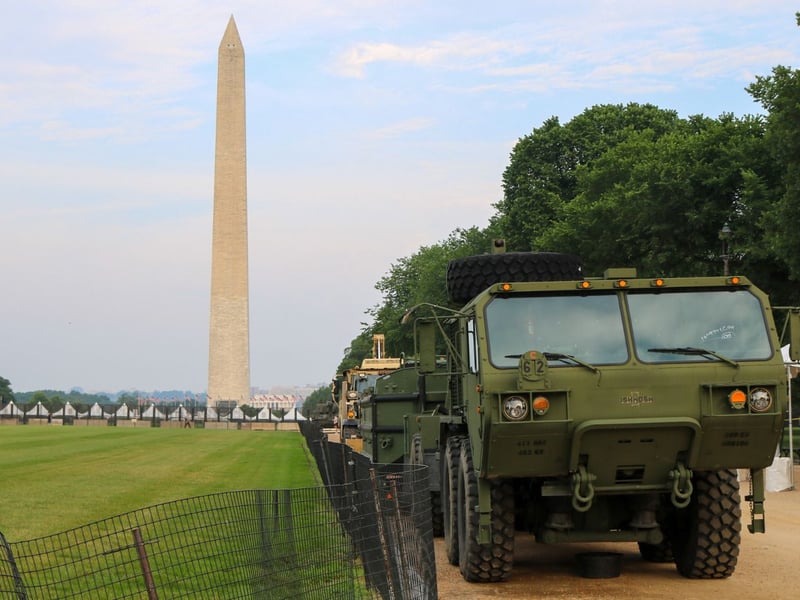
WASHINGTON (CN) — House Democrats on Friday unveiled a resolution aimed at walking back President Donald Trump’s unprecedented takeover of D.C.’s Metropolitan Police Department.
But the lawmakers’ move to assert their legal authority over the capital city’s affairs may be little more than a symbolic gesture in a Congress led by Republicans who have backed the president’s move to crack down on crime — and have already demonstrated a willingness to capitulate to the administration’s broad view of executive power.
Trump on Monday announced that he would invoke a provision in the 1973 D.C. Home Rule Act allowing the president to temporarily take control of the capital’s police force under “special conditions of an emergency nature.” The law allows such a federal takeover for 30 days and requires congressional approval for any extension.
Democrats, however, argued in their resolution unveiled Friday afternoon that Trump has “failed to identify” any emergency conditions warranting the federalization of the D.C. police force. And even if such an emergency existed, they said, the Home Rule Act does not give the White House the ability to fully take over the Metro Police Department, but rather to require the use of D.C. police services for federal purposes.
“Trump has made clear that his efforts in D.C., where 700,000 taxpaying American citizens lack the protections of statehood, are part of a broader plan to militarize and federalize the streets of cities around America whose citizens voted against him,” said Maryland Representative Jamie Raskin, the top Democrat on the House Judiciary Committee who led the resolution.
The legislation is cosponsored by D.C. Representative Eleanor Holmes Norton, California Representative Robert Garcia and Maryland Senator Chris Van Hollen.
Norton, the capital city’s nonvoting congressional delegate, called Trump’s MPD takeover and his move to activate the National Guard and federal agents in D.C. “among the most egregious attacks on D.C. home rule in decades.”
“No emergency exists in D.C. that the president did not create himself, and he is not using the D.C. police for federal purposes, as required by law,” she said.
If approved by Congress, the proposed resolution would rescind Trump’s Monday executive order declaring a “crime emergency” in D.C. and wipe out the president’s legal basis for federalizing MPD and calling up the National Guard.
But there are some key barriers standing in the way of Democrats’ effort to halt Trump’s actions. Most immediately, Congress is not in session, and lawmakers are back in their districts for their annual August recess. House Speaker Mike Johnson has the power to call Congress back to Washington — but that’s a step the Republican leader seems unlikely to take.
A source with knowledge of Democrats’ thinking told Courthouse News that lawmakers were likely eyeing a vote on the proposed resolution after Labor Day, when Congress is back in session. By then, though, the 30-day window for Trump’s initial takeover of the D.C. police force will have nearly elapsed.
However, the president said this week that he may try to secure a “long-term” extension to his control over MPD. He suggested to reporters Wednesday that he could do so unilaterally, sidestepping Congress, which is legally required to approve such an extension.
Congressional Republicans have also already been reticent to assert their constitutional powers. They’ve chosen on several occasions during the second Trump administration not to challenge the president’s expansive view of executive authority, demurring to the White House as it’s gutted federal agencies such as the Education Department and the U.S. Agency for International Development.
Meanwhile, the backlash to Trump’s federal incursion into D.C. deepened Friday as the city’s attorney general sued the administration, similarly arguing that the White House had overstepped the powers granted to it under the Home Rule Act.
The suit also took aim at a Thursday order from Attorney General Pam Bondi, which demanded that D.C. police immediately install Drug Enforcement Administration director Terry Cole as the department’s “emergency” commissioner and revoked some of MPD’s immigration enforcement policies. D.C. Attorney General Brian Schwalb argued that Bondi’s order was a “brazen usurpation” of the city’s self-governance not permitted by law.
Republicans in Congress have long criticized D.C. officials for their approach to crime in the capital city, despite statistics that show crime rates have dropped precipitously in recent years. Some lawmakers have even advocated for repealing the Home Rule Act and bringing administration of the nation’s capital completely under congressional control.
Despite complaints about D.C.’s leadership, however, Congress has left the capital city in a financial rut for months, depriving it of much-needed resources. A mistake in a March stopgap budget resolution — which has so far gone unaddressed — shorted D.C.’s spending authority by nearly $1.1 billion.
 Follow @BenjaminSWeiss
Subscribe to our free newsletters
Our weekly newsletter Closing Arguments offers the latest about ongoing trials, major litigation and rulings in courthouses around the U.S. and the world, while the monthly Under the Lights dishes the legal dirt from Hollywood, sports, Big Tech and the arts.