
 Search Articles


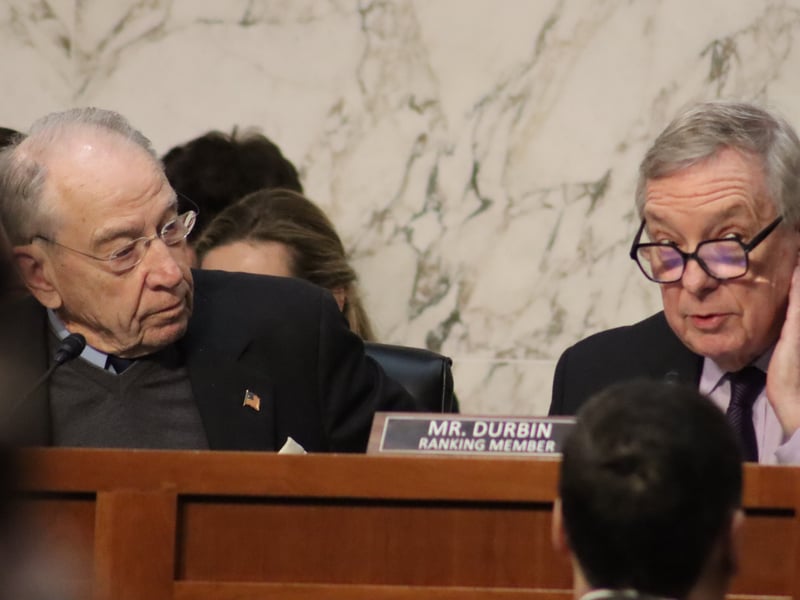
WASHINGTON (CN) — Senate Democrats are fuming at the Donald Trump administration over a pair of circuit court nominees, accusing the White House of cutting their colleagues out of the judicial selection process for appellate vacancies in their home states.
The complaints came as the Senate Judiciary Committee met Wednesday to question Joshua Dunlap, nominated to join the U.S. Court of Appeals for the First Circuit, and Eric Tung, tapped by the administration to fill a similar vacancy on the Ninth Circuit.
Illinois Senator Dick Durbin, the top-ranking Democrat on the panel, contended that the White House named both Dunlap and Tung without “meaningful consultation” from senators representing the appellate courts’ home states of Maine and California.
“For both nominees, the White House did not engage directly with the Democratic home state senators,” Durbin said.
According to the Senate minority whip, his colleague, Maine Senator Angus King, was only informed two months ago that the White House was considering Dunlap for the First Circuit and had no role in submitting or recommending candidates.
But Maine Senator Susan Collins, who introduced Dunlap to the Judiciary Committee, defended the process, noting Maine uses an advisory committee to vet nominees. Once the list is finalized, it’s shared with the senator from the president’s party—in this case, she said, Dunlap was the top choice.
After a decision has been made, Collins continued, the nominee is transmitted to the White House, and only then is Maine’s other senator informed and given the opportunity to interview the potential nominee.
“That is what happened in this case,” the Maine Republican said. “That is what happened in reverse during the Biden administration. I just want to make clear that there was no change in how the selection process was handled.”
Durbin also criticized the Ninth Circuit nomination process, saying California Senators Alex Padilla and Adam Schiff were only consulted three months before Tung’s nomination.
Padilla said Tung was nominated despite their objections, calling him an “unacceptable choice.” He added that he and Schiff had recommended other candidates, some of whom were previously nominated by Trump, to federal district courts.
Complaints about a perceived lack of White House engagement on appellate court nominees have been a common theme among both Democrats and Republicans in recent years.
Under President Biden, GOP lawmakers have frequently complained about being excluded from circuit court picks. Tennessee Senator Marsha Blackburn called Kevin Ritz’s Sixth Circuit nomination a “backroom deal,” and North Carolina Senator Thom Tillis threatened to revolt over the Fourth Circuit pick Ryan Park, who he said was chosen without his input.
Ritz was confirmed; Park never received a floor vote.
On Wednesday, Democrats pressed nominees Dunlap and Tung on political issues—especially Tung, a private practice lawyer and former clerk for the late Supreme Court Justice Antonin Scalia, whom Padilla said was chosen for his “extreme conservative ideology.”
Tung faced sharp questions about comments he made to a student reporter at Yale University in 2004 following a speech by Kim Gandy, then president of the National Organization for Women. The nominee at the time criticized the women’s rights organization for being too radical, telling the Yale Daily News that he believed in “gender roles” and that women are “simply better than men at some things.”
“When these radical feminists try to blur gender roles, they undermine institutions like marriage — institutions which hold society together,” Tung said in the interview.
On Wednesday, Durbin pressed Tung over past comments, including a speech to the Federalist Society, a conservative legal advocacy group, where Tung questioned constitutional rights to abortion, same-sex marriage and gender-affirming care.
Asked by the Illinois Democrat if he would uphold the Supreme Court’s ruling on same-sex marriage, Tung said he would be “bound” by the high court’s precedent.
Defending his comments published in the Yale student paper, Tung said he was merely responding to Gandy, whose views he found to be “extreme.”
“[S]he portrayed the relationship between the sexes of male and female to be antagonistic, and … she was blurring the gender roles,” he told Durbin. “I was responding to that in those comments you quoted because I believed at the time that the relationship between men and women was complementary and that the family should be strengthened.”
Asked what his views were in the present day, Tung demurred, refusing to answer and citing judicial ethics guidelines.
The Ninth Circuit nominee also faced questions from New Jersey Senator Cory Booker about his ties to Mike Davis, founder of the conservative Article III Project and a key adviser on judicial nominations. Tung said Davis was a friend and “might have” recommended him for the seat.
Booker challenged Tung on Davis’ inflammatory statements, including a claim that Democrats are “relentless and evil” and “Marxists who hate America.” Tung distanced himself, saying, “Mr. Davis’ views are not necessarily views of mine, and vice versa.”
Pressed on whether he agreed with that language, Tung initially declined to answer, calling it a “political question.” However, later, under questioning from Louisiana Senator John Kennedy, a Republican, he stated that he did not believe anyone is inherently evil based on their party affiliation.
“Oh, god bless you,” Booker interjected. “That’s the answer I was looking for.”
Davis, meanwhile, did not immediately return a request for comment on his invocation at Wednesday’s hearing.
The Judiciary Committee also interviewed a pair of Trump’s nominees for federal district court vacancies, including William Mercer, nominated to the District of Montana, and Stephen Meredith, tapped to join the Eastern District of Kentucky.
 Follow @BenjaminSWeiss
Subscribe to our free newsletters
Our weekly newsletter Closing Arguments offers the latest about ongoing trials, major litigation and rulings in courthouses around the U.S. and the world, while the monthly Under the Lights dishes the legal dirt from Hollywood, sports, Big Tech and the arts.