
 Search Articles


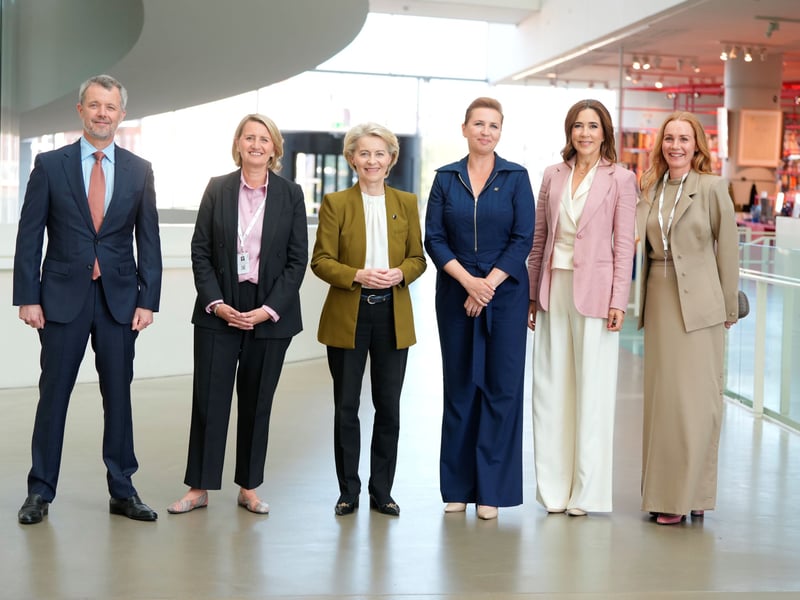
BRUSSELS (CN) — Denmark officially launched its six-month presidency of the European Union on Thursday, bringing to Brussels a unique political formula that combines aggressive climate action with some of Europe’s strictest immigration controls.
Speaking at a joint news conference with European Commission President Ursula von der Leyen in Aarhus, Denmark, Prime Minister Mette Frederiksen outlined her presidency’s mission to navigate what she called “one of the most challenging times in our history.”
Her approach reflects the complex political calculus of a leader who has pioneered combining traditional social democratic environmental policies with hardline positions on migration.
But the presidency’s ultimate measure of success may be whether Denmark can demonstrate that progressive politics and restrictive migration policies can coexist — not just domestically, but across a diverse union of 450 million Europeans.
The EU Council presidency, which rotates every six months among member states, sets the legislative agenda, chairs ministerial meetings, and facilitates negotiations between the European Commission — the executive branch, the European Parliament and the council, which share the bloc’s legislative powers.
Security and competitiveness: Denmark’s twin pillars
The Danish presidency says this apparent tension is part of a coherent strategy built around two overarching themes: Security and competitiveness. The government links security concerns with migration policy while positioning green initiatives as tools for enhancing economic competitiveness.
Danish officials explicitly reject the notion of any contradiction in their approach.
“In fact, the credibility of progressive politics depends on our ability to deliver fair, workable solutions that combine responsibility with ambition — on both climate and migration,” Niels Fuglsang, a Danish member of the European Parliament for the Socialists & Democrats group, told Courthouse News.
Denmark has taken big steps on climate, announcing plans to become the first country to impose a carbon tax on agricultural emissions, which account for nearly 29% of Denmark’s greenhouse gas emissions. The landmark policy, taking effect in 2030, emerged from negotiations between government, farmers and environmental groups — a collaborative approach Copenhagen hopes to export to EU-level discussions.
However, the agricultural tax starts at just 120 kroner ($16) per metric ton, rising to 300 kroner by 2035 — less than half the rate imposed on Danish industry, leading critics to argue the rates are too modest to drive significant change.
At an EU level, the presidency will oversee negotiations on ambitious climate targets for 2040, including a proposed 90% emissions reduction goal.
Denmark’s migration policies include some of Europe’s most restrictive measures: the country has classified parts of Syria as “safe” for return despite U.N. warnings and operates “return centers” where rejected asylum-seekers face severe restrictions on work and education while awaiting deportation. Denmark also offers financial incentives for Syrian families with Danish residency to voluntarily return to Syria, according to the Danish Immigration Service.
What might appear contradictory to outside observers reflects the unique evolution of Danish politics. “That’s due to the heritage of the Danish social democracy, that’s quite different from other center-left-leaning parties, both in Europe and the U.S.,” Alberte Bové Rud, an analyst at Copenhagen-based think tank Europa, told Courthouse News.
“Migration is no longer considered a controversial topic,” but is rather largely considered a threat to the long-term survival of the Nordic welfare state, she said.
Frederiksen’s combination of green policies and migration restrictions is gaining traction across the political spectrum. Leaders from Italy’s Giorgia Meloni to Germany’s Friedrich Merz now embrace similar approaches, suggesting Denmark’s presidency could accelerate this trend at the EU level.
However, Danish attitudes remain more cautious on some EU policies. According to a Eurobarometer poll from November, only 60% support Ukraine’s EU candidacy compared to the 72% EU average, and 63% feel attached to the EU versus 70% EU-wide, suggesting Danish support is pragmatic rather than emotional.
From EU skeptic to ‘staunch European’
Denmark’s presidency benefits from what the Europa expert calls “almost perfect” alignment with European Commission priorities.
This represents a dramatic shift from Denmark’s historically skeptical EU stance. “If you went back in time and looked at how Danish government priorities would look like five years ago, it would look quite different … because Denmark had always, at that time, been hesitant toward the EU, but now things have changed,” Rud noted.
She thinks Denmark will serve effectively as an “honest broker”: “My expectation would be that the Danish presidency is quite competent at securing the efficiency of all of these negotiations rather than promoting its own values and interests.”
Nearly all 27 European commissioners traveled to Denmark for the gathering on Thursday, which blends official meetings with royal ceremonies. The officials will dine aboard the Danish royal yacht with King Frederik and Queen Mary, then attend a 300-person dinner at Aarhus City Hall.
Beyond climate and migration, Denmark’s presidency includes advancing defense spending initiatives established by Poland’s previous presidency, with Frederiksen emphasizing: “We need to rearm Europe by no later than 2030.”
The presidency will also advance EU enlargement discussions, with Ukrainian President Volodymyr Zelenskyy joining the Aarhus meetings. “Ukraine is a part of our European family,” Frederiksen said, adding: “Right now, Ukraine is fighting for all of us.”
The commissioners will hold their regular weekly meeting Friday morning in Aarhus before returning to Brussels. Trade Commissioner Maroš Šefčovič is notably absent, currently in Washington to work on preventing a potential trade war with the United States.
Denmark’s presidency represents a crucial test of whether the European Union can reconcile competing visions of its future — one that balances ambitious climate action with restrictive migration policies, and deep integration with national sovereignty concerns.
Success would establish Denmark’s twin-pillar model as a template for other EU member states grappling with similar political pressures. Failure could deepen existing fractures within the bloc and embolden populist movements across Europe that view Brussels as out of touch with national priorities.
Subscribe to our free newsletters
Our weekly newsletter Closing Arguments offers the latest about ongoing trials, major litigation and rulings in courthouses around the U.S. and the world, while the monthly Under the Lights dishes the legal dirt from Hollywood, sports, Big Tech and the arts.