
 Search Articles


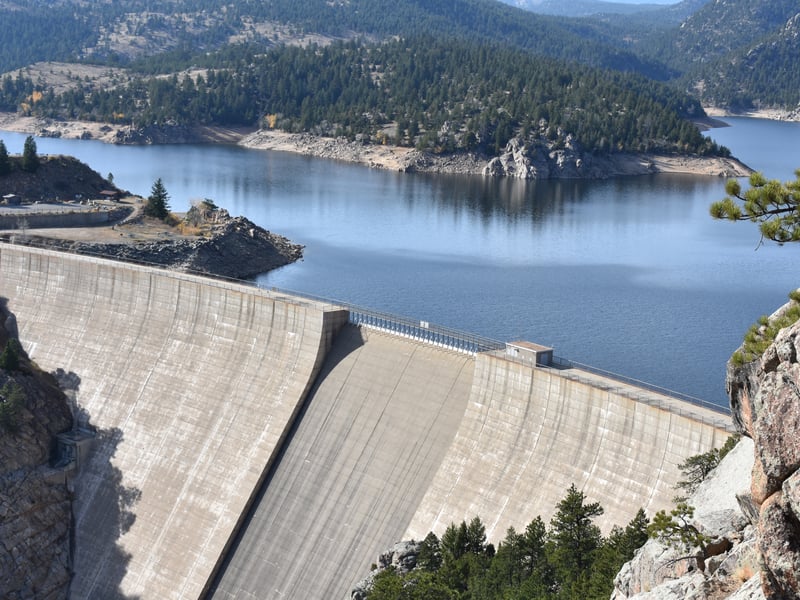
DENVER (CN) — A federal judge on Tuesday heard evidence on the safety and efficacy of leaving Colorado’s largest dam project unfinished, after she vacated a dredge-and-fill permit for violating federal law.
“I held this hearing so the court can hear from experts what is reasonable and necessary to make the currently existing structure safe,” said Senior U.S. Judge Christine Aruguello. The George W. Bush appointee dispensed with opening and closing statements, choosing instead to dive right into witness testimony.
Gross Dam in Boulder, Colorado was constructed as a concrete gravity dam in 1954, but Denver Water has been looking to expand the reservoir since a 2002 integrated resource plan anticipated future water shortfalls.
With litigation pending, the Denver utility began construction on 2022, aiming to complete the dam by 2027. Officials estimate current dam construction to be about 60% complete, and project engineers raised concerns about the safety of leaving it as is.
Rather than outright vacate the federal permit, Arguello initially requested the parties file remedy briefs within a month and work in good faith toward a mutually acceptable solution — an outcome that remains a pipe dream six months later.
On Tuesday, Arguello pressed witnesses to tell her about the risks to people downstream from the dam, and not just the challenges of stopping or changing construction.
“Changing it midstream would be very complicated, it would have to go through a whole rigorous design process,” said Mike Rogers, vice president of Stantec Engineering and the original engineer of record on the project.
Describing the project as his baby, Rogers said the original reconstruction plan to convert the gravity dam into an arch design, took four years of long days and short nights to complete.
“No one has ever raised a dam this high before. The spillway is the highest, steepest spillway in the world,” Rogers said. “It was honestly the hardest thing I ever did.”
By Rogers’ assessment, the expanded dam would withstand floods and earthquakes better than the original build.
Denver Water’s other witnesses, the dam’s project manager and a federal regulator, agreed with Rogers’ assessment that the safest plan was simply to complete construction.
“The only way to quickly address the safety issues today is to build the dam as approved,” testified Jeff Martin, the utility’s Gross Dam Reservoir expansion project manager.
Using nearly identical language, Federal Energy Regulatory Commission engineer Frankel Blackett also told the court, “the fastest, easiest way to address dam safety is to complete it as approved."
On behalf of environmental nonprofit Save the Colorado, attorney William Eubanks called Canadian engineer Stephen Rigbey to testify about the myriad of ways to stabilize the project for two or more years while Denver Water seeks new federal permits.
“At this point, we don’t have a dam, we have two big lumps of concrete, and the concept of catastrophic failure is unlikely," Rigbey said. Rigbey also argued that the risks of leaving the dam unfinished today are the same posed during its construction over the last three years.
After the U.S. Army Corps of Engineers first issued dredge-and-fill permits in 2017, Save the Colorado joined five environmental groups in suing the government in December 2018, claiming the permits lacked adequate environmental review.
Environmental groups calculated that construction would involve removing more than 500,000 trees and the extraction of 1.6 million tons of rock.
Nearing eight hours of testimony on the state of the dam, Arguello said, “I’m sitting here thinking I’m not hearing the answers to my question.”
Arguello ordered both parties to file statements of fact and conclusions of law addressing downstream public safety risks of leaving the dam unfinished to guide her in issuing a permanent injunction.
Arguello initially granted the government’s motion to dismiss in 2021 citing lack of subject-matter jurisdiction. The environmental groups appealed, and the 10th Circuit revived the case in 2022.
After holding a bench trial last year, Arguello found the U.S. Army Corps of Engineers violated the Clean Water Act and the National Environmental Policy Act in issuing the dredge-and-fill permit to Denver. Specifically, the federal agency framed the project too narrowly, and therefore failed to consider alternative plans to increase water supply without expanding the dam.
Today, Denver Water serves 1.5 million people and still anticipates needing 18,000 acre-feet per year of new firm yield. In addition to needing more water, Denver has argued the dam expansion would improve overall system efficiency.
 Follow @bright_lamp
Subscribe to our free newsletters
Our weekly newsletter Closing Arguments offers the latest about ongoing trials, major litigation and rulings in courthouses around the U.S. and the world, while the monthly Under the Lights dishes the legal dirt from Hollywood, sports, Big Tech and the arts.