
 Search Articles


WASHINGTON (CN) — Federal regulations disarming illegal drug users came under fire Monday as the justices struggled to find a precedent for the prohibition.
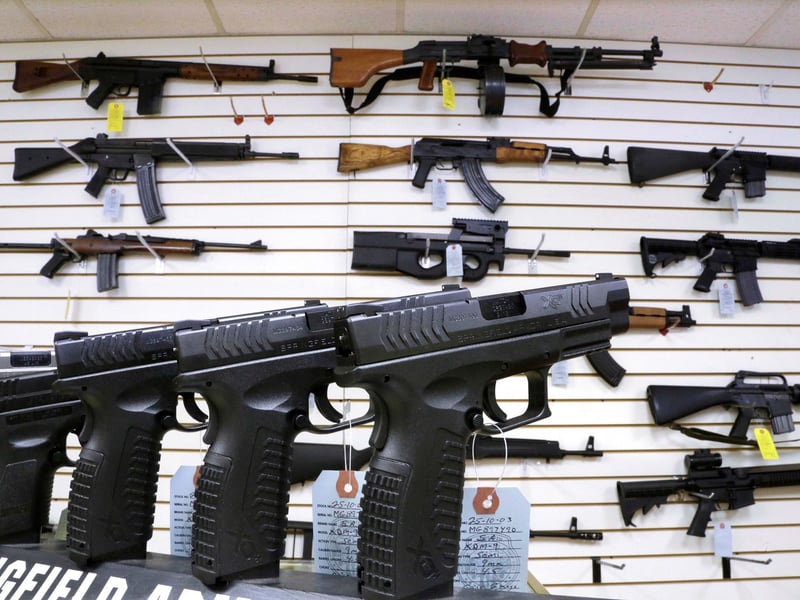
Ali Danial Hemani was indicted for unlawfully possessing a firearm after federal investigators found a Glock 19 9mm pistol and marijuana in his family home. But the Trump administration’s attempt to frame Hemani — who says he only consumed marijuana a few days a week — as analogous to habitual drunkards of the founding-era fell flat with the justices.
“John Adams took a tankard of hard cider with his breakfast every day,” Justice Neil Gorsuch, a Donald Trump appointee, said. “James Madison reportedly drank a pint of whiskey every day. Thomas Jefferson said he wasn’t much a user of alcohol — he only had three or four glasses of wine a night. Are they all habitual drunkards who would be properly disarmed for life under your theory?”
The federal law at issue criminalizes gun possession for “an unlawful user” of any controlled substance. Swapping drunkards for drug users, the Trump administration argued that the law should be upheld.
In NYSRPA v. Bruen, the court held that gun regulations must be historically analogous. In 2024, the court ruled that domestic abusers could still be disarmed under the new historical standard in United States v. Rahimi.
United States v. Hemani asks whether certain groups who present a special danger of misuse can be barred from gun ownership. Unlike Rahimi’s individualized judicial determination of dangerousness, legal experts said Hemani considers a purely legislative determination about a class of persons.
Justice Amy Coney Barrett, another Trump appointee, suggested that legislatures could regulate to keep guns away from dangerous people. However, she questioned why such a categorization applied here.
“What is the government’s evidence that using marijuana a couple times a week makes someone dangerous?” Barrett asked.
Marijuana has been classified as a Schedule I controlled substance, meaning a government assessment found no currently accepted medical use, a high potential for abuse and a lack of accepted safety for use of the drug under medical supervision.
The Trump administration pointed to this designation as evidence of a dangerousness finding. Sarah Harris, principal deputy solicitor general at the Justice Department, said anyone knowingly using illegal drugs could be considered an unlawful user under the statute.
But Gorsuch noted that marijuana sat on hazy legal grounds — even with the federal government, which suggested rescheduling the drug late last year.
“If it all boils down to illegality, what do we do with the fact that marijuana is sort of illegal and sort of isn’t, and that the federal government itself is conflicted on this?” Gorsuch asked. “It doesn’t enforce it quite the same way it does with respect to other drugs.”
The Trump administration argued that the founders disarmed habitual drunkards, so modern Congresses can outlaw firearm possession by habitual drug users.
For nearly two hours, the court quibbled with the drunkard-drug user analogy. While some justices like Gorsuch seemed to see an incompatibility, Justice Samuel Alito, a George W. Bush appointee, appeared open to considering a broader swath of the historical record.
“We don’t know what the founders … thought about illegal drug use per se,” Alito said, noting that alcohol and drugs have been regulated differently throughout history.
Chief Justice John Roberts, also a George W. Bush appointee, worried that striking down the law for marijuana would trickle down to other illegal drugs, requiring courts to make individual determinations about the dangerousness of each substance.
“It just seems to me that takes a fairly cavalier approach to the necessary consideration of expertise and the judgments we leave to Congress and the executive branch,” Roberts said.
Justice Ketanji Brown Jackson, a Joe Biden appointee, seemed to think her colleagues were straying from the history test set out in Bruen.
“The entire point, I thought, of the Bruen test was to say that the only thing the modern legislature gets to do is follow the judgments of the founding-era legislature around who was dangerous and who gets to be disarmed,” Jackson said.
Last month, the Trump administration asked the court to strike down Hawaii’s default prohibition requiring gun owners to receive permission to carry on private property. Jackson questioned how the government could argue that antipoaching laws were different enough from Hawaii’s statute but say historical laws that have nothing to do with guns and very little to do with unlawful users are similar enough here.
“I guess I’m concerned that Bruen and Rahimi are going to be allowing for arbitrary identifications of analogues and producing inconsistent results,” Jackson said.
Some justices seemed interested in an off-ramp from historical analogies. Justice Sonia Sotomayor, a Barack Obama appointee, noted that unlawful users could be considered unconstitutionally vague.
“It seems to me that the government is sort of giving ‘unlawful user’ a definition that’s not present in the statute,” Sotomayor said.
 Follow @KelseyReichmann
 Follow @kelseyreichmann.bsky.social
Subscribe to our free newsletters
Our weekly newsletter Closing Arguments offers the latest about ongoing trials, major litigation and rulings in courthouses around the U.S. and the world, while the monthly Under the Lights dishes the legal dirt from Hollywood, sports, Big Tech and the arts.