
 Search Articles


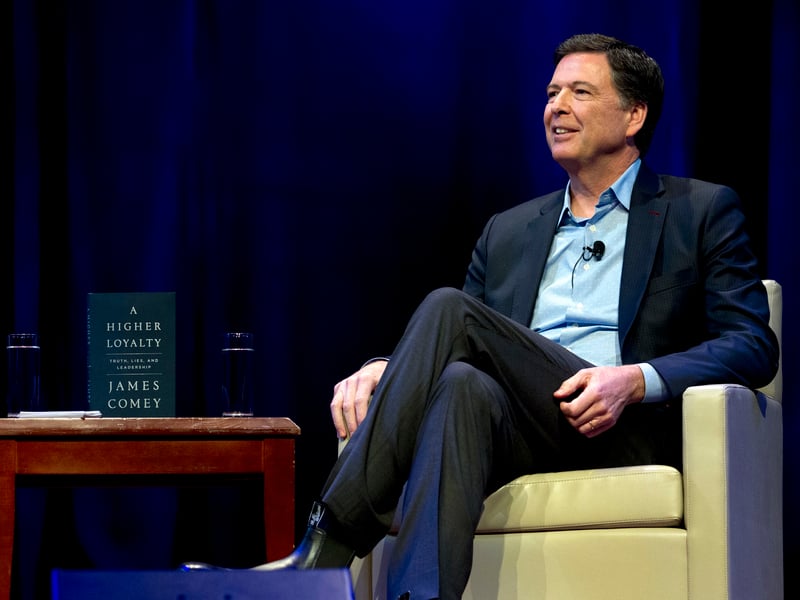
ALEXANDRIA, Va. (CN) — The appointment of Lindsey Halligan, a former aide to and loyalist of President Donald Trump, should not be used to upend criminal charges against two prominent critics of the president, U.S. Department of Justice attorneys argue in a filing Monday.
Halligan, the 36-year-old interim U.S. attorney for the Eastern District of Virginia, was the only government prosecutor to sign on to indictments against former FBI Director James Comey and New York Attorney General Letitia James. Attorneys for the two claim that Halligan’s hasty appointment violated the law and say the cases should be dismissed.
But in court filings, Justice Department lawyers contend that Halligan’s appointment is valid, and “even were Ms. Halligan’s appointment invalid, dismissal, especially with prejudice, would not be an appropriate remedy for what is at most a procedural misstep.”
Four days after Halligan took office, Comey, an outspoken Trump critic, was indicted for making false statements during a legislative hearing. Halligan then pursued mortgage fraud charges against James, who had led a civil fraud case against Trump and his company. In statements and social media posts, Trump has called for Comey’s prosecution. And the president labeled James a “terrible dishonest person,” and Comey a “dirty cop” during a 60 Minutes interview Sunday with Norah O’Donnell.
While the government consolidated its response to the controversy surrounding Halligan, the criminal proceedings against Comey and James are separate. The most recent DOJ filings were primarily in response to a deadline set in the Comey case.
For their part, Comey’s legal team has launched a flood-the-zone strategy, with motions challenging the case on multiple grounds. Beyond charging that Halligan’s appointment was invalid, they contend the court should disclose the grand-jury transcript that resulted in the charges, as they say “a significant risk exists that the government misrepresented key issues of fact and law to the grand jury.” And notably, they also contend the case is the product of the president’s revanchist motives and personal animus.
But government attorneys pushed back against claims that the prosecution of Comey is vindictive. In order to prove that, they argue, Comey would have to show that his case could not be justified and the prosecutor acted with “genuine animus” toward him. Comey’s legal team would also have to prove that the prosecutor pursued the case solely to punish him for exercising a protected right.
The president’s social media posts reflect his view that Comey has committed crimes that should be met with prosecution, DOJ lawyers argue. “They may even suggest that the president disfavors the defendant. But they are not direct evidence of a vindictive motive,” they continued.
Charges against Comey stem from his testimony five years ago before the U.S. Senate Committee on the Judiciary, which was overseeing a probe focused on claimed interference in the 2016 U.S. presidential election.
As part of their defense, Comey’s legal team has asked the court to dismiss the charges, because questions at the hearing, delivered by Senator Ted Cruz, a Republican from Texas, were ambiguous and inaccurate. Specifically, Cruz asked Comey to recall statements he had made three years earlier and to simultaneously address statements that Cruz incorrectly claimed were made by Andrew McCabe, the FBI’s former deputy director, Comey argues in a brief filed Oct. 30.
U.S. District Court Judge Michael Nachmanoff, a Joe Biden appointee, presides over the case and is scheduled to hold a hearing on the dismissal motions Nov. 19.
Subscribe to our free newsletters
Our weekly newsletter Closing Arguments offers the latest about ongoing trials, major litigation and rulings in courthouses around the U.S. and the world, while the monthly Under the Lights dishes the legal dirt from Hollywood, sports, Big Tech and the arts.