
 Search Articles


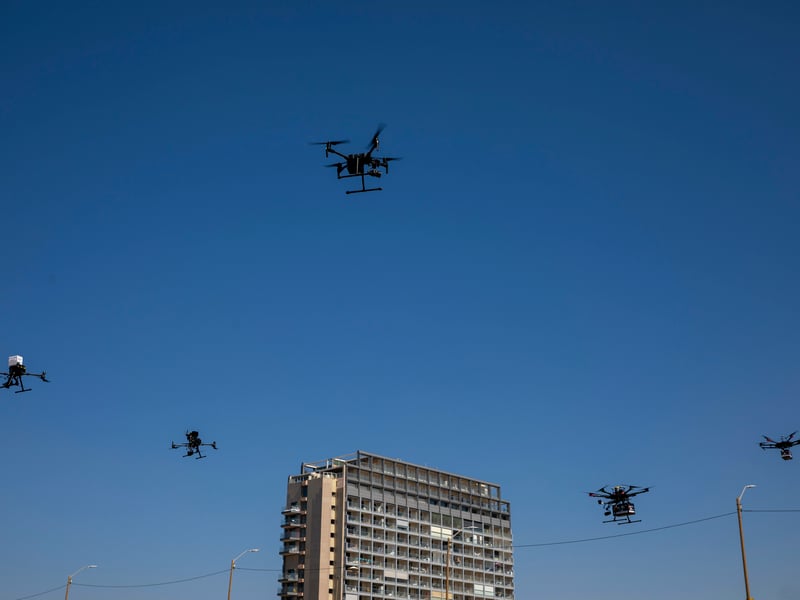
BRUSSELS (CN) — Belgium called in German military help and the European Union banned multiple-entry visas for Russians Friday as unidentified drones disrupted Belgian airports for a fourth straight day, with officials blaming Russian espionage.
Liège Airport briefly halted flights Friday morning after a drone sighting near its FedEx facilities, according to Skeyes, Belgium’s air traffic control authority. The cargo hub also experienced disruptions Thursday night and Tuesday alongside Brussels’ airport.
Brussels Airport rerouted a flight to Amsterdam Thursday night after spotting a drone. Officials said 54 flights were canceled, and the airport operator reported that 41 additional flights were canceled overnight with 24 diverted to other airports. Between 400 and 500 passengers spent the night at the airport.
“The economic impact of yesterday’s drone incident has remained fairly limited, but Tuesday night, that impact will have been much greater,” Brussels Airlines spokesman Nico Cardone said Friday. “With drones, you don’t know how long a runway will remain closed. Do you have to divert? Keep passengers on board? These are all difficult decisions.”
Drones also appeared over Antwerp’s port Thursday night. More drones flew above a military school in Sint-Truiden on Tuesday and Wednesday nights.
Belgian Defense Minister Theo Francken said earlier this week that drones over Kleine-Brogel Air Base — home to NATO operations and rumored U.S. nuclear weapons storage — were spying on fighter jets and ammunition. He suggested Russia was running similar operations across Europe but stopped short of directly blaming Moscow.
“Is it the Russians now? I cannot say that, but the motives are clear,” Francken told broadcaster RTBF. The drone operators are pros, he added: “This is not the work of amateurs.”
Francken sparked controversy last week when he told a local newspaper that a Russian strike on Brussels would prompt NATO to “wipe Moscow off the map.” Russia’s embassy called his remarks “irresponsible,” and former President Dmitry Medvedev called him an “imbecile.”
Amid the escalating incidents, Belgium held a National Security Council meeting Thursday. Interior Minister Bernard Quintin said authorities have things “under control.”
The government reached a tentative agreement on a 50 million-euro anti-drone plan — including detection systems, jammers and drone guns to protect critical sites.
Francken also pledged to get Belgium’s National Air Security Centre in Beauvechain fully operational by Jan. 1, 2026. The center, based on the Defense Ministry’s Control and Reporting Centre that has monitored Belgian airspace for years, will coordinate various agencies, including customs and aviation authorities.
Francken has requested counter-drone help from neighboring countries and contacted NATO Secretary General Mark Rutte. Belgium is considering invoking NATO’s Article 4, which allows members to request consultations when their security is threatened, though no decision has been made.
German help amid asset standoff
German Defense Minister Boris Pistorius said Friday that Germany will send specialists to Belgium.
An advance team of German air force counter-drone experts arrived in Belgium to work with Belgian forces on setting up detection and defense systems, with more troops coming soon, the German Defense Ministry said in a statement. The mission shows “strong security cooperation within the alliance and Europe’s collective capacity to respond to hybrid threats,” according to the ministry.
Pistorius tied the drone activity to a fight over frozen Russian money. Belgium holds 183 billion euros in Russian government assets — most of the EU total — primarily at Euroclear, the Brussels-based securities depository. “The repeated drone sightings over Belgium this week are likely related to the struggle over the use of frozen Russian assets located in Belgium,” Pistorius told reporters.
Prime Minister Bart De Wever met senior European Commission officials Friday trying to break a stalemate over using the frozen funds to finance a 140-billion-euro loan for Ukraine. Belgium has refused to back the commission’s plan without stronger EU-wide guarantees, warning it could get stuck with huge legal and financial bills if Russia successfully sued.
“The fattest chicken is in Belgium, but there are other chickens around,” De Wever told EU leaders at last month’s European Council, according to reports. Belgium wants guarantees that a single country can’t veto sanctions renewals, shared liability if Russia sues and transparency from other G7 nations about their Russian asset holdings.
The Belgian incidents fit a wider wave of drone activity hitting European airports and military sites. Drone encounters have increased from around 500 annually in 2015 to nearly 2,000 in 2019, according to EU Aviation Safety Agency data. Some European governments blame Russia, though proving responsibility is difficult.
“One incident may be a mistake. Two, a coincidence. But three, five, 10? This is a deliberate and targeted gray zone campaign against Europe. And Europe must respond,” European Commission President Ursula von der Leyen told the European Parliament last month.
The European Commission — the EU’s executive arm — announced Friday it will stop giving multiple-entry visas to Russian nationals, citing the same security threats. The policy takes effect Saturday, forcing Russian citizens to apply for new single-entry visas for each EU trip.
The limits address “increased security risks stemming from Russia’s unprovoked and unjustified war of aggression against Ukraine, including the weaponization of migration, acts of sabotage and the potential misuse of visas,” spokesperson Markus Lammert told reporters.
“Russia’s illegal invasion of Ukraine has created the most dangerous security environment in Europe for decades. We now face unprecedented drone disruptions and sabotage on our soil,” High Representative for Foreign Affairs Kaja Kallas said in a statement Friday.
“Traveling to and freely moving within the EU is a privilege not a given,” she said. All member states approved the decision under local Schengen cooperation — which allows travel across 27 European countries without border checks — in Russia.
Russian Foreign Ministry spokeswoman Maria Zakharova dismissed the measure, telling state news agency TASS that “Europe apparently doesn’t need solvent tourists when there are migrants and draft dodgers from Ukraine.”
The visa limits mark a major tightening of EU policy toward Russian travelers. The bloc suspended its visa deal with Russia in 2022, making Russian visa applications harder and pricier. Schengen visas granted to Russians dropped from more than 4 million in 2019 to around 552,000 in 2025, EU data shows.
Brussels plans to present a comprehensive counter-drone strategy alongside the frozen assets decision at the next EU leaders summit in December, along broader defense cooperation measures.
Courthouse News correspondent Yuval Molina is based in Brussels, Belgium.
Subscribe to our free newsletters
Our weekly newsletter Closing Arguments offers the latest about ongoing trials, major litigation and rulings in courthouses around the U.S. and the world, while the monthly Under the Lights dishes the legal dirt from Hollywood, sports, Big Tech and the arts.