
 Search Articles


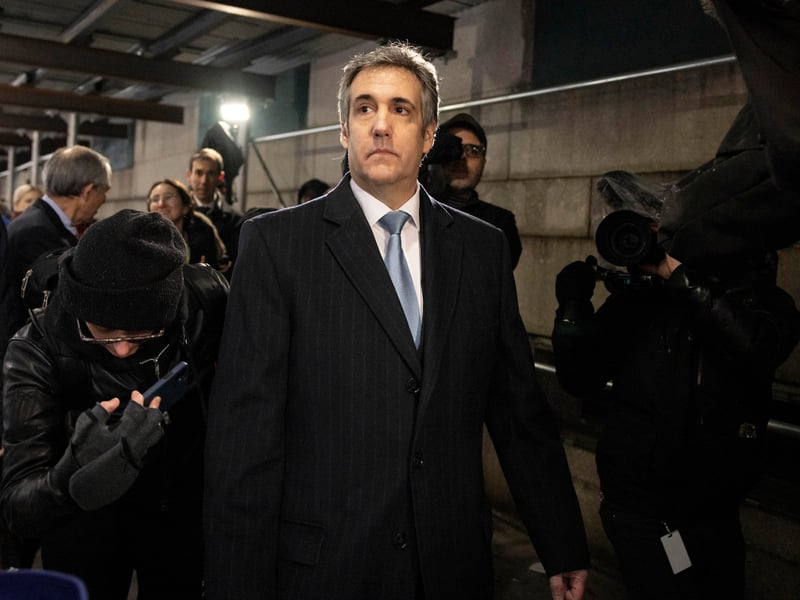
WASHINGTON (CN) — Michael Cohen on Wednesday asked the Supreme Court to revive his fight against Donald Trump and other administration officials for using the prison system to silence him.
Trump’s former personal attorney said the government imprisoned him to prevent Cohen from publishing a book critical of the president during the 2020 election. A federal judge vindicated Cohen’s claims, but the lower courts ultimately ruled there was no path for retribution for violations of his constitutional rights.
“This case represents the principle that presidents and their subordinates can lock away critics of the executive without consequence,” Cohen wrote in his petition. “That cannot be the law in the country the Founders created when they threw off the yoke of the monarch who had imprisoned Wilkes.”
Cohen cites the imprisonment of John Wilkes — a British politician and journalist known for causing political crises in the 18th century — by King George III for seditious libel as an omen for allowing the government to imprison critics without good cause.
The United States’ protection of critics’ speech, Cohen said, has prevailed until now.
In May 2019, Cohen began a three-year prison sentence for campaign finance violations related to hush-money payments made on Trump’s behalf. A little over a year later, Cohen became eligible for release from federal prison to home confinement under Covid-19 policies.
The government made Cohen’s release conditional, however, forcing him to waive his First Amendment rights to engage with any media or news — a condition understood by Cohen as a prohibition against criticizing then-President Trump.
Instead of being sent home, Cohen spent 16 days in solitary confinement after asking the provision to be removed.
A federal judge ordered Cohen’s release, calling the government’s retaliation unprecedented. Federal prosecutors abandoned their gag order request a week later.
“The revocation of Cohen’s approved release to home confinement and incarceration in squalid conditions in retaliation for his refusal to waive his speech rights is a clear violation of his Fourth Amendment rights,” Cohen wrote. “The question then arises — what is the appropriate remedy for such a gross violation of civil liberties?”
Cohen tried to sue the government for violating his constitutional rights but two lower courts said the high court’s precedent in Bivens v. Six Unknown Named Agents blocked his lawsuit.
Cohen — represented by Jon-Michael Dougherty of Washington, D.C.-based law firm Gilbert — wrote Wednesday the Supreme Court’s intervention was necessary.
“The possibility that the federal government has the power to retaliate against critics with imprisonment, without any consequence for or check against the officials engaged in such retaliation, is a chilling prospect,” Cohen wrote. “This court should not turn its eyes away from this profound breach of the contract between a government of limited powers and a free citizenry.”
The justices, Cohen said, needed to expand the court’s 1971 ruling in Bivens , which lets individuals file lawsuits for damages when federal officers violate the Fourth Amendment.
Over the last four decades, the court has turned away from Bivens . In 2022, the conservative majority cast doubt over the ruling, with six justices signing on to Justice Clarence Thomas’ opinion suggesting that the current court would not have recognized the right.
Justice Neil Gorsuch also rejected the court’s attempt to tiptoe around Bivens , stating that the court should have overturned the ruling so future litigants didn’t hold onto false hope.
Despite the court’s reluctance to extend Bivens in previous cases, Cohen framed his case as an exception. He said a president and his subordinates conspiring to use the federal prison system to silence a prominent critic qualified as an unusual circumstance worthy of such a divergence.
“It is more than the ‘most unusual circumstances’ for a president to abuse his power by placing one of his critics in prison,” Cohen wrote. “In this country’s 250-year history, it is an unprecedented act that violates the most fundamental values of our constitutional republic. If this case does not constitute the ‘the most unusual circumstance,’ then what case would?”
Gorsuch said in his 2022 concurrence Congress should take on the responsibility for creating new causes of action. Cohen resists this assertion in his petition, arguing there is no reason to defer to lawmakers to stop the executive from incarcerating critics.
“Presidents are not kings and John Wilkes’s fate should not be possible in this country,” Cohen wrote.
 Follow @KelseyReichmann
 Follow @kelseyreichmann.bsky.social
Subscribe to our free newsletters
Our weekly newsletter Closing Arguments offers the latest about ongoing trials, major litigation and rulings in courthouses around the U.S. and the world, while the monthly Under the Lights dishes the legal dirt from Hollywood, sports, Big Tech and the arts.