
 Search Articles


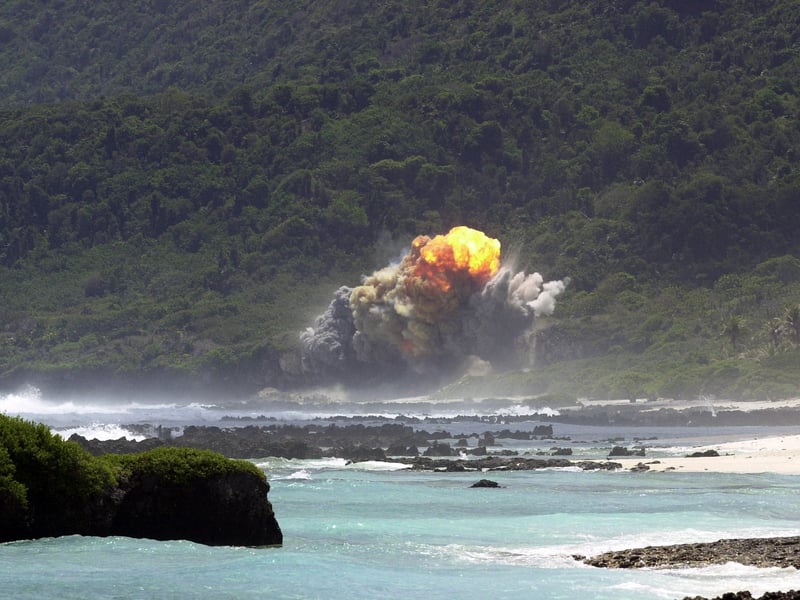
WASHINGTON (CN) — The Supreme Court agreed Monday to decide whether the Air Force must conduct an environmental review before setting off waste munitions on Guam’s beaches.
Last term, the justices limited National Environmental Policy Act assessments in a related case concerning a Utah railway. The Air Force claimed the federal policy didn’t apply to its disposal of hazardous waste in Guam, pushing the court to bar a lawsuit from a local nonprofit.
“The Ninth Circuit’s decision threatens unprecedented ‘redundan[cy] and a waste of resources,’” U.S. Solicitor General John Sauer wrote in the government’s appeal.
At Andersen Air Force Base on Guam’s northern coast, the military disposes of unexploded World War II-era weapons and munitions through controlled detonations or burn pits. For nearly four decades, the Guam Environmental Protection Agency approved permits for the waste disposals, but in 2021 the agency delayed the Air Force’s renewal application based on public comments.
A year later, Prutehi Guahan, a nonprofit corporation formerly known as Prutehi Litekyan: Save Ritidian, sued the Air Force, claiming that it failed to submit the environmental impact statements and environmental assessments required by NEPA.
The Air Force’s 2021 permit application asked to openly detonate around 30,000 pounds and open burn 5,000 pounds of waste munitions. The organization said that the exposure to materials that made up the munitions — like black powder, red and white phosphorus, and tear gas, among other hazardous materials — put nearby reefs and other ecosystems at risk, along with the island’s main aquifer in the north.
David Henkin, deputy managing attorney of Earthjustice’s Mid-Pacific regional office, said federal law requires the Air Force to review the consequences of their policies and consider less environmentally destructive options.
“For years, the Air Force has chosen to dispose of its munitions stockpile by exploding bombs on our clients’ ancestral lands and threatening most of Guam’s drinking water supply,” said Henkin, who represents the nonprofit.
But the military argued a 1976 law, the Resource Conservation and Recovery Act, exempted it from federal requirements. The Supreme Court will review the scope of the required environmental review and whether Prutehi Guahan’s suit can move forward while the Air Force’s permit renewal is still pending.
The Air Force warned that allowing courts to intervene prior to a final decision would be burdensome to the military, which must periodically renew over 2,500 permits in the Ninth Circuit’s jurisdiction alone.
“If left uncorrected, the decision below threatens to burden the military, other agencies and federal courts with premature, wasteful and duplicative proceedings that Congress never contemplated,” Sauer wrote.
The nonprofit said the Supreme Court’s review presented another hurdle to environmental justice for the island.
“We continue to carry many scars of war and war games that remain in our landscape, our bodies, and in our hearts and minds,” Monaeka Flores of Prutehi Guåhan said in a statement. “We deserve justice for the harms that we continue to endure through the military’s ongoing practice of open detonation of hazardous materials. This decision only slows that delivery of justice for our island.”
The Supreme Court will likely hear arguments in the fall and issue a ruling in the months following.
 Follow @KelseyReichmann
 Follow @kelseyreichmann.bsky.social
Subscribe to our free newsletters
Our weekly newsletter Closing Arguments offers the latest about ongoing trials, major litigation and rulings in courthouses around the U.S. and the world, while the monthly Under the Lights dishes the legal dirt from Hollywood, sports, Big Tech and the arts.