Search Articles


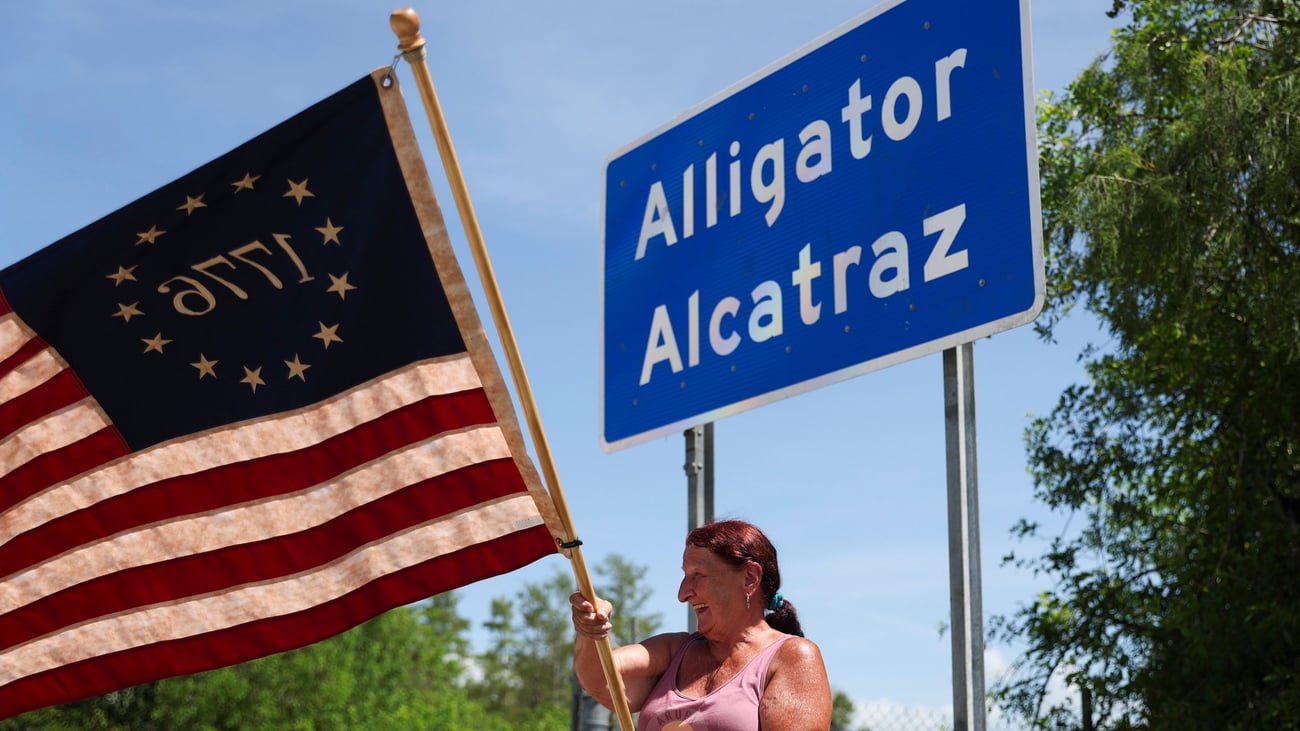
MIAMI (CN) — The fight over who controls the South Florida migrant detention center known as “Alligator Alcatraz" spilled over to the 11th Circuit on Tuesday as environmental groups sought a halt in immigration operations at the facility.
Friends of the Everglades, the Center for Biological Diversity and the Miccosukee Tribe of Florida contend the federal government has final say over the facility and broke federal law by not performing an environmental review as required by the National Environmental Policy Act.
“This facility could not have opened as an immigration detention facility, which is exclusively a federal function, without a federal determination, a federal approval,” said Paul Schwiep, representing the environmental organizations from the Miami-based firm Coffey Burlington. “At the outset, it was approved by the federal government, and that is enough, because the facility cannot operate without federal approval.”
But some judges on the appellate panel expressed doubt that the federal government had any real command over the detention center.
“There’s not federal control,” said Chief U.S. Circuit Judge William Pryor. “When the state agencies retain their state law authority to make the decisions concerning the project, if they want to convert it to helicopter training or return it to the county tomorrow, they can do that.”
“If it’s just operating as the state, NEPA just doesn’t govern it, does it?” the George W. Bush appointee continued. “It has to be federally funded and federally controlled. And if there’s no federal control, if the determination of this project is ultimately the state’s decision, that’s the real issue, right?”
This is the second time the environmental groups have faced a skeptical 11th Circuit panel.
The environmental organizations and the Miccosukee Tribe of Florida filed a lawsuit last June in Miami federal court against state and federal officials for building the detention center without first going through any environmental review.
In August 2025, U.S. District Judge Kathleen Williams sided with the environmental groups, telling state and federal officials to transfer inmates and remove generators, gas, lighting and sewage fixtures from the hastily built site in the middle of the Everglades within 60 days.
Florida Attorney General James Uthmeier immediately appealed to the 11th Circuit, contending that the detention center is operated by the Florida Division of Emergency Management and has yet to receive any federal funding.
A month later, in a divided 2-1 decision, a different 11th Circuit panel ruled state officials “unilaterally” controlled the detention center, therefore barring the environmental groups’ claims that the site violates federal environmental laws. The reversal allowed the facility to continue operating while the lawsuit continues.
In Tuesday’s oral arguments, attorneys for the Florida Division of Emergency Management and the Department of Homeland Security maintained that the decision to build and operate the facility rested with state officials.
“What every state and federal official attested to in declarations in the District Court is that the ultimate use of this property is Florida’s,” said Jesse Panuccio, representing the Florida Division of Emergency Management. “It is Florida’s decision to accept or not accept any detainee. It is Florida’s decision whether it can decommission this property and use it for something else.”
U.S. Circuit Judge Nancy Abudu asked Panuccio if Florida can unilaterally back out of its 287(g) agreement with U.S. Immigration and Customs Enforcement that allows local law enforcement to implement some immigration enforcement.
“Of course, Florida and any other state or municipality that enters into a 287(g) agreement can back out of that agreement or can operate within the confines of that agreement to say we’re not taking that particular alien or that particular detainee,” Panuccio said, referencing the state’s refusal to house women or children at the detention center.
Acting Assistant Attorney General Adam Gustafson, representing DHS, agreed.
“The 287(g) agreement doesn’t enslave the state to the federal government’s priorities,” Gustafson said.
Abudu pushed back.
“You’re saying that states can now be in charge of immigration matters in our country?” the judge asked. “And there’s standards, federally set standards that the states are expected to follow as well, or is it also once the federal government gives the states its authority, it’s the wild, wild west?”
“Of course, there are federal standards that the state has to comply with and the federal government supervises the state’s compliance with those standards,” Gustafson countered. “But at a facility like the one that we’re talking about today, it is the state that is responsible for managing day-to-day operations.”
Abudu then latched onto statements from DHS that authorized $608 million in federal funding for the facility.
“Then why did the federal government, I believe not only the president but also [former DHS Secretary] Noem, state it publicly, the feds will cover this, we will pay for it?” the Joe Biden appointee asked.
“The federal statements in the record are statements of cooperation, partnership,” Gustafson answered. “Final agency action is not dictated by press conferences, Facebook posts.”
Last summer, in response to Trump’s immigration crackdown, Republican Governor Ron DeSantis and Florida’s attorney general proposed the idea of a detention center in the Everglades and used emergency powers to acquire the Dade-Collier Training and Transition Airport, a small runway surrounded by the Big Cypress National Preserve and Everglades National Park.
Within days, trucks carrying prefabricated housing, generators, security lighting and fill dirt entered the area and workers hastily set up tents and trailers to house those arrested by immigration authorities and state law enforcement.
Trump visited the facility on July 1, 2025 — the day before the first detainees arrived — and told reporters, “We’re going to teach them how to run away from an alligator if they escape prison.”
Since then, environmental activists, indigenous tribes, Democratic state lawmakers and members of Congress have decried the detention center as inhumane and detrimental to the ecosystem, pointing to reports of flooding, pest infestations, sewage backups and light pollution.
U.S. Circuit Judge Andrew Brasher, a Donald Trump appointee, joined Pryor and Abudu on the panel.
 Follow @alexbpickett
Subscribe to our free newsletters
Our weekly newsletter Closing Arguments offers the latest about ongoing trials, major litigation and rulings in courthouses around the U.S. and the world, while the monthly Under the Lights dishes the legal dirt from Hollywood, sports, Big Tech and the arts.
Additional Reads
 Judge sentences Tren De Aragua lookout to time served April 7, 2026
 Feds face suit over bid to gut Presidential Records Act April 7, 2026